Facts
The appellant, Sanjubai, was allegedly hit by a Honda scooter on 4 November 2014 while standing near St. Teresa School, Dhar. She sustained injuries, including a fracture of the right tibia, and underwent treatment at Bhoj Hospital and Patidar Hospital, including surgery.
Source reference: p. 2–3She claimed medical expenses of ₹25,000, loss of income for three months, and that she had been earning ₹6,000 per month from cleaning and related work at the school before the accident.
Source reference: p. 3The appellant filed a claim under Section 166 of the Motor Vehicles Act, 1988, seeking ₹7,25,000 in compensation.
Source reference: p. 3–4The Motor Accident Claims Tribunal awarded ₹31,500 as compensation and ₹1,210 towards litigation expenses, payable jointly and severally by the respondents.
Source reference: p. 3–4The appellant preferred the present appeal under Section 173 of the Motor Vehicles Act, seeking enhancement of compensation by ₹1,00,000, principally relying on a disability certificate showing 33.92% permanent physical disability.
Source reference: p. 1, 4–5Issues
Whether the compensation awarded by the Tribunal was just and reasonable in light of the appellant’s injuries, medical treatment, and alleged permanent disability?
Source reference: para. 11Whether the appellant was entitled to enhanced compensation on the basis of the disability certificate recording 33.92% permanent physical disability and alleged loss of earning capacity?
Source reference: para. 8, 11–14Law Applied
The Court applied Sections 166 and 173 of the Motor Vehicles Act, 1988, concerning claims for compensation arising from motor-vehicle accidents and appellate review of awards, respectively.
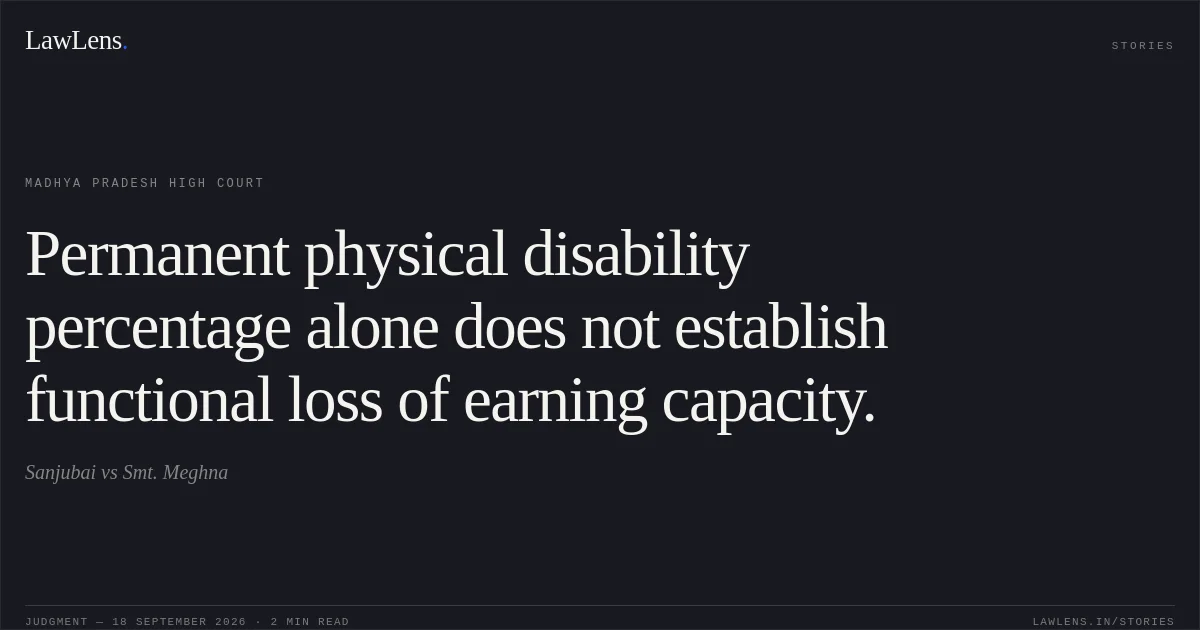
Source reference: para. 1, 6It applied the principle that compensation for permanent disability must be assessed with reference not merely to the percentage of medical or physical disability affecting a particular limb, but to the corresponding functional disability and its effect on the claimant’s earning capacity.
Source reference: para. 12The Court further proceeded on the principle that compensation must be based on losses and expenses proved through the evidence on record, including medical expenses, treatment, temporary loss of income, pain and suffering, and other legally compensable heads.
Source reference: para. 13–14Reasoning
The Court accepted that the appellant had suffered injuries and undergone treatment, but held that the evidence did not establish that the recorded 33.92% physical disability resulted in an equivalent permanent functional loss of earning capacity.
Source reference: para. 12, 14The disability certificate, by itself, was therefore insufficient to justify the claimed enhancement.
Source reference: para. 12, 14The Tribunal had considered the medical documents, treatment bills, X-ray reports, hospitalisation, pain and suffering, and temporary loss of income, and had awarded ₹31,500 on the basis of the losses proved before it.
Source reference: para. 13Since the appellant failed to demonstrate a legally compensable permanent loss of future earning capacity or any other error in the Tribunal’s assessment, the Court found no ground for appellate interference.
Source reference: para. 14–15Holding
The Court held that the Tribunal’s award was just, reasonable, and free from legal or factual error.
The appeal seeking enhancement of compensation was dismissed, and the award dated 2 December 2021 was affirmed in its entirety.
Source reference: para. 15–16The parties were directed to bear their own costs, and the record was ordered to be returned to the Tribunal for compliance.
Source reference: para. 17Acts & Sections Cited
2 provisions across 1 statute referred to in this judgment. Each provision opens on LawLens.
Motor Vehicles Act, 19882
Original Court PDF
SanjubaivsSmt. Meghna
Click to open original judgment
Original judgment, available to read, download and summarize on LawLens.in