Facts
The petitioner, an Assistant Engineer, was placed in charge of a government store at Barabanki.
Source reference: para. 3In July 1997, he directed Shri V.P. Sinha, Junior Engineer, to hand over charge of the store to Shri Akhilesh Kumar, Sub-Store Officer.
Source reference: para. 3However, Shri Sinha was relieved by the Executive Engineer without ensuring that the handover had occurred.
Source reference: para. 4When the store was opened on 11 December 1997, 3,216 bags of cement were found unusable, causing an assessed loss of Rs.5,57,525 to the Government.
Source reference: para. 5Disciplinary proceedings were initiated approximately seven years later against the petitioner, Shri Sinha and the then Executive Engineer.
Source reference: para. 5The petitioner denied negligence, requested production and cross-examination of departmental witnesses, and sought notice of the date, time and place of the inquiry.
Source reference: paras. 5–7No oral inquiry was allegedly conducted, no departmental witness was examined in the petitioner’s presence, and no opportunity of cross-examination was provided.
Source reference: para. 7Nevertheless, the Inquiry Officer submitted a report finding the charge proved.
Source reference: para. 7The petitioner’s representation against the inquiry report was obtained, but comments subsequently procured from the Director-cum-Chief Engineer were not supplied to him.
Source reference: para. 8By order dated 17 September 2006, the State Government permanently withheld two annual increments, directed recovery of Rs.1,11,505, and imposed a censure entry.
Source reference: para. 2The petitioner challenged the order under Article 226 of the Constitution.
Source reference: no citationIssues
Whether permanent withholding of two annual increments constituted a major penalty under Rule 3 of the Uttar Pradesh Government Servant (Discipline and Appeal) Rules, 1999, thereby attracting the procedure prescribed under Rule 7?
Source reference: paras. 18–22Whether the disciplinary inquiry was vitiated by failure to conduct an oral inquiry, examine departmental witnesses, and provide the petitioner an opportunity of cross-examination as required by Rule 7?
Source reference: paras. 23–28Whether the punishment order was invalid for failing to consider the petitioner’s material defence and for relying, potentially, on adverse comments that were not supplied to him?
Source reference: paras. 29–33Whether, in view of the lapse of time, the petitioner’s retirement and the procedural defects, the matter should be remitted for a fresh inquiry?
Source reference: paras. 34–35Law Applied
Rule 3 of the Uttar Pradesh Government Servant (Discipline and Appeal) Rules, 1999 distinguishes between withholding increments for a specified period, which is a minor penalty, and withholding increments with cumulative effect, which is a major penalty.
Source reference: paras. 19–22Rule 7 prescribes the procedure for imposing a major penalty; where the charge is denied, the Inquiry Officer must examine the departmental witnesses in the presence of the charged employee and provide an opportunity for cross-examination, followed by recording of the defence evidence.
Source reference: para. 23Even in an ex parte inquiry, the departmental witnesses must be examined and their statements recorded.
Source reference: para. 24The principles of natural justice require that disciplinary findings be based on legally adduced evidence and that the employee receive a reasonable opportunity to meet the case against him.
Source reference: paras. 26–28The disciplinary authority must consider material submissions and provide reasons for its conclusions; the Court relied on Raj Kumar Mehrotra v. State of Bihar, (2005) 12 SCC 256, which holds that failure to consider the employee’s objections and record reasons vitiates the punishment order.
Source reference: para. 31The Court also relied on M.P. State Agro Industries Development Corporation Ltd. v. Jahan Khan, (2007) 10 SCC 88, recognising that withholding increments with continuing or cumulative effect is ordinarily a major penalty requiring a regular inquiry.
Source reference: para. 21Reasoning
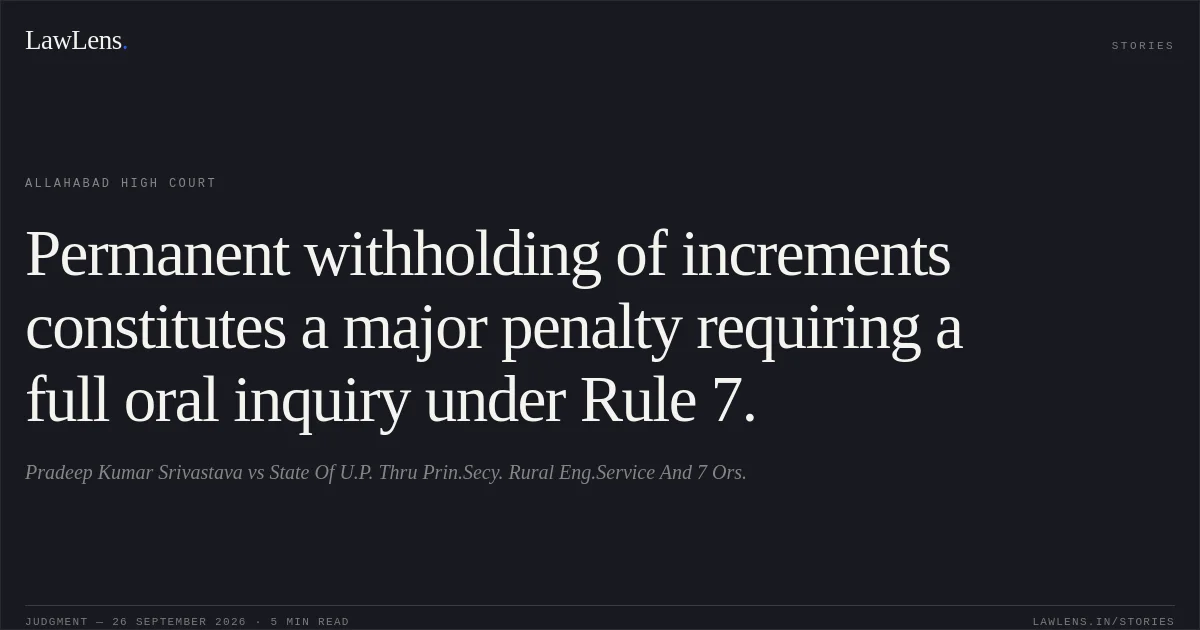
The Court held that the expression “permanently withholding” two increments described a penalty whose effect continued throughout the petitioner’s service and affected his retiral benefits; it therefore operated with cumulative effect and was a major penalty under Rule 3.
Source reference: paras. 19–22Consequently, the mandatory procedure under Rule 7 applied.
Source reference: paras. 19–22Since the petitioner had denied the charge and expressly sought cross-examination, the Inquiry Officer was required to fix an inquiry date, examine the departmental witnesses in his presence, and permit cross-examination.
Source reference: paras. 23–26The record disclosed no such proceedings; the inquiry appeared to have been based merely on departmental documents and the petitioner’s written explanation.
Source reference: paras. 23–26The Court held that inspection of documents and submission of a written reply could not substitute for the oral evidence required by Rule 7, particularly because responsibility for the loss involved disputed questions concerning the petitioner’s direction to Shri Sinha and the Executive Engineer’s decision to relieve him without ensuring the handover.
Source reference: para. 27The procedural defect was not cured by supplying the inquiry report or obtaining a representation thereafter, because those steps could not retrospectively provide the denied opportunity of cross-examination.
Source reference: para. 28Independently, the punishment order failed to address the petitioner’s specific defence regarding his direction dated 23 July 1997 and the Executive Engineer’s conduct on 24 July 1997, and did not give a rational basis for attributing the loss to him.
Source reference: paras. 29–31The failure to furnish potentially adverse comments of the Director-cum-Chief Engineer constituted a further procedural infirmity if those comments materially influenced the decision.
Source reference: para. 32Given that the incident occurred in 1997, the petitioner had retired in 2011, and the matter had remained pending for nearly three decades, the Court found that a fresh inquiry would serve no useful purpose.
Source reference: paras. 34–35Holding
The Court held that permanent withholding of two annual increments was a major penalty under Rule 3 and could be imposed only after compliance with Rule 7.
The inquiry was invalid because no oral evidence was recorded, no departmental witnesses were examined, and the petitioner was denied the opportunity to cross-examine them despite his specific request.
Source reference: paras. 33, 36The punishment order was also vitiated by failure to consider the petitioner’s material defence and by the further non-disclosure of potentially adverse departmental comments.
Source reference: paras. 33, 36The writ petition was allowed; the State Government’s order dated 17 September 2006 was quashed, and the interim order dated 11 December 2006 was made absolute.
Source reference: para. 37No order as to costs was passed.
Source reference: para. 38Original Court PDF
Pradeep Kumar SrivastavavsState Of U.P. Thru Prin.Secy. Rural Eng.Service And 7 Ors.
Click to open original judgment
Original judgment, available to read, download and summarize on LawLens.in