Facts
The parties married on 8 June 2017 and had no children.
Source reference: no citationThe husband petitioned for divorce under Section 13(1)(ia) of the Hindu Marriage Act, 1955, alleging mental and physical cruelty, including repeated quarrels, demands for separate residence, abusive conduct and strained relations with his family. The wife denied cruelty and alleged ill-treatment by the husband and his family.
Source reference: paras. 2–8, 12–19The Family Court dismissed the husband’s petition, finding cruelty unproved; he appealed.
Source reference: paras. 2–8, 12–19Issues
Whether the wife’s conduct, assessed cumulatively, amounted to mental cruelty entitling the husband to divorce under Section 13(1)(ia) of the Hindu Marriage Act, 1955.
Source reference: paras. 6, 31–35Whether the Family Court’s finding that cruelty was not proved warranted appellate interference.
Source reference: paras. 8–10, 35–36Law Applied
Section 13(1)(ia) of the Hindu Marriage Act, 1955 permits divorce where one spouse has treated the other with cruelty.
Source reference: no citationUnder N.G. Dastane (Dr) v. S. Dastane, the inquiry is whether the conduct creates a reasonable apprehension that living with the other spouse would be harmful or injurious.
Source reference: para. 21Shobha Rani v. Madhukar Reddi explains that cruelty may be physical or mental and that its effect must be assessed in context; intention is not essential.
Source reference: para. 22Under V. Bhagat v. D. Bhagat, mental cruelty is conduct causing such mental pain and suffering that the parties cannot reasonably be expected to live together, assessed in light of the circumstances of the case.
Source reference: para. 23The illustrative principles in Samar Ghosh v. Jaya Ghosh require assessment of the parties’ matrimonial life as a whole: ordinary quarrels and isolated incidents are insufficient, but sustained conduct and its cumulative effect may constitute cruelty.
Source reference: para. 20Reasoning
The Court did not treat the unsubstantiated allegations concerning pregnancy termination, denial of sexual relations, suicide threats and other individual acts as independently establishing cruelty.
Source reference: paras. 26–30It nevertheless found that the evidence, taken as a whole, showed persistent disputes, repeated quarrels, serious distrust, strained relations with the husband’s family and continuing disagreement over residence, beginning soon after marriage and resulting in separation.
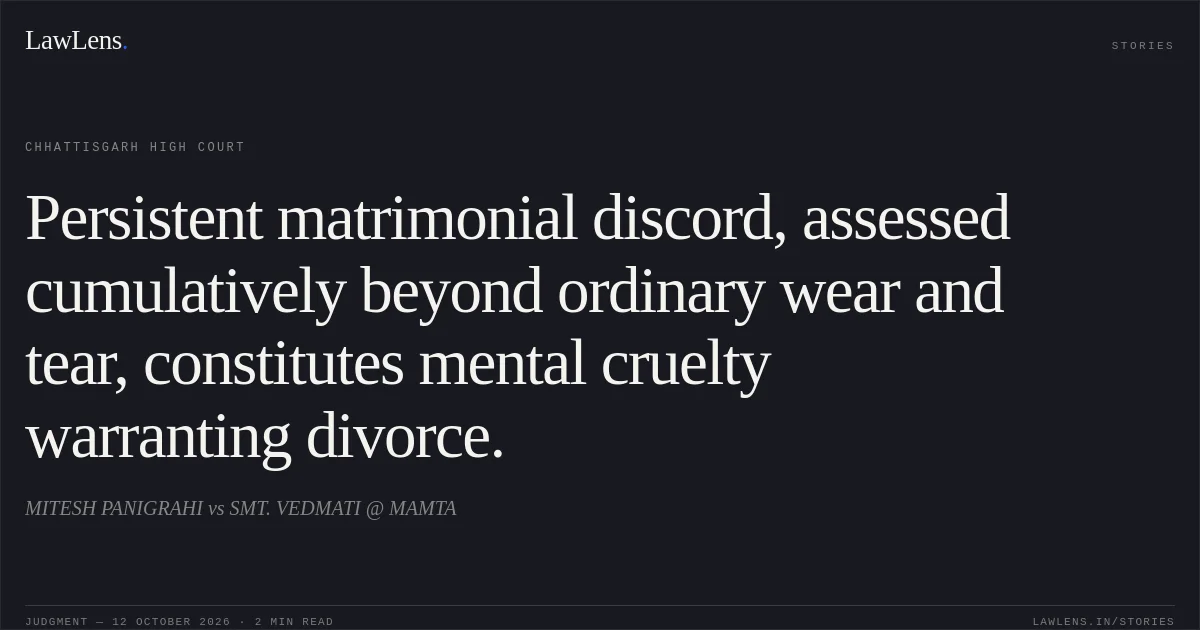
Source reference: paras. 31–33Applying the cumulative assessment required by Samar Ghosh, the Court concluded that the established circumstances caused sustained mental distress beyond ordinary marital discord.
Source reference: paras. 34–35The wife’s willingness to resume cohabitation did not erase the discord already established.
Source reference: paras. 34–35Holding
The Court held that the husband had proved mental cruelty under Section 13(1)(ia) of the Hindu Marriage Act, 1955.
It set aside the Family Court’s judgment and decree, allowed the appeal and granted the husband a decree of divorce.
Source reference: paras. 35–37Acts & Sections Cited
2 provisions across 1 statute referred to in this judgment. Each provision opens on LawLens.
Hindu Marriage Act, 19552
Original Court PDF
MITESH PANIGRAHIvsSMT. VEDMATI @ MAMTA
Click to open original judgment
Original judgment, available to read, download and summarize on LawLens.in