Facts
The appellants (legal heirs of the deceased) filed a claim petition under Section 163A of the Motor Vehicles Act, 1988, following a fatal accident involving an auto-rickshaw driven by the deceased.
Source reference: no citationInitially, the Tribunal awarded Rs. 2,64,000/-, but the High Court remanded the matter to decide "fault" grounds following the Sinitha precedent.
Source reference: p. 4Evidence showed the deceased was driving a vehicle registered to Respondent No. 1, though statements suggested he may have been purchasing it on installments or renting it.
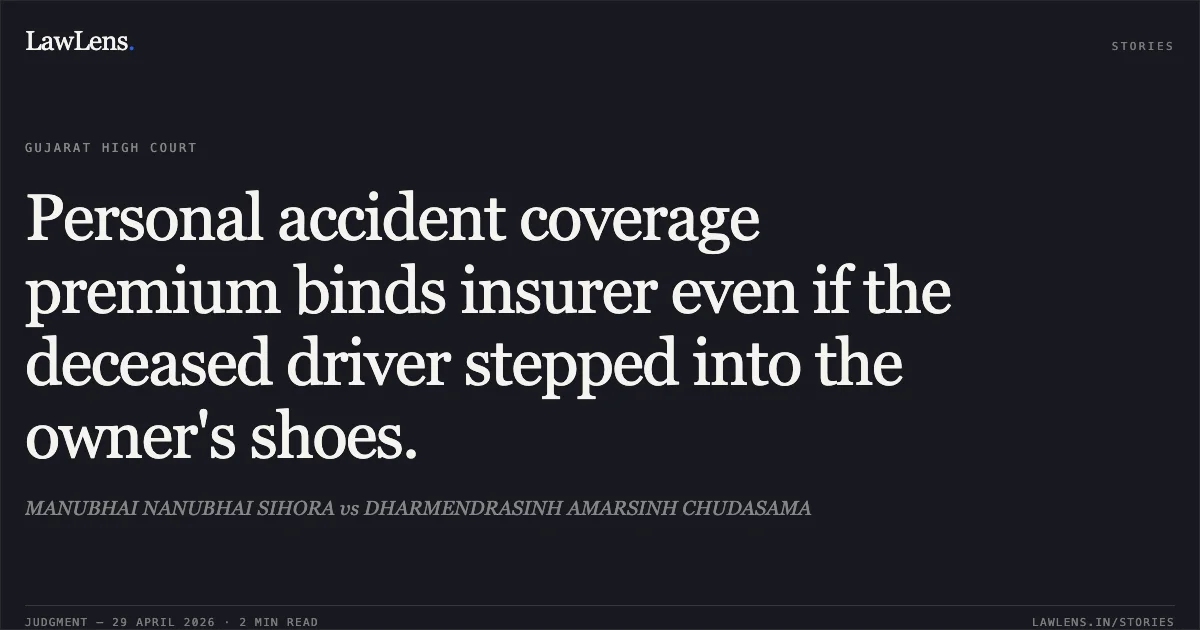
Source reference: p. 5-6, 17The insurance policy included a specific premium of Rs. 100/- for Compulsory Personal Accident (CPA) cover for the owner-driver.
Source reference: p. 7, 18The Tribunal dismissed the claim, holding the deceased was a tortfeasor who "stepped into the shoes of the owner" and thus could not claim against his own insurer.
Source reference: p. 2, 9Issues
1. Whether the Tribunal erred in dismissing the claim petition under Section 163A by holding that a borrower/permissive user who is also the tortfeasor is precluded from receiving compensation.
Source reference: p. 112. Whether the claimants are entitled to compensation under the Personal Accident cover of the insurance contract despite the deceased being at fault.
Source reference: p. 10, 18Law Applied
Section 163A of the Motor Vehicles Act, 1988, which provides for compensation on a structured formula basis without requiring proof of negligence.
Source reference: p. 12Ningamma v. United India Insurance Co. Ltd. [(2009) 13 SCC 710] and New India Assurance Co. Ltd. v. Sadanand Mukhi [(2009) 2 SCC 417], establishing that a borrower or permissive user "steps into the shoes of the owner" and is not a "third party" for the purposes of Section 163A.
Source reference: p. 13-14The principle from Ramkhiladi v. United India Insurance Co. Ltd. [(2020) 2 SCC 550], which holds that while statutory liability under Section 163A may be absent, the insurer remains liable to pay the specific sum contracted under Personal Accident coverage if a premium was paid.
Source reference: p. 10, 14Reasoning
The Court noted that while Section 163A generally dispenses with the need to prove a "wrongful act", it cannot be invoked by the owner or someone stepping into the owner’s shoes against their own insurer, as they are not "third parties".
Source reference: p. 12, 13Reviewing the evidence, including the investigating officer's report [Exh. 59] and the owner's statement [Exh. 60], the Court confirmed the deceased was a permissive user/purchaser on installments.
Source reference: p. 16-17Consequently, he was correctly identified as standing in the place of the owner, barring a general claim under Section 163A. However, the Court observed that the insurer had accepted a Rs. 100/- premium for Personal Accident cover.
Source reference: p. 18Following the Ramkhiladi ratio, the Court reasoned that the contractual liability for Personal Accident cover exists independently of the "third party" statutory bar.
Source reference: p. 18Holding
The High Court held that while the claimants were not entitled to general compensation under Section 163A as "third parties," they were entitled to the contractual Personal Accident cover.
The High Court partly allowed the appeal, setting aside the total dismissal of the claim and ordered the Insurance Company to pay Rs. 2,00,000/- to the claimants with interest at 7.5% per annum from the date of the petition until realization.
Source reference: p. 18-19Acts & Sections Cited
4 provisions across 1 statute referred to in this judgment. Each provision opens on LawLens.
Motor Vehicles Act, 19884
Original Court PDF
MANUBHAI NANUBHAI SIHORAvsDHARMENDRASINH AMARSINH CHUDASAMA
Click to open original judgment
Original judgment, available to read, download and summarize on LawLens.in