Facts
The applicants, personal guarantors of M/s RGV Infra Project Ltd., had appealed orders admitting insolvency-resolution applications against them under Sections 95 and 100 of the Insolvency and Bankruptcy Code, 2016 (“IBC”).
Source reference: para. 7, 9, 17During the appeals, the Bank sanctioned an OTS for ₹4.60 crore on 8 October 2025. The OTS required an upfront payment of ₹46 lakh and payment of the balance in two instalments; it also required the guarantors to withdraw their appeals.
Source reference: para. 17–20The applicants sought dismissal of the appeals as infructuous, with liberty to revive them if the settlement failed. The NCLAT dismissed the appeals on that basis on 16 October 2025.
Source reference: para. 17–20The principal borrower paid only the upfront ₹46 lakh and did not pay the instalments. The Bank rejected the OTS, and the Adjudicating Authority admitted a bankruptcy application under Section 123 of the IBC against the applicants on 13 February 2026. The applicants then sought restoration of their appeals.
Source reference: para. 7–8, 21, 23, 26Issues
Whether the liberty to revive the appeals if the settlement failed permitted restoration where the OTS failed because the principal borrower and guarantors did not comply with its payment terms.
Source reference: para. 20, 25–27Whether the applicants were entitled to restoration of the appeals in the circumstances of the OTS default and subsequent bankruptcy proceedings.
Source reference: para. 23, 26–28Law Applied
Sections 95 and 100 of the IBC govern applications and orders concerning insolvency resolution of personal guarantors, while Section 123 provides for an application initiating bankruptcy proceedings.
Source reference: para. 7, 9, 17The Tribunal also applied the principle that a party cannot take advantage of its own wrong: the liberty to revive the appeals if the settlement failed did not extend to a failure caused by the applicants’ or principal borrower’s own non-compliance.
Source reference: para. 27The Tribunal further observed that the liability of the principal borrower and guarantor is co-extensive.
Source reference: para. 24Reasoning
The Tribunal read the restoration liberty in the context of the OTS and the order dismissing the appeals. The OTS required payment of the agreed instalments and imposed obligations on the guarantors; the record showed that, beyond the upfront ₹46 lakh, no further payment was made.
Source reference: para. 21–22, 26The Tribunal construed the liberty to revive as applying where the settlement failed due to default by the Bank, not where the applicants’ side failed to honour the OTS. Because the failure resulted from non-payment by the principal borrower, the applicants could not rely on that failure to obtain restoration.
Source reference: para. 27Holding
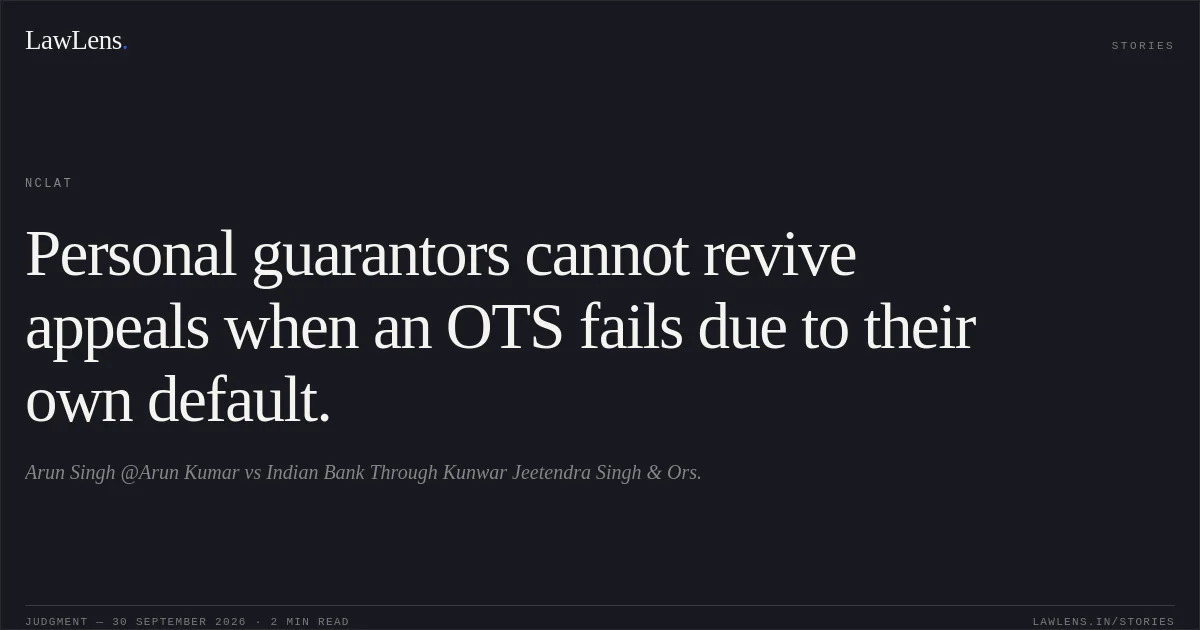
The NCLAT held that the applicants could not invoke the liberty to revive the appeals when the OTS failed because of non-compliance on their side.
It dismissed all three restoration applications, leaving the appeals unrestored.
Source reference: para. 28Acts & Sections Cited
3 provisions across 1 statute referred to in this judgment. Each provision opens on LawLens.
Insolvency and Bankruptcy Code, 2016.3
Original Court PDF
Arun Singh @Arun KumarvsIndian Bank Through Kunwar Jeetendra Singh & Ors.
Click to open original judgment
Original judgment, available to read, download and summarize on LawLens.in