Facts
The applicant, serving as a Lower Selection Grade Sub Postmaster (LSG SPM) at Boudh Court, challenged a transfer order dated 28.04.2025, which directed her transfer to Phulbani HO
Source reference: p. 2She submitted a representation on 14.05.2025, requesting a one-year deferment on the grounds of her son’s Class IX education and her personal health issues, specifically diabetes and arthritis, which she claimed would be exacerbated by Phulbani's cold climate
Source reference: p. 2-3The respondents rejected her representation on 12.06.2025, stating that the transfer was a routine rotational exercise following the completion of her tenure on 30.09.2025
Source reference: p. 3The applicant was relieved of her duties on 12.09.2025
Source reference: p. 3She subsequently approached the Tribunal to quash the transfer and relief orders
Source reference: p. 2Issues
1. Whether the transfer order was issued in violation of statutory rules or characterized by mala fides
Source reference: para. 6 / p. 52. Whether personal hardships, such as a child’s mid-academic session or the medical condition of the employee, constitute sufficient legal grounds for the Tribunal to interfere with an administrative transfer order
Source reference: para. 6, 11 / p. 5, 7Law Applied
The Tribunal applied the settled principle that transfer is an incident of service and an employee holds no vested right to be posted at a specific station
Source reference: para. 6-7It relied on the summary of law in Ghanshyam Dass v. State of Himachal Pradesh (2020), which establishes that judicial review of transfers is limited to cases involving statutory violations or proven mala fides
Source reference: para. 6Per Mrs. Shilpi Bose v. State of Bihar (1991) and Union of India v. S.L. Abbas (1993), executive guidelines and transfer policies do not confer legally enforceable rights upon employees
Source reference: para. 8-9The Tribunal invoked S.C. Saxena v. Union of India, which mandates that a government servant must first report to the transferred post before submitting representations regarding personal grievances
Source reference: para. 10Reasoning
The Tribunal found that the applicant’s transfer was a "rotation transfer" necessitated by the completion of her post tenure, falling squarely within the administrative domain of the employer
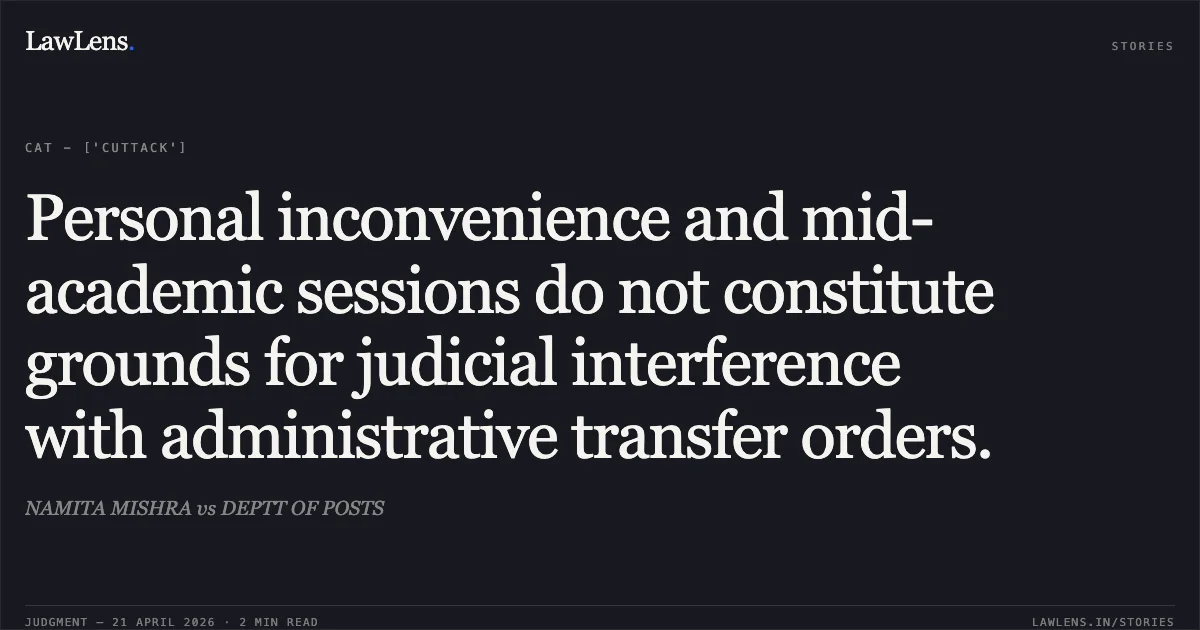
Source reference: para. 3In applying the Ghanshyam Dass precedent, the Tribunal reasoned that personal inconveniences—including the education of children and health challenges—are matters for the employer to consider and do not justify judicial interference
Source reference: para. 6, points 10-11The Tribunal noted that the applicant failed to demonstrate any violation of statutory rules or provide "impeccable evidence" of mala fides
Source reference: para. 6, 11Since the applicant had already been relieved and the transfer was conducted as per Departmental Rules and Regulations, the Tribunal determined that the respondents acted within their legal authority
Source reference: para. 3, 11Holding
The Tribunal answered the issues in the negative, holding that there was no illegality in the transfer order or the rejection of the applicant’s representation
The Tribunal held that it cannot act as an appellate authority over administrative transfer decisions based on personal hardship
Source reference: para. 6Consequently, the Original Application (OA) was dismissed as being devoid of merit
Source reference: para. 11Original Court PDF
NAMITA MISHRAvsDEPTT OF POSTS
Click to open original judgment
Original judgment, available to read, download and summarize on LawLens.in


![Subsequent exoneration does not retrospectively invalidate a finalized promotion select list.. UNNIKRISHNAN M vs M/o Environment And Forests. CAT - ['Ernakulam']. LawLens](/stories/thumbnails/subsequent-exoneration-does-not-retrospectively-invalidate-a-finalized-promotion-select-li-ce80a0e84f2f4887857271e8b4341c42.webp)