Facts
The petitions arose from the communal violence in North-East Delhi in February 2020, following protests and counter-mobilisations related to the Citizenship Amendment Act, 2019 and the proposed National Register of Citizens.
Source reference: paras. 1–8Seven petitions sought, among other reliefs, registration of criminal cases against persons alleged to have made inflammatory speeches, transfer of investigations or constitution of an SIT, preservation of electronic evidence, and compensation and rehabilitation for victims.
Source reference: paras. 1–8At the hearing, the petitioners confined their submissions to those surviving prayers.
Source reference: paras. 3–4By February 2026, 757 criminal cases had been registered; investigations, prosecutions and trials had substantially progressed, and a Claims Commissioner had been appointed to assess riot-related damage and compensation claims.
Source reference: paras. 11–12One petitioner had pursued a complaint through the Magistrate and this Court, with the matter ultimately considered by the Supreme Court in Ashwini Kumar Upadhyay v. Union of India & Ors.
Source reference: paras. 10, 33–35Issues
1. Whether the Court should direct registration of criminal cases against individuals alleged to have delivered inflammatory speeches, notwithstanding the statutory remedies and the Supreme Court’s ruling in Ashwini Kumar Upadhyay.
Source reference: paras. 21–22, 29–402. Whether the allegations and material concerning police inaction, complicity or misconduct justified transferring the riot investigations to an independent agency, constituting an SIT, or ordering a general inquiry.
Source reference: paras. 41–45, 46–633. Whether a general direction was warranted for preservation of CCTV footage and other electronic evidence, given the stage of the investigations and proceedings.
Source reference: paras. 64–714. Whether further general directions for compensation and rehabilitation of riot victims were required, given the existing claims mechanism.
Source reference: paras. 72–80Law Applied
Article 226 confers wide but discretionary constitutional jurisdiction, to be exercised cautiously and not ordinarily as a substitute for statutory criminal procedures.
Source reference: paras. 14–20Under Lalita Kumari v. Government of Uttar Pradesh, registration of an FIR is mandatory where information discloses a cognizable offence; Sakiri Vasu v. State of Uttar Pradesh recognises recourse through Sections 154(3), 156(3) and 200 of the CrPC for grievances about non-registration or investigation.
Source reference: paras. 29–33Ashwini Kumar Upadhyay held that constitutional courts cannot create or expand criminal offences, that the existing law addresses hate speech, and that the CrPC provides an effective procedural framework; extraordinary constitutional relief should not routinely bypass it.
Source reference: paras. 34–36Transfer of investigation to an independent agency is reserved for rare and exceptional cases where material shows the investigation is tainted, compromised or incapable of inspiring confidence (Committee for Protection of Democratic Rights; Rubabbuddin Sheikh; K.V. Rajendran).
Source reference: paras. 15–16, 46Public-interest proceedings should not ordinarily be used to supervise criminal investigations or trials.
Source reference: paras. 17–20Compensation under Articles 32 and 226 may be awarded for an established infringement of fundamental rights, but public-law compensation is distinct from private-law damages (Rudul Sah; Nilabati Behera).
Source reference: para. 75Reasoning
The Court held that no further FIR direction was justified: statutory remedies had not generally been pursued, the speech material was disputed and incomplete, and Ashwini Kumar Upadhyay had addressed the relevant legal framework without directing FIR registration or continuing judicial supervision.
Source reference: paras. 33–40As to investigation, the materials—including the Delhi Minorities Commission report, videos, affidavits and victim accounts—did not establish a systemic or institutional compromise of the investigations.
Source reference: paras. 48–62The alleged misconduct by police personnel was not sufficiently connected to the conduct of the subsequent investigations, and the criminal process had substantially progressed.
Source reference: paras. 48–62On electronic evidence, no specific instance of destruction, tampering or deliberate withholding was identified; issues concerning evidence in individual prosecutions could be raised before the competent criminal courts.
Source reference: paras. 68–71On compensation and rehabilitation, the existing claims mechanism had processed claims and awarded compensation, and the petitioners had not demonstrated systemic failure requiring further general directions.
Source reference: paras. 74, 77–80Holding
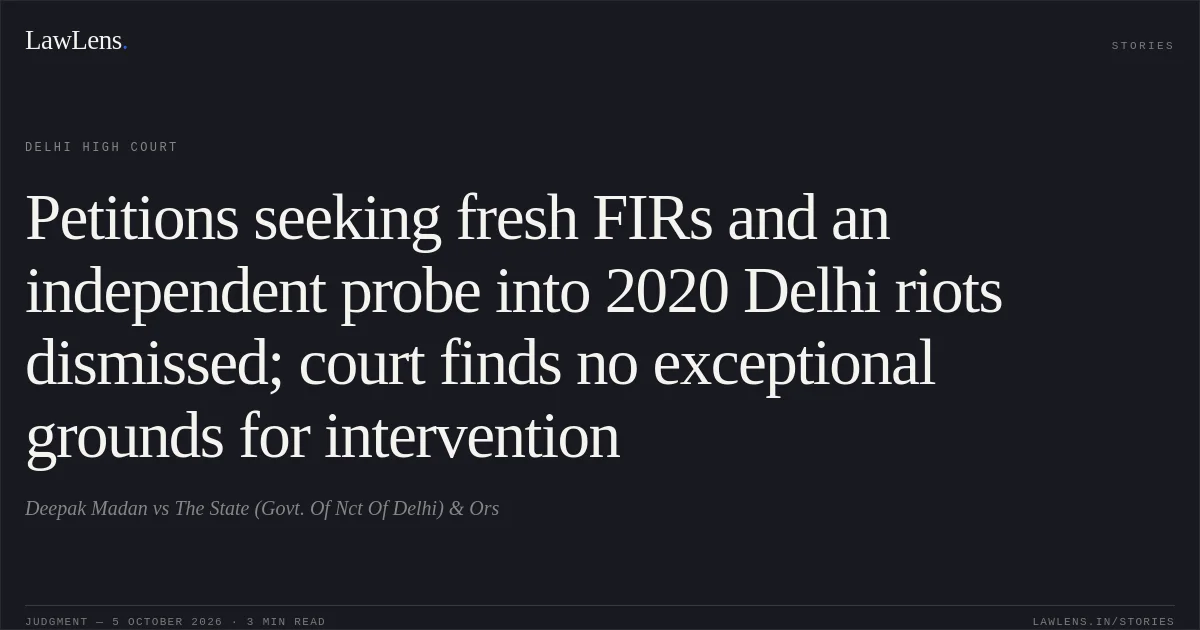
The Court declined to direct registration of further FIRs, transfer investigations, constitute an SIT, order a general inquiry into police conduct, issue blanket evidence-preservation directions, or grant further general relief concerning compensation and rehabilitation.
The dismissal did not preclude individuals or competent authorities from pursuing remedies available under law in particular cases.
Source reference: paras. 40, 63, 71, 80–81The writ petitions and pending applications were dismissed, with no order as to costs.
Source reference: paras. 82–83Acts & Sections Cited
20 provisions across 3 statutes referred to in this judgment. Each provision opens on LawLens.
Indian Penal Code, 1860
Code of Criminal Procedure, 19737
Original Court PDF
Deepak MadanvsThe State (Govt. Of Nct Of Delhi) & Ors
Click to open original judgment
Original judgment, available to read, download and summarize on LawLens.in