Facts
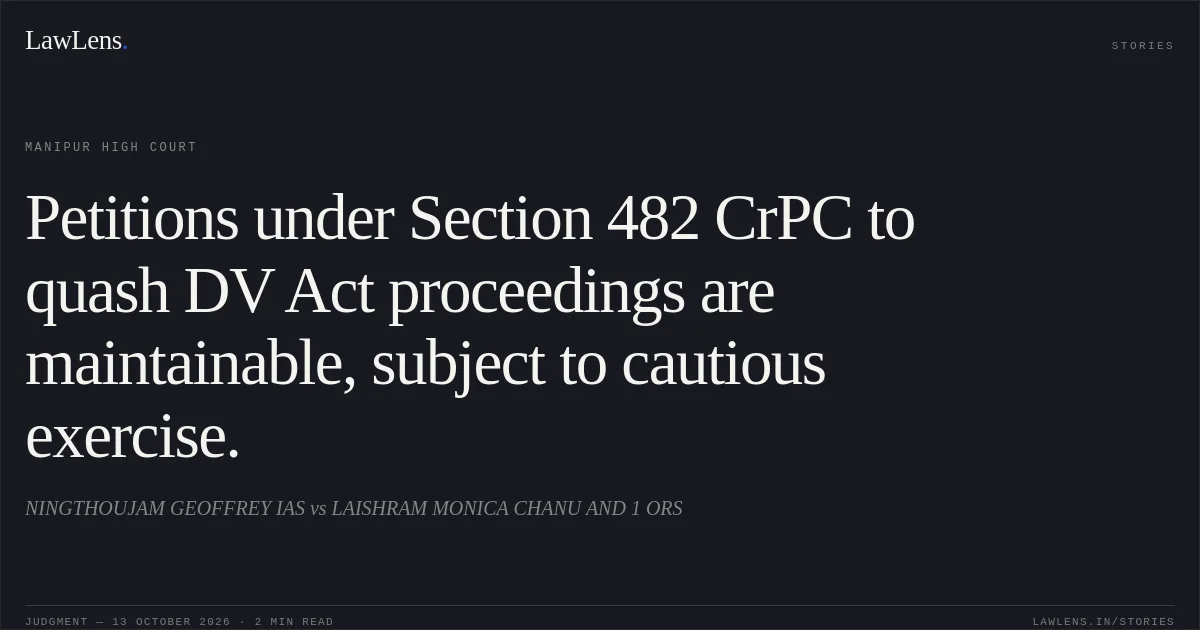
The petitioner filed a petition under Section 482 of the Code of Criminal Procedure, 1973, seeking to quash proceedings under Section 12 of the Protection of Women from Domestic Violence Act, 2005, pending before the Judicial Magistrate First Class, Imphal West-II, Lamphelpat.
Source reference: p.1, para. 3Respondent No. 1 challenged the petition’s maintainability.
Source reference: p.1, para. 3While that objection was pending, the Supreme Court decided Shaurabh Kumar Tripathi v. Vidhi Rawal, 2025 SCC OnLine SC 1158.
Source reference: p.3, paras. 4–5The petitioner sought disposal of the objection in light of that decision; respondent No. 1 argued that the petitioner had not shown gross illegality or injustice.
Source reference: p.3, paras. 4–5Issues
1. Whether a petition under Section 482 CrPC, or Section 528 of the Bharatiya Nagarik Suraksha Sanhita, 2023, is maintainable to seek quashing of proceedings arising from an application under Section 12(1) of the DV Act.
Source reference: p.2, para. 3; p.3, para. 62. Whether the petitioner had established gross illegality or injustice warranting interference with the DV Act proceedings.
Source reference: p.3, para. 5; p.4, para. 7Law Applied
Section 12(1) of the DV Act provides for an application by an aggrieved person before a Magistrate.
Source reference: p.2, para. 3Relying on Shaurabh Kumar Tripathi v. Vidhi Rawal, 2025 SCC OnLine SC 1158, the Court applied the rule that a High Court may exercise its inherent jurisdiction under Section 482 CrPC or Section 528 BNSS to quash proceedings arising from a Section 12(1) DV Act application.
Source reference: p.2, para. 3; pp. 2–3, paras. 6–7Given the DV Act’s object, that power must be exercised cautiously and with circumspection; ordinarily, interference is warranted only in cases of gross illegality or injustice.
Source reference: pp. 2–3, paras. 6–7Reasoning
The Court distinguished the question of maintainability from the merits threshold for exercising inherent jurisdiction.
Source reference: pp. 3–4, paras. 5–7It read Shaurabh Kumar Tripathi as establishing both that such a petition is maintainable and that relief should ordinarily be granted only where gross illegality or injustice is shown.
Source reference: pp. 3–4, paras. 5–7Respondent No. 1’s submission that the petitioner had not shown that threshold concerned the merits, not maintainability.
Source reference: pp. 3–4, paras. 5–7The Court expressly left the existence of gross illegality or injustice for consideration when hearing the main petition.
Source reference: pp. 3–4, paras. 5–7Holding
The Court held that a petition under Section 482 CrPC or Section 528 BNSS is maintainable to challenge proceedings initiated under Section 12 of the DV Act, and disposed of respondent No. 1’s maintainability application accordingly.
It did not decide whether the petitioner had established gross illegality or injustice.
Source reference: p.4, paras. 7–10The main petition remained pending; the respondents were granted two weeks to file any counter-affidavit, and the matter was listed for 27 October 2026.
Source reference: p.4, paras. 7–10Acts & Sections Cited
3 provisions across 3 statutes referred to in this judgment. Each provision opens on LawLens.
Code of Criminal Procedure, 19731
Bharatiya Nagarik Suraksha Sanhita, 20231
Protection of Women from Domestic Violence Act, 20051
Original Court PDF
NINGTHOUJAM GEOFFREY IASvsLAISHRAM MONICA CHANU AND 1 ORS
Click to open original judgment
Original judgment, available to read, download and summarize on LawLens.in