Facts
On January 30, 2002, a Maruti Car carrying four occupants collided with a tanker on the Allahabad-Kanpur Road
Source reference: para. 4Three occupants, all teachers, died; one survived with injuries
Source reference: paras. 5, 7Claimants filed petitions under Section 166 of the Motor Vehicles Act, 1988
Source reference: para. 6The Motor Accident Claims Tribunal (MACT) and the Allahabad High Court dismissed the claims, holding the Maruti driver solely negligent based on photographs taken by the tanker owner 10-12 hours after the incident
Source reference: paras. 11, 16The appellants challenged these concurrent findings before the Supreme Court
Source reference: para. 12Issues
1. Whether the Courts below were justified in holding the driver of the Maruti Car solely responsible for the accident based on the evidence on record
Source reference: para. 132. Whether the standard of proof applied by the lower courts was consistent with the requirements of motor accident claim proceedings
Source reference: para. 14Law Applied
The Court applied the principle that the standard of proof in motor accident claims is the "preponderance of probabilities" rather than "proof beyond reasonable doubt" required in criminal trials
Source reference: para. 14It relied on Sithara N.S. v. Sai Ram General Insurance Co. Ltd. and Sunita v. Rajasthan SRTC to emphasize that the Motor Vehicles Act is beneficial legislation where strict rules of evidence do not apply
Source reference: para. 14, fn. 1The Court also invoked the doctrine of res ipsa loquitur (the thing speaks for itself), holding that parking a heavy vehicle on a public road at night without warning signals constitutes negligence
Source reference: para. 25For quantum determination, the Court followed the guidelines in Sarla Verma v. DTC and National Insurance Co. Ltd. v. Pranay Sethi
Source reference: para. 31Reasoning
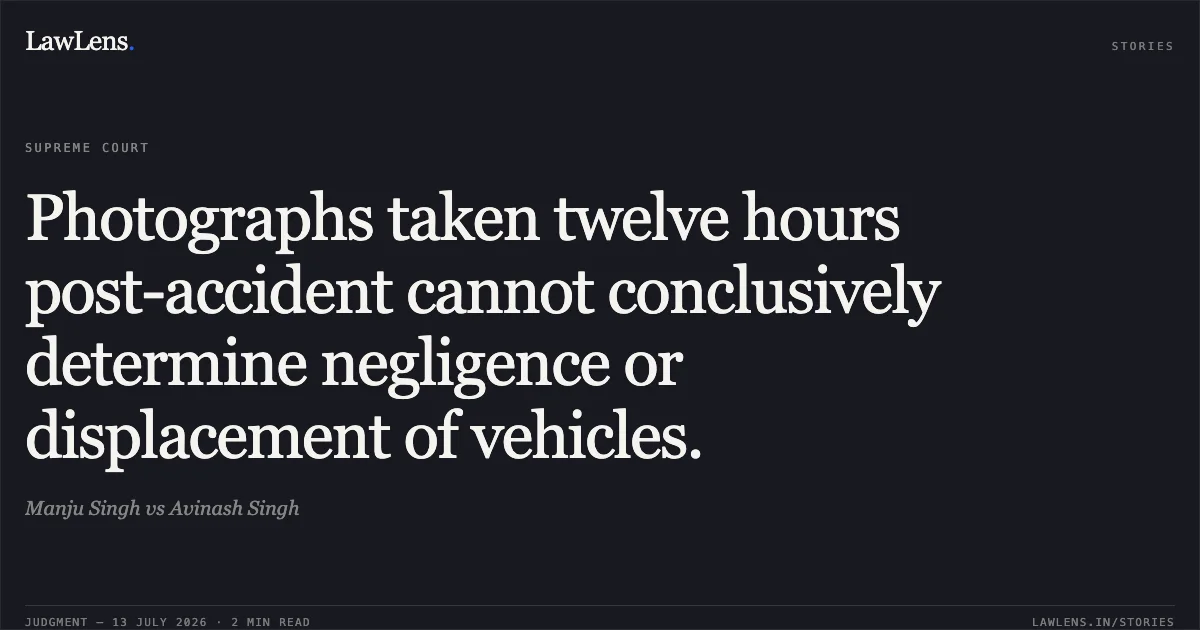
The Supreme Court found the lower courts' reliance on Exhibits 3 and 4 (photographs) perverse, as they were taken by the interested party (tanker owner) nearly 12 hours after the accident and did not necessarily reflect the position of vehicles at the time of impact
Source reference: paras. 16-17, 21Conversely, the Court credited the testimony of PW-2, the sole surviving injured eyewitness, whose account of the tanker's high speed and the car driver’s efforts to avert the collision was found consistent and trustworthy
Source reference: paras. 22-23The Court drew an adverse inference against the respondents for failing to produce the tanker's conductor as a witness
Source reference: para. 24Furthermore, the Court noted that the tanker driver failed to lodge an FIR and provided no evidence of using parking lights or hazard indicators, which shift the burden of proof to the respondents under res ipsa loquitur
Source reference: paras. 14, 24-25The filing of a police charge-sheet against the tanker driver also lent support to the claimants' case
Source reference: para. 26Holding
The Supreme Court set aside the High Court and Tribunal orders, holding that the accident occurred due to the rash and negligent driving of the tanker driver
The Court allowed the appeals and awarded total compensation (including interest) of ₹65,58,449.30, ₹41,66,829.68, and ₹35,36,132.78 to the respective claimants. The respondent-Insurance Company was directed to deposit the amounts within eight weeks, with interest at 6% p.a. from the date of filing until realization
Source reference: paras. 31, 33-34, 37Acts & Sections Cited
2 provisions across 2 statutes referred to in this judgment. Linked provisions open on LawLens.
Motor Vehicles Act, 19881
Indian Penal Code, 18601
Original Court PDF
Manju SinghvsAvinash Singh
Click to open original judgment
Original judgment, available to read, download and summarize on LawLens.in


![Authorities must decide pensionary and retiral-benefit claims through a reasoned order within eight weeks.. Habibullah khan vs HOME DEPARTMENT. CAT - ['Srinagar']. LawLens](/stories/thumbnails/authorities-must-decide-pensionary-and-retiral-benefit-claims-through-a-reasoned-order-wit-d0cbe8a8119c48fbabe7df9f2d353488.webp)