Facts
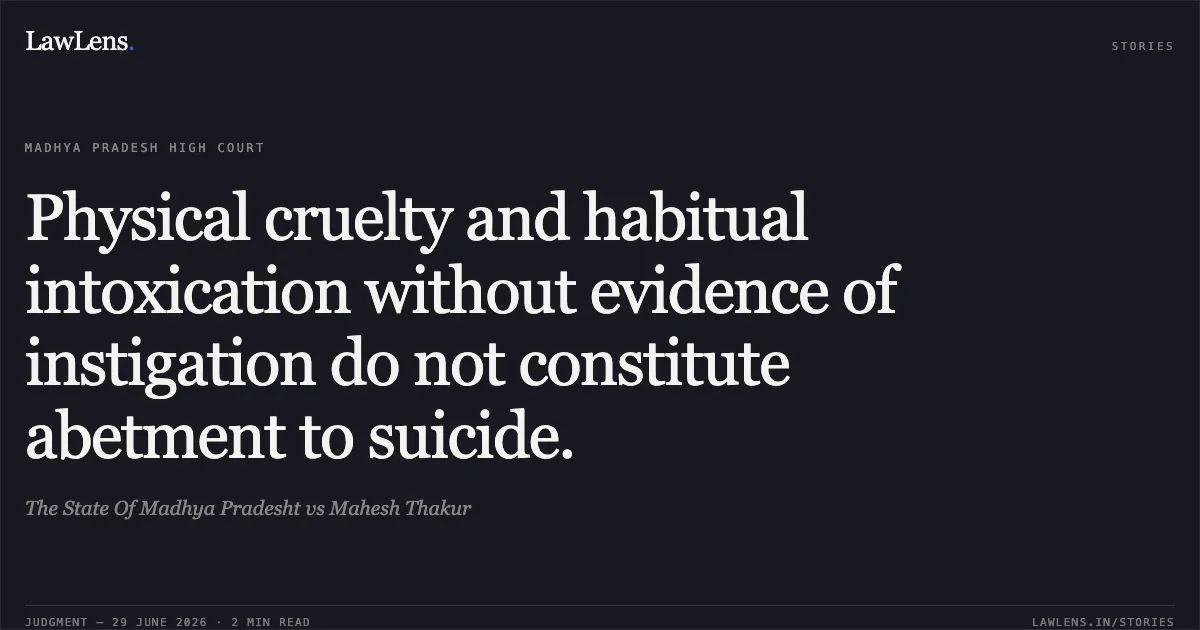
The State appealed against a judgment dated 10.03.2023 by the Second Additional Sessions Judge, Nasrullaganj, which acquitted the respondent of charges under Section 306 of the IPC.
Source reference: para. 1The prosecution alleged that Sudhabai (married to the respondent in 2014) committed suicide by hanging on 30.03.2020 due to persistent physical abuse ("marpeet") and harassment by the respondent under the influence of liquor.
Source reference: para. 2, 6The trial court acquitted the respondent, finding a lack of evidence regarding instigation or abetment.
Source reference: para. 5Issues
1. Whether the prosecution established the essential ingredients of "abetment to suicide" under Section 306 read with Section 107 of the IPC.
Source reference: para. 92. Whether the findings of the trial court were perverse or legally unsustainable warranting interference in an appeal against acquittal.
Source reference: para. 23, 28Law Applied
The court primarily applied Section 306 of the IPC (Abetment of suicide) and the definition of abetment under Section 107 of the IPC, which requires instigation, conspiracy, or intentional aid.
Source reference: para. 9-10It relied on S.S. Cheena v. Vijay Kumar Mahajan, emphasizing that conviction requires "clear mens rea" and an active act intended to push the deceased to commit suicide.
Source reference: para. 12The court further applied the principle from Abdul Hanif v. State of M.P., which establishes that mere threatening or beating does not automatically constitute instigation for suicide.
Source reference: para. 15Finally, it followed the appellate standards for acquittal set in Mallappa v. State of Karnataka, stating that if two views are possible, the view favoring the accused must be followed.
Source reference: para. 27Reasoning
The High Court observed that while family members (PW-1 to PW-4) alleged habitual abuse, their testimonies were riddled with material omissions and contradictions.
Source reference: para. 17Notably, these witnesses did not mention the abuse in initial police documents like the Naksha Panchayatnama (Ex.P/2) and even falsely suggested the deceased was murdered by strangulation, which was contradicted by medical evidence.
Source reference: para. 17, 21The court noted that the independent village Chowkidar (PW-6) turned hostile and testified that the couple lived well and the deceased suffered from illnesses.
Source reference: para. 20Crucially, the court found no evidence of a "positive act" or "active instigation" by the respondent in close proximity to the death.
Source reference: para. 11-14Since the marriage was over seven years old, no legal presumption under Section 113-A of the Evidence Act was applicable.
Source reference: para. 20Holding
The Court held that the prosecution failed to establish the ingredients of abetment beyond a reasonable doubt.
It found the trial court’s view to be a "legally plausible view" based on the evidence. Consequently, the High Court dismissed the application for leave to appeal and the appeal itself, affirming the acquittal of Mahesh Thakur.
Source reference: para. 28, 29Acts & Sections Cited
4 provisions across 2 statutes referred to in this judgment. Each provision opens on LawLens.
Code of Criminal Procedure, 19732
Indian Penal Code, 18602
Original Court PDF
The State Of Madhya PradeshtvsMahesh Thakur
Click to open original judgment
Original judgment, available to read, download and summarize on LawLens.in


![Subsequent exoneration does not retrospectively invalidate a finalized promotion select list.. UNNIKRISHNAN M vs M/o Environment And Forests. CAT - ['Ernakulam']. LawLens](/stories/thumbnails/subsequent-exoneration-does-not-retrospectively-invalidate-a-finalized-promotion-select-li-ce80a0e84f2f4887857271e8b4341c42.webp)