Facts
The Petitioner, a proprietary concern, challenged a Labour Court Award dated 03.07.2010.
Source reference: p. 1, 3The Respondent/workman claimed he was a permanent tailor employed since 1988, first with M/s Dayal Sons Selection and then with the Petitioner, at monthly wages of Rs. 2,000.
Source reference: p. 1-2The Petitioner contended that the Respondent was a piece-rated worker engaged from July 1998 to August 1999, who voluntarily resigned and accepted a full and final settlement of Rs. 2,000 (Ex. MW1/3).
Source reference: p. 2, 4On 05.08.1999, the Respondent filed a complaint alleging illegal termination.
Source reference: p. 2The Labour Court held the cessation of service amounted to illegal retrenchment under Section 25F of the Industrial Disputes (ID) Act, 1947, and ordered reinstatement with 80% back wages.
Source reference: p. 3Issues
1. Whether the Respondent, being a piece-rate worker, falls under the definition of "workman" under Section 2(s) of the ID Act, 1947.
Source reference: p. 8, 122. Whether the cessation of service on 04.08.1999 was a voluntary resignation or an illegal retrenchment in violation of Section 25F of the ID Act.
Source reference: p. 113. Whether the Award became unenforceable under Section 19(3) of the ID Act due to delays in implementation.
Source reference: p. 5, 23Law Applied
The court applied Section 2(s) of the ID Act, which defines "workman" based on the "test of control and supervision" rather than the method of payment.
Source reference: p. 12-13It relied on M/s Shining Tailors v. Industrial Tribunal II, U.P. and Silver Jubilee Tailoring House v. Chief Inspector of Shops and Establishments to establish that piece-rated workers are "workmen" if the employer controls the manner of work.
Source reference: p. 12, 13Section 2(oo) defines "retrenchment" as termination for any reason other than specific exceptions like voluntary resignation.
Source reference: p. 17Section 25F mandates payment of notice pay and compensation as a condition precedent for retrenchment.
Source reference: p. 22The court also applied the doctrine of election/consistency regarding the enforceability of awards and cited BSNL v. Bhurumal regarding the substitution of reinstatement with monetary compensation.
Source reference: p. 24, 25Reasoning
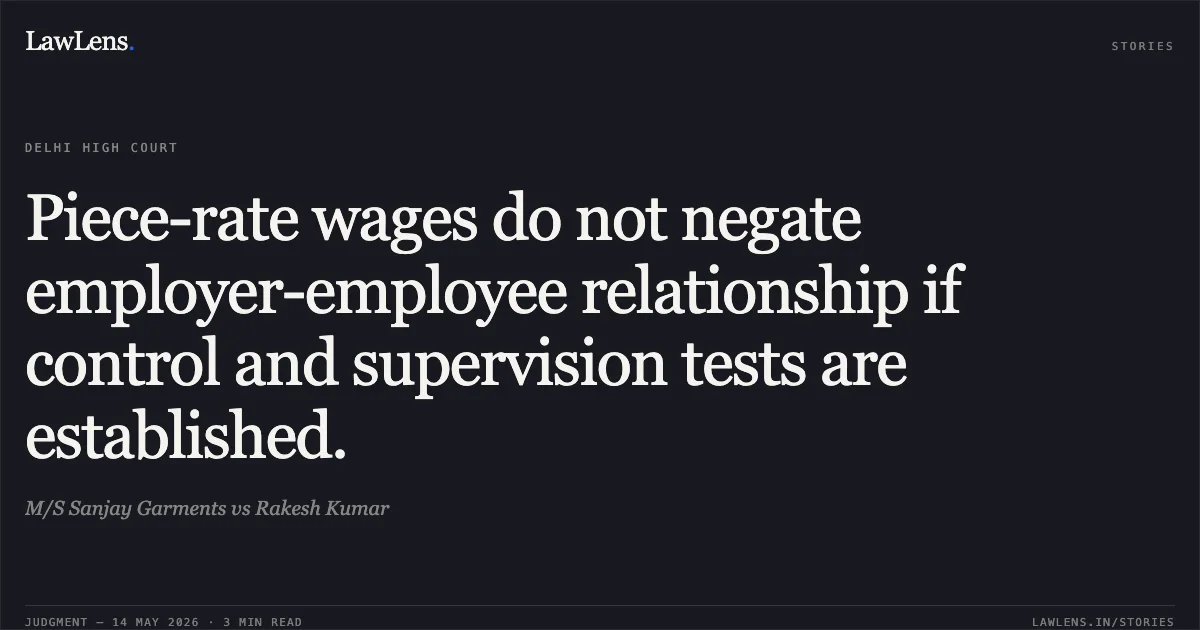
The Court affirmed the Respondent was a "workman" because the work was performed on the Petitioner's premises under its supervision, and piece-rate payment does not negate an employer-employee relationship.
Source reference: p. 14Regarding the pre-1998 service, the Court found the evidence of succession between the two firms inconclusive; however, since the Petitioner admitted service from July 1998 to August 1999 (exceeding 240 days), Section 25F was applicable.
Source reference: p. 15-16The Petitioner's plea of "voluntary resignation" was rejected because the alleged settlement documents (Ex. MW1/2 and MW1/3) were not pleaded in the Written Statement, appeared to be prepared on typed proformas with the same pen, and the Respondent lodged a complaint for illegal termination the very next day.
Source reference: p. 19-21Since the payment of Rs. 2,000 was insufficient to cover statutory notice pay and compensation at the admitted rate of Rs. 2,600/month, the retrenchment was held void ab initio.
Source reference: p. 23The Court rejected the Section 19(3) argument, noting that the Petitioner cannot challenge an award’s validity while simultaneously claiming it has ceased to exist.
Source reference: p. 24Holding
The Court upheld the finding of illegal retrenchment but set aside the order of reinstatement and 80% back wages, modifying the relief to a lump-sum compensation due to limited proved service and the long lapse of time.
The Petitioner is directed to pay the Respondent a consolidated sum of Rs. 1,25,000 within eight weeks, failing which simple interest at 8% per annum will apply; the Writ Petition was disposed of accordingly.
Source reference: p. 26Acts & Sections Cited
4 provisions across 1 statute referred to in this judgment. Linked provisions open on LawLens.
Industrial Disputes Act, 19474
Original Court PDF
M/S Sanjay GarmentsvsRakesh Kumar
Click to open original judgment
Original judgment, available to read, download and summarize on LawLens.in


