Facts
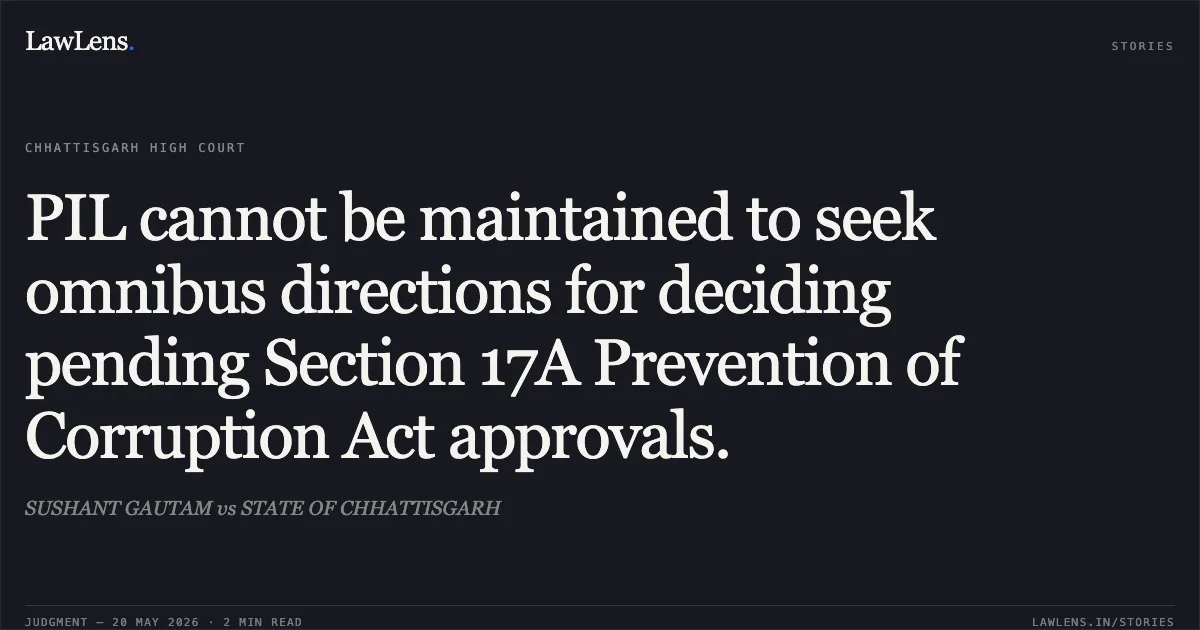
The petitioner, a journalist, filed a Public Interest Litigation (PIL) seeking a writ of mandamus to compel the State of Chhattisgarh to decide pending requisitions for previous approval under Section 17A of the Prevention of Corruption Act, 1988.
Source reference: para. 2-3The petitioner alleged that numerous FIRs against government officials are stalled because the State has failed to grant or refuse approval for investigations within a reasonable timeframe, thereby shielding accused officials and obstructing the criminal justice system.
Source reference: para. 4-5The petitioner relied on the fact that lists of such pending cases had been discussed in the State Legislative Assembly (Vidhan Sabha).
Source reference: para. 5The State contested the maintainability of the petition, arguing that the allegations were vague, generalized, and lacked specific instances of injury or material evidence.
Source reference: para. 7Issues
1. Whether a generalized direction can be issued to the State Government under Article 226 to decide all pending requisitions under Section 17A of the Prevention of Corruption Act without examining the facts of individual cases.
Source reference: para. 8-92. Whether the current petition qualifies as a genuine Public Interest Litigation or constitutes an abuse of the court's process.
Source reference: para. 12 & 15Law Applied
Section 17A of the Prevention of Corruption Act, 1988, noting its statutory timeline (three months, extendable by one month) and its objective to protect honest public servants from vexatious inquiries.
Source reference: para. 10-11Centre for Public Interest Litigation v. Union of India (2026 INSC 55) regarding the constitutional validity and purpose of Section 17A.
Source reference: para. 10For the maintainability of PILs, the Court followed Ashok Kumar Pandey v. State of West Bengal (2004) 3 SCC 349, State of Uttaranchal v. Balwant Singh Chaufal (2010) 3 SCC 402, and Holicow Pictures (P) Ltd. v. Prem Chand Mishra (2007) 14 SCC 281, which mandate that PILs must not be "Publicity Interest Litigations" and must be backed by concrete factual foundations.
Source reference: para. 12-14Reasoning
The Court reasoned that the grant of approval under Section 17A is a quasi-administrative function requiring a case-specific examination of records, preliminary inquiry materials, and administrative satisfaction.
Source reference: para. 8 & 16Consequently, the Court cannot issue "sweeping" or "omnibus" directions in a PIL without a factual matrix for each specific case, as doing so would improperly involve the judiciary in the executive’s decision-making domain.
Source reference: para. 9 & 16The Court found the petitioner’s claims regarding "mala fide intention" and "shielding of officials" to be unsupported assumptions or based on newspaper reports rather than cogent evidence.
Source reference: para. 9 & 17It emphasized that the statutory proviso for a three-month timeline in Section 17A does not authorize the Court to act as a universal supervisory body over all pending administrative requisitions in the absence of a demonstrated legal injury.
Source reference: para. 11 & 16Holding
The Court dismissed the petition, holding that it was in the nature of "Publicity Interest Litigation" rather than a genuine public grievance.
The Court ruled it could not entertain roving inquiries into administrative functions based on speculative apprehensions.
Source reference: para. 17The petition was dismissed, and the security amount deposited by the petitioner was ordered forfeited.
Source reference: para. 18-19Acts & Sections Cited
1 provisions across 1 statute referred to in this judgment. Linked provisions open on LawLens.
Prevention of Corruption Act, 19881
Original Court PDF
SUSHANT GAUTAMvsSTATE OF CHHATTISGARH
Click to open original judgment
Original judgment, available to read, download and summarize on LawLens.in