Facts
The petitioner filed an RTI application on 16.08.2020 seeking 17 points of information from AIIMS regarding wage rates (1994–2003), rules for festival bonuses, and copies of specific office memoranda/departmental orders
Source reference: p. 1-3The Public Information Officer (PIO) denied several queries citing "personal information" under Section 8(1) without detailed reasoning and directed the petitioner to different departments for other queries, stating some info was in the "public domain"
Source reference: p. 3-4Both the First Appellate Authority and the Central Information Commission (CIC) dismissed the appeals, with the CIC claiming the matter was barred by res judicata and that eligible information had already been furnished
Source reference: p. 4-5The petitioner challenged these orders via a writ petition before the Delhi High Court.
Source reference: no citationIssues
1. Whether a PIO can validly reject an RTI request by merely citing Section 8(1) without assigning specific reasons or examining the severability of information
Source reference: p. 5 / para. 11-122. Whether a PIO is obligated to consolidate information from different branches of the same public authority rather than directing the applicant to various departments
Source reference: p. 5 / para. 6-73. Whether the principle of res judicata can be invoked to dismiss a second appeal without a clear analysis of the identity of the subject matter
Source reference: p. 7 / para. 14Law Applied
Section 5(3) of the RTI Act, 2005, which mandates PIOs to render reasonable assistance
Source reference: p. 5Section 5(4) and 5(5), which empower PIOs to seek assistance from other officers within the same authority
Source reference: p. 5Section 6(3) regarding the mandatory transfer of applications to other public authorities within five days
Source reference: p. 5Section 8(1)(j) regarding the exemption of personal information
Source reference: p. 6Section 10, which mandates the "doctrine of severability" for non-exempt portions of a record
Source reference: p. 6Reasoning
The Court observed that the PIO’s approach of "driving the applicant from pillar to post" was contrary to the mandate of the Act
Source reference: p. 5Under Section 5(4), the PIO had the statutory power to collect information from various wings of the same authority rather than forcing the petitioner to approach different branches
Source reference: p. 5Regarding the denial of information, the Court held that a "bare reference" to Section 8(1) without explaining how the disclosure would cause an unwarranted invasion of privacy is insufficient
Source reference: p. 6The Court further noted that the respondents failed to apply the doctrine of severability under Section 10 for records containing both exempt and non-exempt data
Source reference: p. 6the Court found the CIC's invocation of res judicata flawed as it lacked a comparative analysis of the previous and current subject matter
Source reference: p. 7Holding
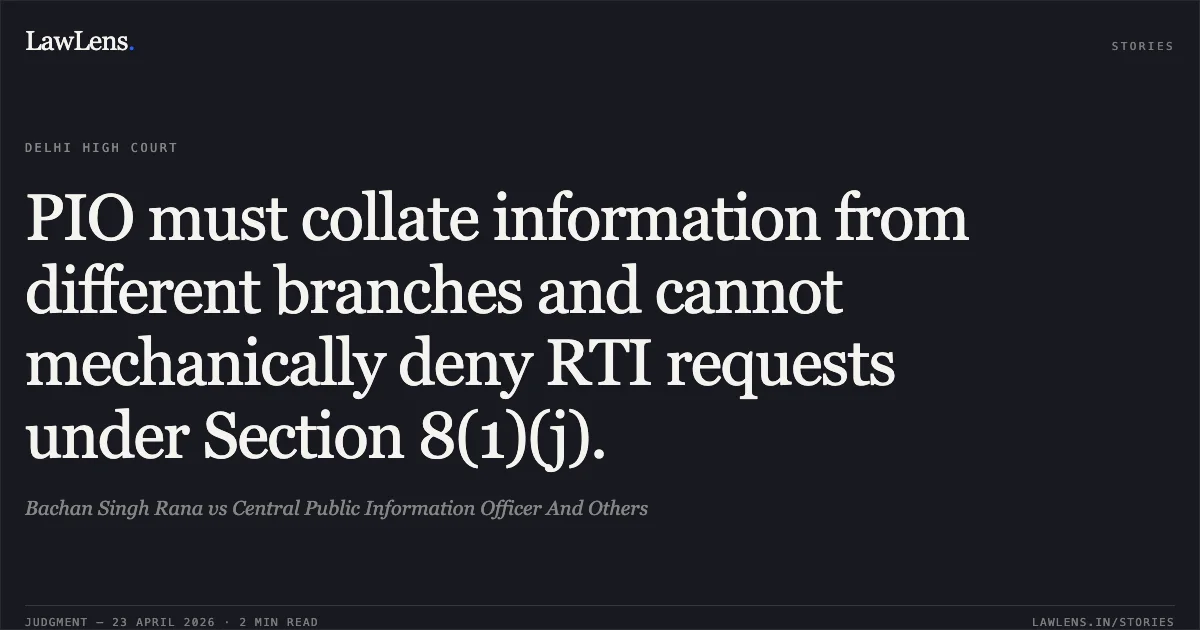
The Court set aside the CIC order dated 11.02.2022 and restored the RTI application to its original number
It held that the PIO must personally collate information from all respective branches and provide it to the petitioner
Source reference: p. 7If any information is withheld, specific reasons must be communicated
Source reference: p. 7The Court directed that all information be furnished free of cost
Source reference: p. 7The writ petition was disposed of accordingly
Source reference: p. 7Acts & Sections Cited
8 provisions across 1 statute referred to in this judgment. Each provision opens on LawLens.
Right to Information Act, 20058
Original Court PDF
Bachan Singh RanavsCentral Public Information Officer And Others
Click to open original judgment
Original judgment, available to read, download and summarize on LawLens.in


![Subsequent exoneration does not retrospectively invalidate a finalized promotion select list.. UNNIKRISHNAN M vs M/o Environment And Forests. CAT - ['Ernakulam']. LawLens](/stories/thumbnails/subsequent-exoneration-does-not-retrospectively-invalidate-a-finalized-promotion-select-li-ce80a0e84f2f4887857271e8b4341c42.webp)