Facts
The appellants/plaintiffs filed a suit in 2008 for partition, declaration, and permanent injunction regarding four schedule properties, claiming a 1/7th share derived from their great-grandmother, Smt. Nagubai
Source reference: p. 18, 36They sought to declare two prior judgments (from 1995 and 2002) and several subsequent sale deeds and Joint Development Agreements (JDAs) as void ab-initio and not binding
Source reference: p. 18-19Defendants 24 and 26 filed an application under Order VII Rule 11 (a) to (d) of the CPC (I.A. No. 24) seeking rejection of the plaint on grounds of lack of cause of action, lack of title, and bar by limitation
Source reference: p. 17, 31-32A prior similar application (I.A. No. 8) had been dismissed by the Trial Court in 2011, but the High Court remanded the matter in 2012 with directions to reconsider after a potential amendment to the plaint
Source reference: p. 26, 29-30Instead of following the specific remand directions, the Trial Court passed the "Impugned Order" on 14.10.2019, allowing I.A. No. 24 and rejecting the plaint as a whole
Source reference: p. 16, 31Issues
1. Whether the Trial Court was justified in rejecting the plaint under Order VII Rule 11 of the CPC based on disputed questions of fact regarding title and limitation
Source reference: p. 40-412. Whether a plaint can be partially rejected against only some defendants or regarding only certain properties under Order VII Rule 11
Source reference: p. 42, 463. Whether the suit for partition and declaration of voidance of prior decrees was ex-facie barred by limitation
Source reference: p. 43, 52Law Applied
The court applied Order VII Rule 11 of the CPC, which mandates that a plaint can only be rejected if, on its face, it fails to disclose a cause of action or is barred by law
Source reference: p. 40, 48It relied on Vinod Infra Developers Ltd. v. Mahaveer Lunia, affirming that courts must strictly confine examination to the averments in the plaint
Source reference: p. 40The principle that a plaint cannot be rejected in part was drawn from Kum. Geetha v. Nanjundaswamy and Sejal Glass Ltd. v. Navilan Merchants (P) Ltd.
Source reference: p. 42, 47Regarding partition, the court cited Vidya Devi v. Prem Prakash, which establishes that partition is a recurring cause of action with no specific limitation period
Source reference: p. 52Balasaria Constructions (P) Ltd v. Hanuman Seva Trust was applied to show that limitation is a mixed question of fact and law that generally requires trial
Source reference: p. 55Reasoning
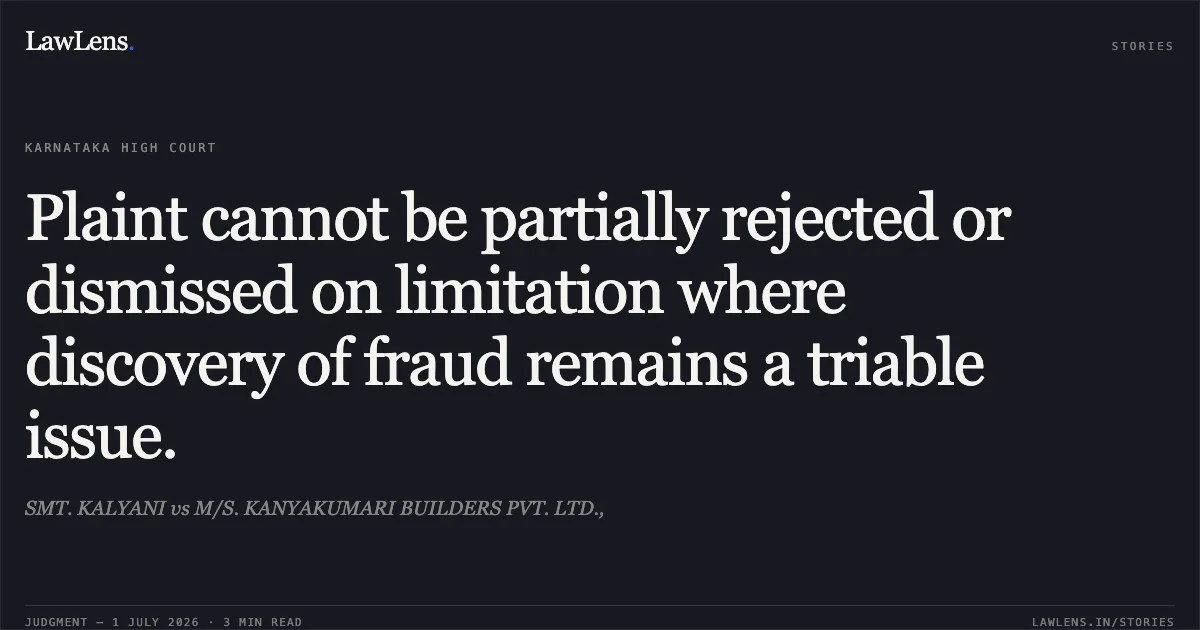
The High Court found that the Trial Court erred by delving into the merits and veracity of the plaintiffs' claims at the threshold stage. Specifically, the Trial Court failed to consider the plaintiffs' averment that they only gained knowledge of the 1995 decree and subsequent alienations in 2008
Source reference: p. 27, 54Since the plaintiffs pleaded fraud and a specific timeline for discovery, the issue of limitation became a triable issue of fact that could not be determined on a demurrer
Source reference: p. 43, 55The Trial Court ignored the "meaningful reading" rule by failing to note the plaintiffs' references to High Court orders and LAC proceedings apparently recognizing their grandmother's interest
Source reference: p. 37-38I.A. No. 24 was allowed despite seeking rejection against only two defendants, violating the established law that a plaint must be rejected as a whole or not at all
Source reference: p. 46, 51The High Court observed that if a plaint survives against any defendant or discloses any triable issue, it must proceed to trial
Source reference: p. 49, 52Holding
The High Court set aside the Impugned Order dated 14.10.2019, holding that the Trial Court’s summary rejection was unsustainable as the plaint disclosed triable issues regarding title, fraud, and limitation
The Court held that the date of knowledge for the purpose of limitation is a factual dispute requiring evidence
Source reference: p. 54The appeal was allowed, the suit was restored, and the Trial Court was directed to decide the matter expeditiously, preferably within six months, while permitting Defendants 24 and 26 to raise their legal objections during the trial. The parties were directed to appear before the Trial Court on 09.07.2026
Source reference: p. 56Acts & Sections Cited
8 provisions across 3 statutes referred to in this judgment. Each provision opens on LawLens.
Code of Civil Procedure, 19085
KARNATAKA COURT-FEE AND SUITS VALUATION ACT, 1958.2
Limitation Act, 19631
Original Court PDF
SMT. KALYANIvsM/S. KANYAKUMARI BUILDERS PVT. LTD.,
Click to open original judgment
Original judgment, available to read, download and summarize on LawLens.in


