Facts
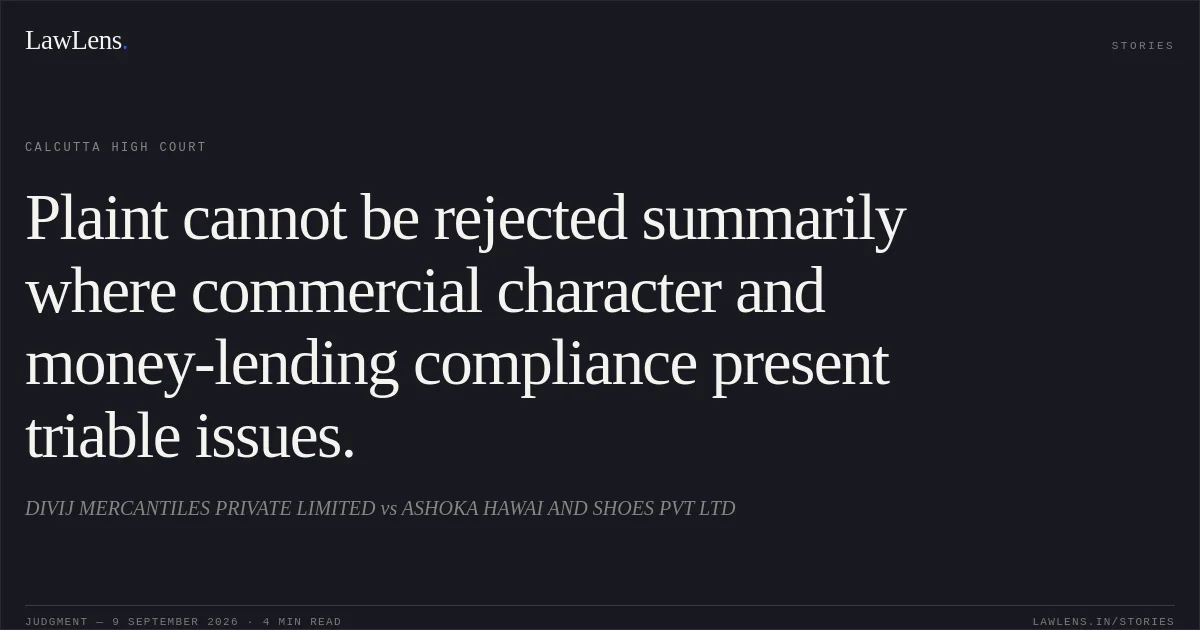
The plaintiff, a company engaged inter alia in financial intermediation and financial activities, instituted a suit for recovery of ₹65,00,000 allegedly advanced to the defendant between January and September 2020, together with interest at 12% per annum.
Source reference: no citationThe plaintiff relied on its ledger, bank statement and Form 26AS records, and pleaded that the defendant had made part-payment towards interest and deposited tax deducted at source on the interest payable.
Source reference: para. 10The defendant applied under Order VII Rule 11 of the Code of Civil Procedure, 1908, seeking rejection of the plaint on the grounds that the suit was not a “commercial dispute” under Sections 2(1)(c) and 2(1)(f) of the Commercial Courts Act, 2015, and that the claim was barred by the Bengal Money-Lenders Act, 1940, in the absence of a valid money-lending certificate.
Source reference: paras. 1, 4–6The defendant had also filed its written statement beyond 120 days from service of summons, pursuant to a concession by the plaintiff; the plaintiff’s application to take the written statement off the record remained pending.
Source reference: para. 2Issues
Whether, on a meaningful reading of the plaint, the suit was ex facie not a commercial dispute under Sections 2(1)(c) and 2(1)(f) of the Commercial Courts Act, 2015, warranting rejection under Order VII Rule 11 CPC.
Source reference: paras. 5, 10–13Whether the plaint was barred by the Bengal Money-Lenders Act, 1940, because the plaintiff had not pleaded or disclosed that it possessed the requisite money-lending certificate.
Source reference: paras. 6, 8, 14–15Whether the defendant’s objections concerning maintainability should be determined at the threshold or left for adjudication at trial.
Source reference: paras. 12–20Law Applied
The Court applied Order VII Rule 11 CPC, under which a plaint may be rejected at the threshold where, on a meaningful reading of its averments, it is ex facie barred by law; however, rejection is inappropriate where the pleadings disclose an arguable or triable case.
Source reference: para. 13Sections 2(1)(c) and 2(1)(f) of the Commercial Courts Act, 2015, concerning “commercial dispute” and “document”, were read conjointly; the statutory reference to mercantile documents was not treated as confined only to a formal written contract.
Source reference: paras. 11–12Section 13 of the Bengal Money-Lenders Act, 1940, was applied as containing a statutory opportunity to cure the defect relating to the requisite licence or certificate before dismissal of the suit.
Source reference: para. 14The Court distinguished Prime Hitech Textiles LLP v. Manish Kumar and Meena Vohra v. Master Hosts Pvt. Ltd., where rejection was justified by an unimpeachable absence of a commercial dispute, and relied on the principle in Dutta Vinimay Private Limited v. Dinesh Singh concerning the curable nature of the defect under Section 13 of the Bengal Money-Lenders Act.
Source reference: paras. 14, 16–17The Supreme Court’s orders in Raj Kumar Santoshi v. Prashant Malik were distinguished as arising in criminal proceedings rather than in an application for rejection of a civil plaint.
Source reference: para. 15Reasoning
The plaint specifically pleaded that the plaintiff had advanced money to the defendant pursuant to an arrangement carrying interest, that the sums were transferred through the plaintiff’s bank account, and that the defendant made payments towards interest and TDS.
Source reference: para. 10These pleadings, read with the disclosed ledger, bank statements and Form 26AS, did not establish an unimpeachable case that the transaction was outside the scope of a commercial dispute.
Source reference: no citationThe nature and character of the financial transaction, including whether the documents constituted mercantile documents within the Commercial Courts Act, required factual examination and could not be conclusively determined under Order VII Rule 11 CPC.
Source reference: paras. 11–13, 16–17Similarly, the objection under the Bengal Money-Lenders Act could not result in immediate rejection because Section 13 contemplated an opportunity to cure the licensing defect; the Court therefore left the issue open for trial.
Source reference: para. 14The defendant remained free to raise both objections as issues of maintainability during the trial.
Source reference: paras. 18–20Holding
The Court held that the plaint could not be rejected at the threshold.
It found that the question whether the transaction constituted a commercial dispute and whether the claim was affected by the Bengal Money-Lenders Act required adjudication after a properly constituted trial.
Source reference: paras. 12–20The application for rejection of plaint, IA No. GA-COM/11/2025, was dismissed without costs.
Source reference: para. 22The defendant was permitted to raise all maintainability objections, including those under the Commercial Courts Act and the Bengal Money-Lenders Act, during trial.
Source reference: no citationThe Court expressed no opinion on the merits of those objections or on the plaintiff’s pending application to strike off the defendant’s delayed written statement.
Source reference: paras. 19–21Acts & Sections Cited
1 provisions across 1 statute referred to in this judgment. Each provision opens on LawLens.
Commercial Courts Act, 20151
Original Court PDF
DIVIJ MERCANTILES PRIVATE LIMITEDvsASHOKA HAWAI AND SHOES PVT LTD
Click to open original judgment
Original judgment, available to read, download and summarize on LawLens.in