Facts
The Appellants and Respondents 1–3 are the legal heirs of Late Shri Surendra Prakash Gupta
Source reference: para. 2Following prior unsuccessful litigations regarding Property No. 144, Deepali Pitampura (1995–2008), the Appellants instituted CS(OS) 20/2022 for partition and declaration
Source reference: para. 2, 3The suit was predicated on an unregistered Will dated 17.02.2002, which allegedly superseded a registered Will dated 23.05.1997
Source reference: para. 4The Appellants claimed they only learned of the 1997 Will and subsequent mutation in favor of Respondent No. 1 in November 2021
Source reference: para. 9, 18Respondent No. 1 filed an application under Order VII Rule 11 of the CPC, asserting the 2002 Will was a fabrication and the suit was barred by limitation
Source reference: para. 6A Single Judge of the High Court allowed the application on 02.04.2025, rejecting the plaint as vexatious and time-barred under Article 58 of the Limitation Act
Source reference: para. 1, 14The Appellants challenged this rejection in the present appeal.
Source reference: no citationIssues
1. Whether the learned Single Judge erred in rejecting the plaint under Order VII Rule 11(a) and (d) of the CPC by prematurely adjudicating disputed facts regarding the validity of the Wills.
Source reference: para. 15, 222. Whether the suit was ex-facie barred by limitation, or if the issue of limitation constituted a mixed question of fact and law requiring trial.
Source reference: para. 25, 29Law Applied
The Court applied Order VII Rule 11 of the CPC, which mandates the rejection of a plaint that fails to disclose a cause of action or is barred by law
Source reference: para. 1, 16It relied on Popat and Kotecha Property v. State Bank of India Staff Assn. (2005) 7 SCC 510, establishing that for Rule 11 purposes, only the averments in the plaint are germane and must be read as a whole
Source reference: para. 16The Court further referenced T. Arivandandam v. T. V. Satyapal (1977) 4 SCC 467 regarding the duty to detect "clever drafting" while cautioning against a "pedantic approach"
Source reference: para. 16Article 58 of the Limitation Act, 1963 was considered, which prescribes a three-year period for declarations starting from when the right to sue first accrues
Source reference: para. 14, 25Reasoning
The Division Bench found that the Single Judge exceeded the limited scope of Order VII Rule 11 by conducting a mini-trial on the "implausibility" of the 2002 Will
Source reference: para. 13, 22The Bench noted that the Single Judge’s conclusion—that a father reverting from a registered 1997 Will to an unregistered 2002 Will was "inconceivable"—constituted a factual inquiry into "suspicious circumstances" inappropriate for the threshold stage
Source reference: para. 22The Single Judge’s finding that the Appellants did not dispute the 1997 Will was held to be contrary to the express pleadings in paragraph 32 of the plaint
Source reference: para. 23On the issue of limitation, the Bench observed that the Appellants pleaded a lack of knowledge of the 1997 Will until 2021 and alleged fraud in the mutation process
Source reference: para. 18, 26Since the Appellants also claimed a "continuously accruing cause of action" due to threats of dispossession, the Bench determined that limitation in this context was a mixed question of fact and law that cannot be summarily decided without evidence
Source reference: para. 27, 29Holding
The High Court allowed the appeal and set aside the judgment dated 02.04.2025
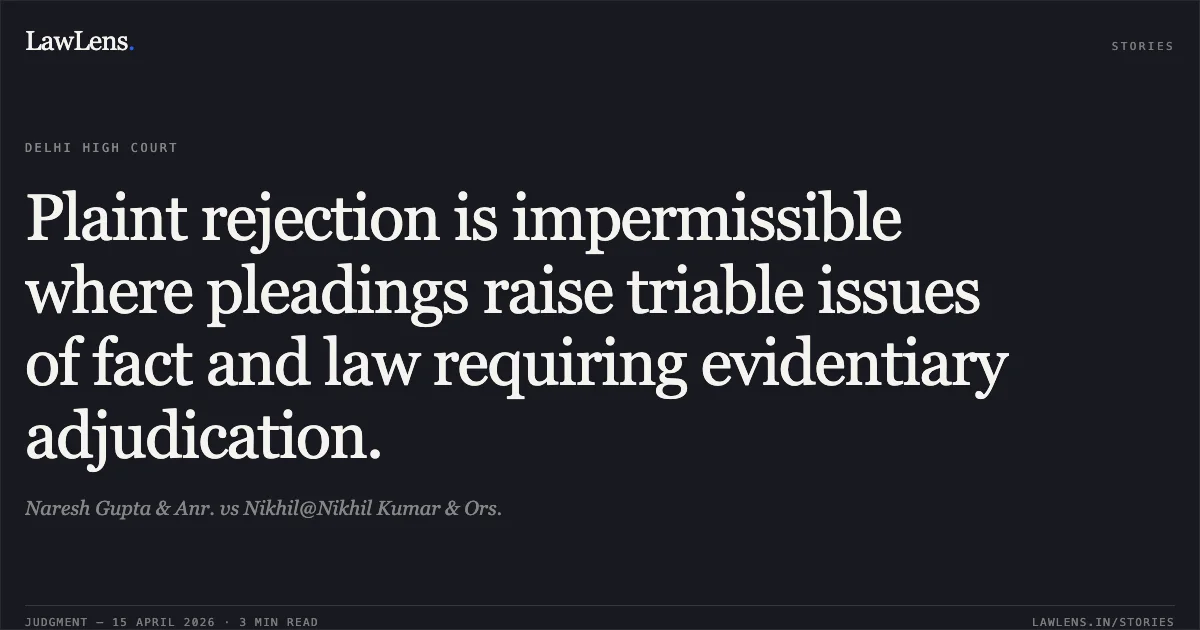
The Court held that the plaint raised triable issues regarding the validity of the subsequent Will and the discovery of alleged fraud, which must be adjudicated through a full trial rather than rejected at the threshold
Source reference: para. 28-29The suit [CS(OS) 20/2022] was restored to its original number, and parties were directed to appear before the Roster Bench on 28.04.2026
Source reference: para. 30-31Acts & Sections Cited
7 provisions across 4 statutes referred to in this judgment. Each provision opens on LawLens.
Delhi High Court Act, 19661
Code of Civil Procedure, 19084
Indian Succession Act, 19251
Limitation Act, 19631
Original Court PDF
Naresh Gupta & Anr.vsNikhil@Nikhil Kumar & Ors.
Click to open original judgment
Original judgment, available to read, download and summarize on LawLens.in


