Facts
The Plaintiff established a Biomass Power Plant following a 2003 Government Notification providing for a 2% interest subsidy
Source reference: paras 3.1–3.2Between 2008 and 2023, the parties engaged in extensive litigation (W.P.(C) 353/2008, W.P.(C) 8070/2011, and W.P.(C) 8827/2015) regarding the release of the subsidy
Source reference: paras 3.5, 3.8, 3.17During the pendency of the third writ, the Defendant issued a letter dated 26th April 2023 agreeing to release the principal subsidy amount of ₹1,96,67,074/-.
Source reference: para 3.19Relying on this letter, the Plaintiff withdrew its writ petition on 17th May 2023 without reserving liberty to claim interest
Source reference: paras 3.19, 23After receiving the principal amount on 31st August 2023, the Plaintiff filed the present suit seeking ₹2,53,70,525/- as interest for the delay from 2012 to 2023
Source reference: paras 1, 3.20The Defendant filed the present application under Order VII Rule 11 CPC seeking rejection of the plaint
Source reference: para 2Issues
1. Whether the plaint discloses a real cause of action or an illusory one camouflaged by clever drafting
Source reference: para 162. Whether the suit is barred by the principle of acquiescence due to the unconditional withdrawal of previous proceedings
Source reference: paras 26, 303. Whether the suit is barred by limitation under Article 113 of the Limitation Act, 1963
Source reference: para 34Law Applied
The court applied Order VII Rule 11(a) and (d) of the CPC, emphasizing that a plaint must be rejected if it fails to disclose a cause of action or is barred by law
Source reference: paras 9, 10It relied on Dahiben v. Arvindbhai Kalyanji Bhanusali to hold that "clever drafting" creating an illusory cause of action should be nipped in the bud
Source reference: para 9The principle of "acquiescence" as a bar to suit was drawn from Asha Sharma v. Sanimiya Vanijiya P. Ltd., where the court held that inconsistent pleas in subsequent suits are barred
Source reference: para 28Regarding limitation, the court applied Article 113 of the Limitation Act, 1963, which prescribes a three-year period from when the "right to sue" accrues
Source reference: para 34Section 9 of the Limitation Act, which dictates that once time begins to run, no subsequent disability stops it
Source reference: para 45Reasoning
The court found that the Plaintiff’s claim for interest was intrinsically linked to the principal subsidy amount already litigated
Source reference: para 14By withdrawing W.P.(C) 8827/2015 "satisfied" with the principal amount and without seeking liberty to claim interest, the Plaintiff’s current suit was barred by acquiescence
Source reference: para 30The court rejected the argument that the cause of action arose only upon payment in 2023; instead, the "right to sue" for interest accrued when the delay first occurred in 2012
Source reference: paras 42, 45Since the Plaintiff admitted the amount was due from 2006/2012, the three-year limitation period under Article 113 expired long before the 2024 filing
Source reference: paras 38, 47The court determined the Plaintiff was attempting to revive a dead claim by linking it to the date of "quantification" of interest, which is legally impermissible under Section 9 of the Limitation Act
Source reference: para 45Holding
The Court allowed the Defendant’s application (I.A. 39173/2024) and rejected the plaint under Order VII Rules 11(a) and (d) CPC
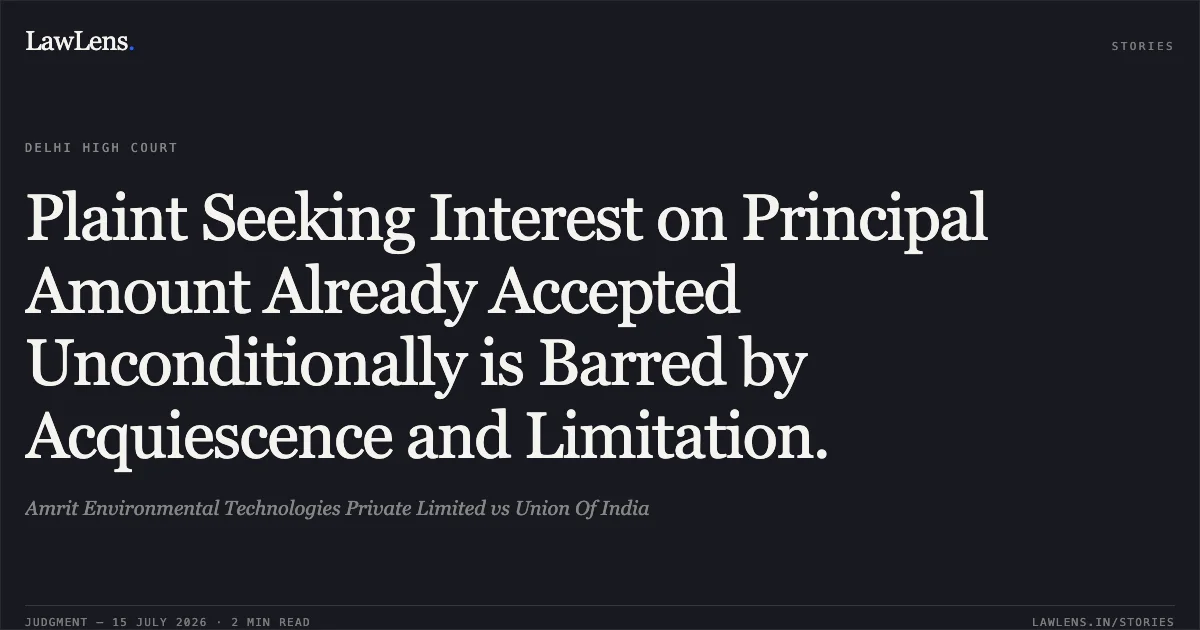
The court held that the suit disclosed no real cause of action, was barred by the principle of acquiescence, and was ex-facie barred by limitation
Source reference: paras 33, 47The suit [CS(OS) 200/2024] was dismissed
Source reference: para 56Acts & Sections Cited
29 provisions across 4 statutes referred to in this judgment. Each provision opens on LawLens.
Code of Civil Procedure, 19083
Limitation Act, 1963
Interest Act, 19781
Securitisation and Reconstruction of Financial Assets and Enforcement of Security Interest Act, 20021
Original Court PDF
Amrit Environmental Technologies Private LimitedvsUnion Of India
Click to open original judgment
Original judgment, available to read, download and summarize on LawLens.in


