Facts
The Petitioner (Original Defendant) owns a bungalow in Lonavala. The Respondent (Original Plaintiff) occupied an 8x8 sq. ft. room therein
Source reference: para. 3In 2008, the Respondent filed a suit for declaration of tenancy under the Maharashtra Rent Control Act, 1999, claiming he paid monthly rent to the Petitioner’s mother
Source reference: para. 4The Petitioner contested this, asserting the Respondent was employed as a gardener and the room was service-related permissive possession. The Petitioner produced nokar-namas (employment contracts) and salary receipts
Source reference: para. 5The Trial Court dismissed the suit, finding the Respondent failed to prove tenancy
Source reference: para. 8However, the District Court (Appellate Court) reversed this decision, declaring the Respondent a tenant because the Petitioner failed to conclusively prove continuous employment via nokar-namas for the entire duration of possession
Source reference: para. 1, 17Issues
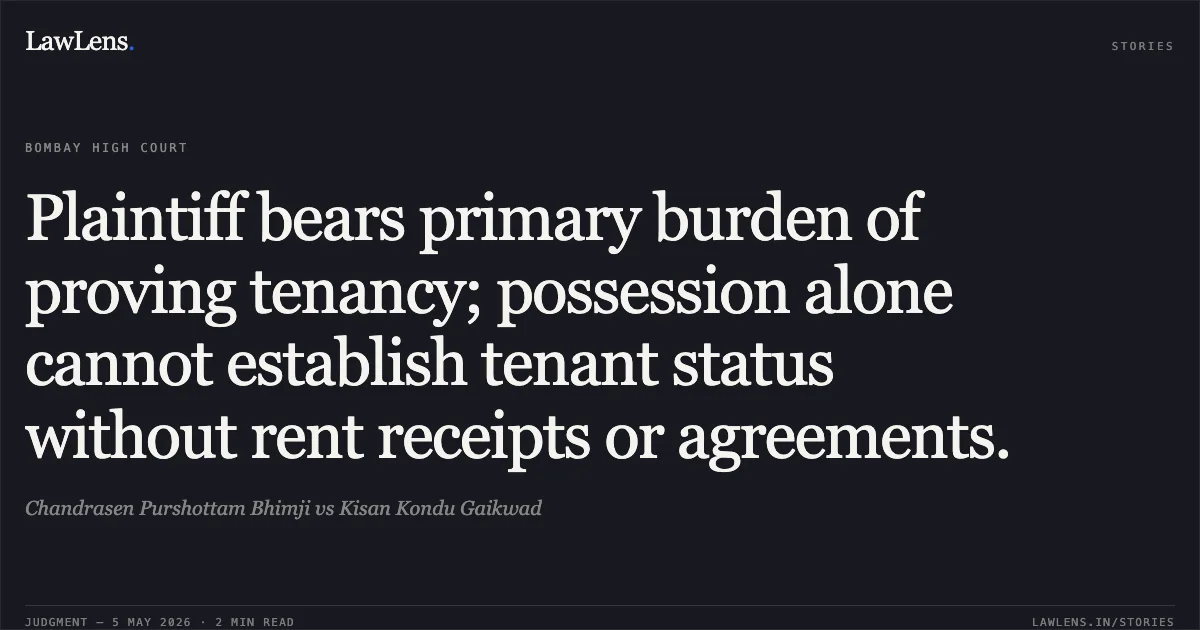
1. Whether the burden of proof to establish tenancy lies upon the party claiming to be a tenant
Source reference: para. 122. Whether long-standing or permissive possession of a premises is sufficient to establish a legal tenancy under the Maharashtra Rent Control Act
Source reference: para. 143. Whether the Appellate Court was justified in shifting the burden of proof onto the landlord to disprove tenancy by proving employment
Source reference: para. 22-23Law Applied
The Court applied the principle that the burden of proving a tenancy rests strictly on the person claiming the status of a tenant
Source reference: para. 12It relied on Rajaram Hiralal Bhoi v. Chintaman Waman Sathe [2012(2) Mh.L.J. 151] to affirm this burden
Source reference: para. 9, 12Furthermore, the Court applied the principle from Pandurang Dharma Gaikwad v. Mahamudmuya Ahmadsaheb Patil [2013(2) Mh.L.J. 949], which establishes that long-standing or permissive possession does not, by itself, create or prove a tenancy
Source reference: para. 14Reasoning
The High Court found the Appellate Court’s reasoning perverse because it erroneously shifted the burden of proof to the Petitioner. The Respondent failed to produce any rent receipts or a tenancy agreement; conversely, the 116 salary receipts produced were signed by the Respondent, indicating he was a recipient of money (salary) rather than a payer of rent
Source reference: para. 15The High Court noted that the Appellate Court focused on "weaknesses" in the Petitioner's defense—such as the lack of nokar-namas for certain intervals—rather than requiring the Plaintiff to prove his positive case
Source reference: para. 17, 22The Court emphasized that even if the Petitioner failed to prove the respondent was a gardener, the Respondent remained legally obligated to prove he was a tenant, which he failed to do
Source reference: para. 13The Court held that the Appellate Court's inference of tenancy from the "failure" of the employment defense was a legal error
Source reference: para. 23Holding
The High Court allowed the Writ Petition and quashed the District Court's judgment dated 07.10.2013. The Court held that the Respondent failed to discharge the primary burden of proving tenancy.
Consequently, the Civil Appeal No. 65/2012 was dismissed, and the Trial Court’s decree dismissing the Respondent’s suit was confirmed. The Court concluded that the Appellate Court's decision resulted in a miscarriage of justice by misplacing the legal onus
Source reference: para. 23, 24Acts & Sections Cited
1 provisions across 1 statute referred to in this judgment. Linked provisions open on LawLens.
Maharashtra Rent Control Act, 19991
Original Court PDF
Chandrasen Purshottam BhimjivsKisan Kondu Gaikwad
Click to open original judgment
Original judgment, available to read, download and summarize on LawLens.in


