Facts
The respondent-plaintiffs (a registered society and its members) filed a suit for injunction and possession of an ancient temple, "Moorti Swarup Shri Govardhan Nath Ji," and its appurtenant properties
Source reference: p. 2The plaintiffs claimed ownership and management of the temple, asserting they had historically appointed "pujaris" (priests) to manage the affairs
Source reference: p. 2-3The appellant-defendant was appointed as a caretaker in 1951 but, in 1976, asserted private ownership over the property, claiming it devolved to him through a chain of successive adoptions and a will
Source reference: p. 3-4Both the Trial Court and the High Court ruled in favor of the plaintiffs, finding the defendant was merely a manager/pujari without proprietary interest
Source reference: p. 5-7Issues
1. Whether the respondent-plaintiffs successfully established their title to the suit property to justify a decree for declaration and removal of the appellant-defendant
Source reference: p. 6, para. 82. Whether the burden of proof in a title suit can be discharged by merely highlighting the weakness of the defendant’s case
Source reference: p. 8-9, paras. 12-14Law Applied
The Court applied the settled principles of the Indian Evidence Act, 1872, specifically Sections 101, 102, and 110, regarding the burden of proof in civil litigation
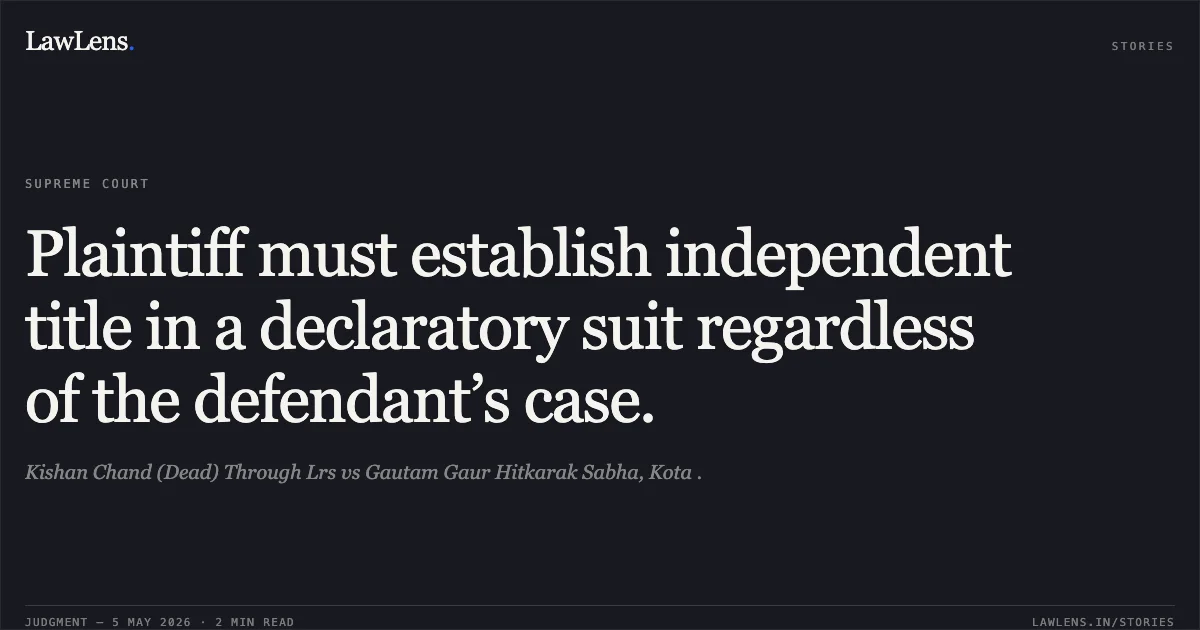
Source reference: p. 9, para. 14It relied on the precedent Union of India v. Vasavi Co-op. Housing Society Ltd. (2014), which established that in a suit for declaration of title, the plaintiff must succeed on the strength of their own case and cannot rely on the weakness of the defendant's defense
Source reference: p. 8-9, para. 13The Court also distinguished between the legal right to manage a religious institution and the legal ownership of its immovable property
Source reference: p. 10, para. 16Reasoning
The Supreme Court observed that the lower courts' approach suffered from a fundamental legal infirmity by shifting the focus to the defendant's failure to prove title rather than the plaintiffs' requirement to prove it
Source reference: p. 9, para. 14The court found that the plaintiffs failed to produce any formal deed of dedication, endowment, or title document evidencing ownership
Source reference: p. 9, para. 15The documents relied upon by the lower courts (minutes of meetings from 1926 and 1951) merely established a managerial arrangement for "seva-pooja" and the appointment of a "pujari," which is legally insufficient to confer proprietary title over immovable property
Source reference: p. 10, para. 16The Court reasoned that even if the defendant failed to prove his claim of succession via adoption, the plaintiffs still bore the primary burden to affirmatively establish their own title, which they failed to discharge
Source reference: p. 10, para. 17-18Holding
The Supreme Court answered the core issue in the negative, holding that management practices or the power to appoint priests do not equate to ownership of property
The Court set aside the High Court's judgment dated September 28, 2007
Source reference: p. 11, para. 20Consequently, the appeal was allowed, and the original civil suit for injunction and possession was dismissed
Source reference: p. 11, para. 21Acts & Sections Cited
3 provisions across 1 statute referred to in this judgment. Linked provisions open on LawLens.
Indian Evidence Act, 18723
Original Court PDF
Kishan Chand (Dead) Through LrsvsGautam Gaur Hitkarak Sabha, Kota .
Click to open original judgment
Original judgment, available to read, download and summarize on LawLens.in