01Facts
The petitioners (plaintiffs) sued in O.S. No. 150 of 2017, before the Subordinate Court, Tiruttani, for declaration of title and delivery of possession.
p. 3After pleadings were completed and issues framed, PW1 was examined in chief. Proof affidavit was filed only on 18.08.2022, after adjournments from 04.04.2022 to 04.08.2022, so the documents were marked nearly four months after examination in chief.
p. 4Cross-examination of PW1 was posted for 16.11.2022 but was repeatedly adjourned because PW1 remained absent, until 09.02.2023.
p. 4The trial court then closed PW1's evidence and the plaintiffs' evidence, and posted the matter for defendants' evidence.
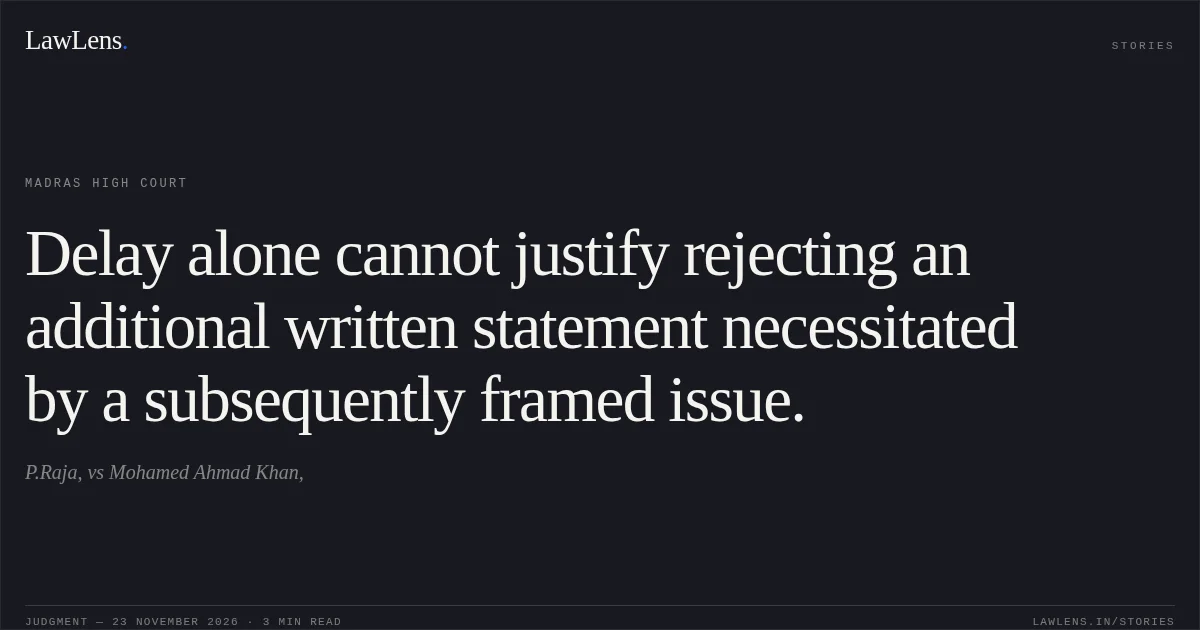
pp. 3–4In April 2023, the plaintiffs filed two applications (I.A. Nos. 1 and 2 of 2023) to reopen the evidence and recall PW1.
p. 3The plaintiffs contended that they were awaiting the outcome of a Civil Revision Petition against an order appointing an Advocate Commissioner, which was disposed of only on 30.03.2023, and that they therefore did not prosecute the suit during that period.
pp. 4–5The trial court dismissed both applications by order dated 09.10.2023, citing the plaintiffs' lack of diligence.
p. 4The plaintiffs challenged that order under Article 227 of the Constitution.
pp. 2–302Issues
i.1. Whether the trial court was justified in refusing to reopen the plaintiffs' evidence and recall PW1 for cross-examination, given the plaintiffs' conduct in prosecuting the suit.
p. 4ii.2. Whether the plaintiffs' explanation for the delay, namely the pendency of the proceedings concerning the Advocate Commissioner, is supported by the record.
pp. 4–5iii.3. Whether, and on what conditions, the plaintiffs should be afforded an opportunity to lead evidence without causing serious prejudice to the defendants.
p. 503Law Applied
The Court exercised its supervisory jurisdiction under Article 227 of the Constitution of India to review the trial court's discretionary refusal to reopen evidence and recall a witness.
pp. 2–3The judgment does not cite any statutory provision of the Code of Civil Procedure or any precedent. The governing principle, as stated by the Court, is that a litigant must ordinarily be given an opportunity to prove its case, since the plaintiffs "will have to prove their case."
p. 5Such an opportunity may be granted on terms, and the defendants are adequately protected where they retain the right to cross-examine the witness.
p. 5Conduct in prosecuting the suit, including repeated non-appearance and unexplained delay, is a relevant consideration in exercising this discretion.
p. 4The Court also has power to impose costs as a condition of relief.
p. 604Reasoning
The Court accepted the trial court's factual finding that the plaintiffs had failed to prosecute diligently despite several opportunities. The record showed a four-month delay in filing the proof affidavit and repeated adjournments caused by PW1's absence from 16.11.2022 to 09.02.2023.
p. 4The Court rejected the plaintiffs' justification that they were waiting for the revision petition concerning the Advocate Commissioner, because that explanation was "not borne out by the affidavit" filed in support of the applications.
p. 5Despite this finding of lack of diligence, the Court declined to uphold the outright exclusion of the plaintiffs' evidence. It held that the merits required the plaintiffs to be heard on their evidence, and that the defendants would suffer no serious prejudice because they could cross-examine the witness.
p. 5The Court therefore allowed the recall of PW1 but made the relief conditional. The conditions were payment of costs of Rs. 4,000, strict adherence to the posted dates, a same-day or next-day cross-examination, and a four-month deadline for disposal of the suit.
pp. 5–605Holding
The Court held that the plaintiffs' explanation for their conduct was unsupported by the record, but that they should still be given an opportunity to lead evidence on the merits, subject to strict terms.
p. 5(a) The petitioners must pay costs of Rs. 4,000 to the respondents within one week of receiving the order. (b) After compliance, the trial court must reopen the plaintiffs' evidence and recall PW1 for cross-examination. (c) If PW1 fails to appear on the fixed date, the trial court may close the plaintiffs' evidence.
pp. 5–6(d) PW1 must be cross-examined on the day of appearance, or at most the following day. (e) The trial court must dispose of O.S. No. 150 of 2017 within four months of receiving the order. Both CRPs were disposed of accordingly.
pp. 5–6Original Court PDF
MEERABAIvsGNANAMANI
Click to open original judgment
Original judgment, available to read, download and summarize on LawLens.in