Facts
The petitioner owns land in Nallagoundanpalayam Village, Erode District, through which a plan-marked channel (Nilaviyal Odai) runs.
Source reference: p. 2, 5Based on complaints from neighboring landowners, revenue authorities conducted an inspection and found that the petitioner had laid a 63-foot pipeline and constructed a 7-foot wall within the channel, obstructing the free flow of water.
Source reference: p. 2Consequently, the authorities initiated proceedings under the Tamil Nadu Land Encroachment Act, 1905, issuing notices under Section 7 and Section 6.
Source reference: p. 2-3The petitioner’s statutory appeal under Section 10 was rejected by the District Collector, and a subsequent revision petition under Section 10-A was rejected by the Government via G.O.Ms.No.349 dated 12.07.2023.
Source reference: p. 3The petitioner challenged this G.O., alleging personal rivalry and selective enforcement by the authorities.
Source reference: p. 3-4Issues
1. Whether a plan-marked channel running through patta land is to be treated as Government land for the purpose of removing encroachments under Revenue Standing Order 26(15).
Source reference: p. 2-32. Whether the construction of a pipeline and wall in the plan-marked channel constitutes an unauthorized encroachment liable for eviction under the Tamil Nadu Land Encroachment Act, 1905.
Source reference: p. 4-6Law Applied
The Court applied Revenue Standing Order (RSO) 26(15), which mandates that a plan-marked channel or pathway running through patta land is construed as Government land, and while diversions for land consolidation may be permitted, they must not interfere with the original course or public use.
Source reference: p. 3The Court also relied on the procedural framework of the Tamil Nadu Land Encroachment Act, 1905, specifically Sections 6, 7, 10, and 10-A, regarding the summary eviction of encroachers from Government lands and the hierarchy of administrative remedies.
Source reference: p. 2-3Reasoning
The Court observed that under RSO 26(15), the subject water channel is classified as a "plan-marked channel," vesting the Government with the power to identify and remove obstructions.
Source reference: p. 4Although the petitioner argued that the pipeline did not fully block water flow, the Court accepted the Revenue Department's report that the 63-foot pipeline and 7-foot wall caused partial obstruction, posing a significant flood risk during rainy seasons.
Source reference: p. 6The Court dismissed the petitioner’s plea of "selective targeting," holding that the existence of other encroachers does not grant the petitioner a right to maintain an illegal structure; rather, it imposes a duty on the State to initiate consistent enforcement against all such encroachers in the locality.
Source reference: p. 4, 6-7The Court emphasized that topography and water flow cannot be altered at the petitioner's choice without prior official permission.
Source reference: p. 5-6Holding
The High Court dismissed the writ petition, upholding G.O.Ms.No.349 and the Government's decision to reject the revision petition.
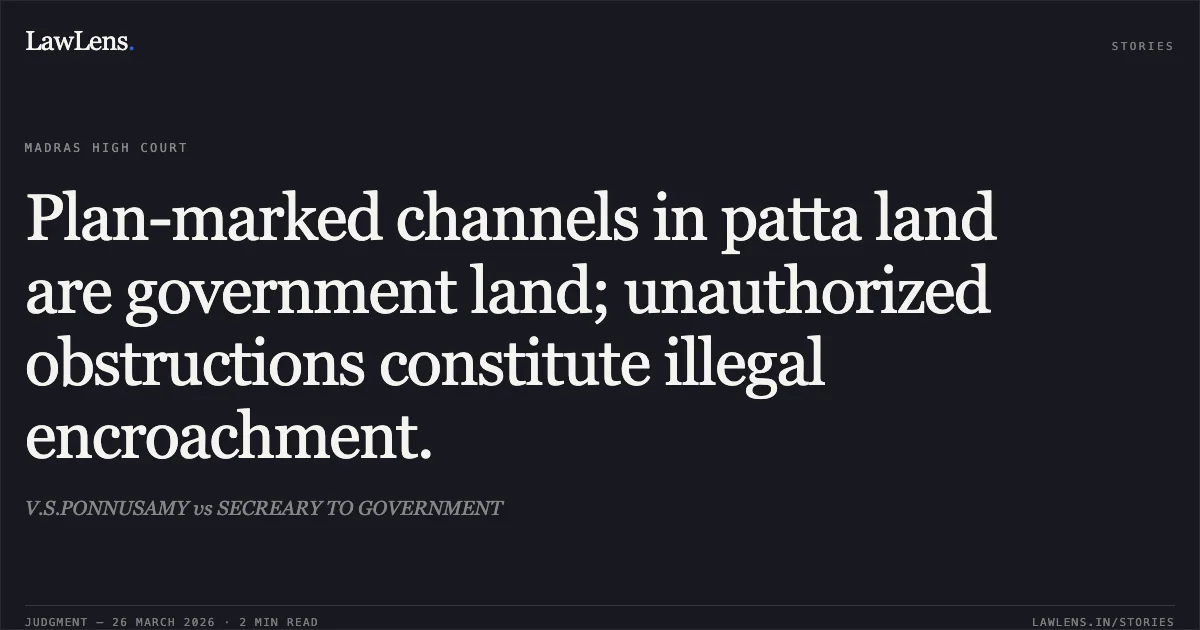
The Court held that the unauthorized construction in the plan-marked channel was an encroachment subject to removal.
Source reference: p. 6The Court granted the petitioner liberty to submit an application to the competent authorities for remedial measures—such as a kalvettu (culvert) or a small bridge—to facilitate the consolidation of his property without hindering the free flow of water, which the authorities must consider on its merits.
Source reference: p. 5, 7The official respondents were further directed to maintain consistency by removing all identified encroachments in the plan-marked channel in that locality.
Source reference: p. 6-7Original Court PDF
V.S.PONNUSAMYvsSECREARY TO GOVERNMENT
Click to open original judgment
Original judgment, available to read, download and summarize on LawLens.in