Facts
The Election Petitioner (Respondent No. 1), having lost the 2022 Tankara Assembly election, challenged the victory of the "returned candidate" (the Applicant) on grounds of "corrupt practices" and "improper acceptance of nomination" under Sections 100(1)(b) and 100(1)(d) of the Representation of the People Act, 1951 (RP Act).
Source reference: p. 2The Petitioner alleged that the Applicant suppressed material information in his Form No. 26 affidavit, including social media accounts, specific financial years for income tax returns, and details of certain assets, and left some columns blank or marked with dashes.
Source reference: p. 3-5The Applicant filed an application under Order VII Rule 11 of the CPC, contending that the petition lacked a concise statement of "material facts," failed to disclose a cause of action, and did not plead how the election result was "materially affected".
Source reference: p. 5-6, 32Issues
1. Whether the election petition discloses a triable cause of action and contains a concise statement of "material facts" as mandated by Section 83(1) of the RP Act.
Source reference: p. 20, 322. Whether the alleged discrepancies in the candidate's affidavit constitute a "defect of substantial character" under Section 36(4) or amount to "undue influence" under Section 123(2).
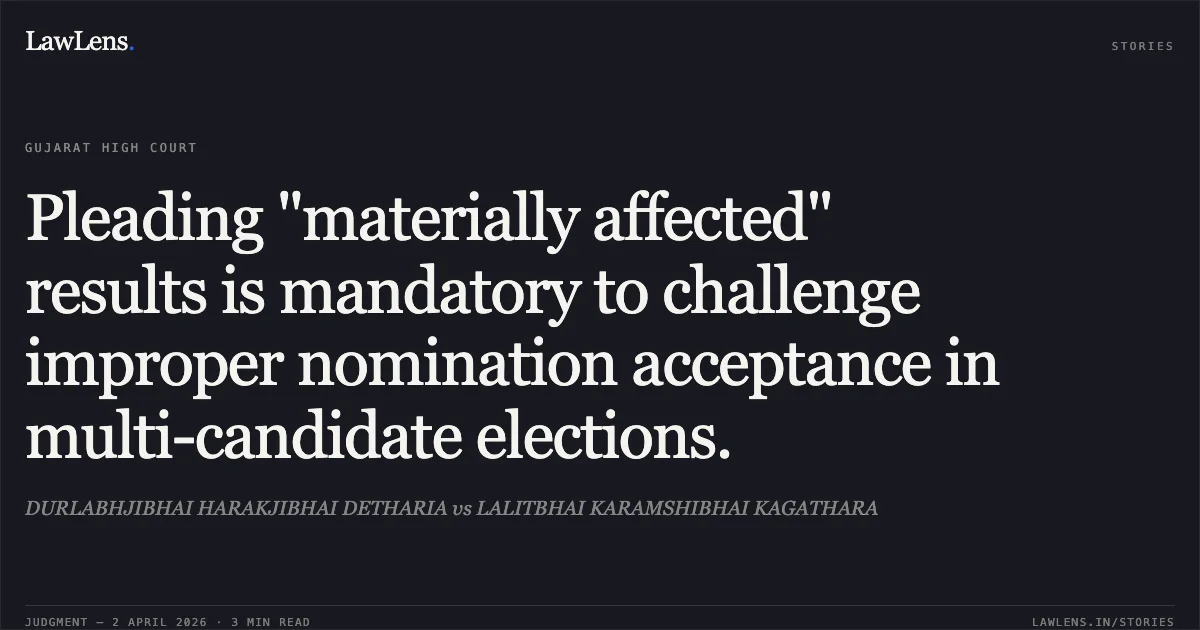
Source reference: p. 26-273. Whether, in a multi-candidate contest, the Petitioner must specifically plead how the improper acceptance of a nomination "materially affected" the election result under Section 100(1)(d).
Source reference: p. 29, 37Law Applied
The Court primarily applied Section 83(1)(a) of the RP Act, which requires an election petition to contain a concise statement of material facts, and Section 86, which authorizes dismissal for non-compliance with Section 81.
Source reference: p. 15-16It relied on Section 100(1)(d), which necessitates proving that the election result was "materially affected" by any non-compliance or improper acceptance.
Source reference: p. 16The Court invoked Order VII Rule 11 of the CPC to reject the petition for failure to disclose a cause of action.
Source reference: p. 20Precedents including Karim Uddin Barbhuiya v. Aminul Haque Laskar and Kanimozhi Karunanidhi v. A. Santhana Kumar were applied to establish that the omission of a single material fact leads to an incomplete cause of action.
Source reference: p. 17, 19Principles from Shri Karikho Kri and Ajmera Shyam v. Kova Laxmi were used to clarify that minor or technical non-disclosure of assets does not invalidate an election.
Source reference: p. 27Reasoning
The Court conducted a "meaningful reading" of the petition and found that the Applicant had substantially disclosed his criminal antecedents, assets, and qualifications.
Source reference: p. 26-27The Court determined that marking "not applicable" instead of a tick or failing to list specific sale deeds were technicalities and not "defects of substantial character" under Section 36(4).
Source reference: p. 23, 27Regarding the allegation of "undue influence" under Section 123(2), the Court found no pleading demonstrating how these minor discrepancies interfered with the voters' free exercise of electoral rights.
Source reference: p. 27, 32Crucially, the Court distinguished the Petitioner's reliance on Durai Muthuswami, noting that since five candidates contested the election (not just two), Section 100(1)(d) required specific pleadings on how the result was "materially affected".
Source reference: p. 36-37The Court held that the petition merely narrated statutory provisions without providing the "fundamental, vital, and basic" facts necessary to prove the claim.
Source reference: p. 31-32, 37Holding
The Court allowed the Election Application and rejected Election Petition No. 2 of 2023 under Order VII Rule 11(a) and (d) of the CPC.
It held that the petition failed to disclose a triable cause of action due to the absence of "material facts" and non-compliance with the mandatory pleading requirements of Section 83 of the RP Act.
Source reference: p. 37The Court concluded that the alleged defects were not of a substantial character and that the Petitioner failed to plead how the election result was materially affected in a multi-candidate field.
Source reference: p. 37-38Acts & Sections Cited
16 provisions across 2 statutes referred to in this judgment. Each provision opens on LawLens.
Code of Civil Procedure, 19083
Representation of the People Act, 1951
Original Court PDF
DURLABHJIBHAI HARAKJIBHAI DETHARIAvsLALITBHAI KARAMSHIBHAI KAGATHARA
Click to open original judgment
Original judgment, available to read, download and summarize on LawLens.in