Facts
The appellant instituted a suit seeking declarations and mandatory injunctions concerning the conduct of elections of the Council and President of the Institution of Engineers (India), alleging that the defendants were required to ensure elections in accordance with the organisation’s bye-laws, rules, regulations and Royal Charter.
Source reference: paras. 2–4He also sought ad interim and temporary injunctions and appointment of a receiver in the form of a “scrutinizer” to supervise the elections.
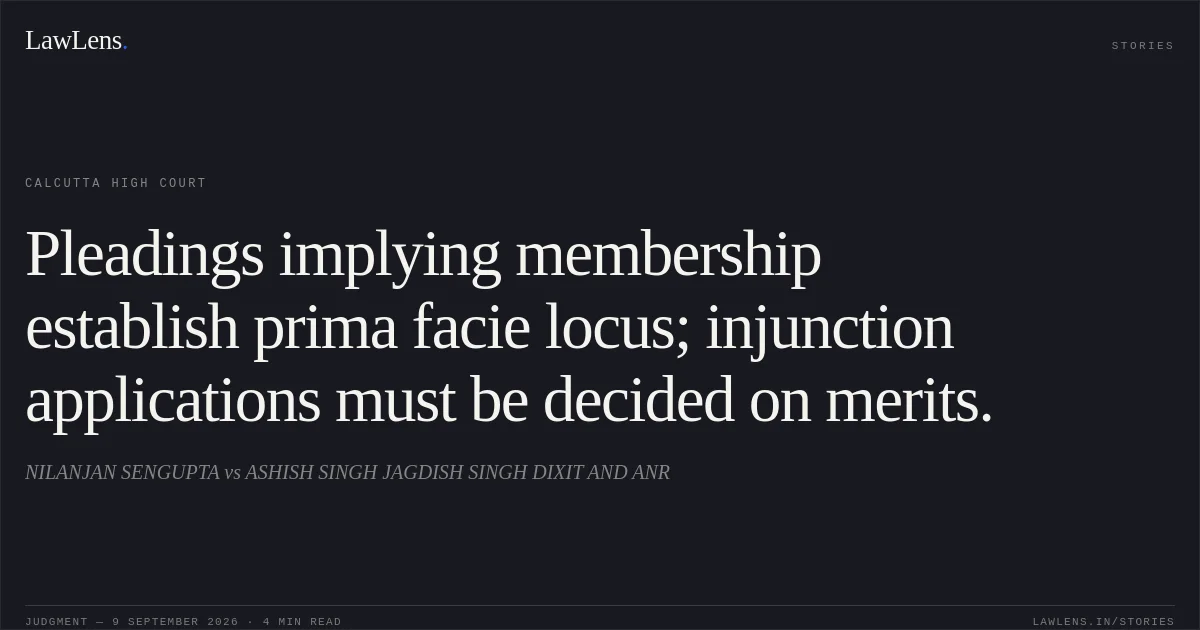
Source reference: paras. 2–4The Trial Court rejected both interlocutory applications at the ad interim stage, principally on the ground that the plaint and injunction application did not expressly state the appellant’s status as a member of the organisation.
Source reference: para. 5In appeal, the appellant relied on paragraphs 34 and 36 of the plaint and supporting documents to establish his membership and locus standi.
Source reference: paras. 6–8The respondents stated that they had no objection in principle to appointment of a scrutinizer, while a proposed intervener sought to participate on the basis of his position as Chairman of the West Bengal State Centre.
Source reference: paras. 9–11Issues
Whether the Trial Court was justified in rejecting the applications at the threshold on the ground that the plaint did not sufficiently disclose the appellant’s membership and locus standi.
Source reference: paras. 5–7, 15–17Whether the appellant was entitled to interim protection restraining the respondents from conducting elections in violation of the organisation’s bye-laws, rules, regulations and Royal Charter, pending adjudication of the injunction application.
Source reference: paras. 20, 25–26Whether the High Court ought itself to have decided the application for appointment of a scrutinizer, or whether that issue should be remanded to the Trial Court for determination on merits.
Source reference: paras. 17–19Whether the proposed intervener should be permitted to participate in the appeal or be added as a party to the suit at that stage.
Source reference: paras. 10–14, 27Law Applied
The Court applied the principles governing temporary injunctions and appointment of a receiver under Order XL Rules 1 and 2 of the Code of Civil Procedure, 1908.
Source reference: para. 18It held that appointment of a scrutinizer, being in the nature of appointment of a receiver, attracts a higher threshold and stricter factual and legal requirements than an ordinary injunction.
Source reference: para. 18The Court further applied the procedural principle that an appellate court, while examining an order rejecting interlocutory applications at the threshold, should not usurp the Trial Court’s jurisdiction by adjudicating the applications on merits for the first time.
Source reference: para. 19It also recognised that a plaintiff alleging infringement of membership rights in relation to the organisation’s elections must disclose a prima facie basis for locus standi; such disclosure may arise from the pleadings read as a whole.
Source reference: paras. 15–17Reasoning
The High Court found that paragraphs 34 and 36 of the plaint sufficiently alleged that the appellant possessed valuable rights as a member of the organisation and was entitled, along with other members, to free and fair elections.
Source reference: paras. 15–17These averments prima facie established his locus standi and required the Trial Court to consider the interlocutory applications on their merits rather than reject them solely for want of an express statement of membership.
Source reference: paras. 15–17However, because the Trial Court had not examined either application on merits, the High Court declined to decide whether a scrutinizer should be appointed.
Source reference: paras. 18–19It noted that such an appointment would operate as a receivership order and therefore required satisfaction of a higher legal threshold.
Source reference: paras. 18–19Since the prayer for interim protection merely sought compliance with the organisation’s existing rules and regulations, the Court considered limited ad interim protection appropriate pending the Trial Court’s decision.
Source reference: para. 20The proposed intervener was not permitted to intervene at that stage because he had not filed an averment on oath establishing his interest and locus standi, but he was given liberty to seek addition as a party before the Trial Court.
Source reference: paras. 12–14, 27Holding
The appeals were allowed and the Trial Court’s order dated 28 August 2026 was set aside.
The applications for temporary injunction and appointment of a scrutinizer under Order XL Rules 1 and 2 CPC were remanded to the Trial Court for adjudication on merits after allowing the defendants to file written objections.
Source reference: para. 21The objections were directed to be filed by the following day, and the Trial Court was requested to dispose of both applications as expeditiously as possible, preferably within one week thereafter.
Source reference: paras. 22–23Until disposal of the injunction application, the respondents were restrained from conducting the organisation’s election in violation of its bye-laws, rules and regulations; however, they remained free to conduct the election in accordance with those governing provisions.
Source reference: paras. 25–26The proposed intervener was granted liberty to apply for addition as a party before the Trial Court, without any direction that such application be allowed.
Source reference: paras. 13–14, 27The Court expressly clarified that it had not adjudicated the merits of the parties’ claims or the suit.
Source reference: para. 28No order as to costs was made.
Source reference: para. 29Original Court PDF
NILANJAN SENGUPTAvsASHISH SINGH JAGDISH SINGH DIXIT AND ANR
Click to open original judgment
Original judgment, available to read, download and summarize on LawLens.in