Facts
On 11 November 2013, Ashwani Kumar was travelling in Tata Sumo bearing registration No. HP-01K-0404, driven by Raj Kumar. Near Kowaji Mor, Shour, the driver lost control, causing the vehicle to fall into a gorge; Ashwani Kumar died at the spot.
Source reference: para. 2His legal representatives filed a claim petition under Section 166 of the Motor Vehicles Act, 1988, alleging rash and negligent driving and claiming ₹20,00,000 as compensation.
Source reference: para. 2The owner disputed the vehicle’s involvement but admitted its ownership and stated that it was insured with the appellant.
Source reference: para. 3The Insurance Company pleaded, inter alia, that the vehicle was being operated without a valid permit and fitness certificate, in breach of the insurance policy.
Source reference: para. 4The Motor Accidents Claims Tribunal awarded ₹9,86,160 with interest at 9% per annum and directed the Insurance Company to indemnify the award.
Source reference: para. 7The Insurance Company appealed under Section 173 of the Act, challenging the fastening of liability upon it.
Source reference: para. 8Issues
Whether the owner of a transport vehicle could lawfully ply it in a public place without a valid permit under the Motor Vehicles Act, 1988?
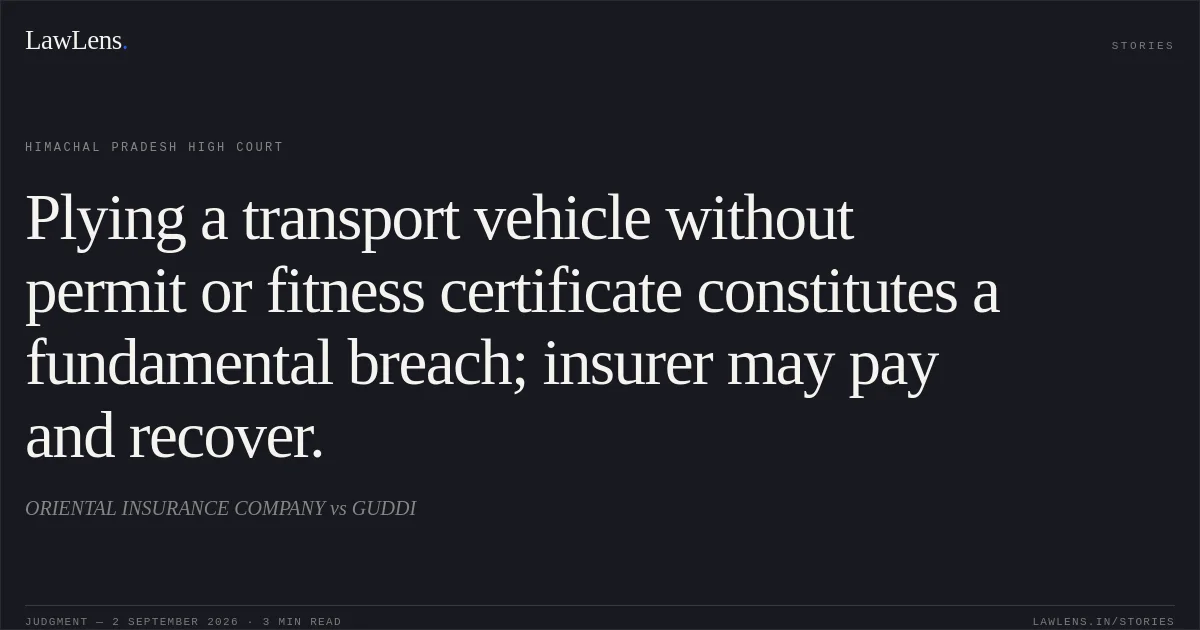
Source reference: paras. 12–17Whether the absence of a valid fitness certificate rendered the transport vehicle’s use unlawful and constituted a breach of the insurance-policy conditions?
Source reference: paras. 18–22Whether, despite the policy breach, the Insurance Company should first satisfy the compensation award and thereafter recover the amount from the vehicle owner?
Source reference: paras. 15–16, 22–23Law Applied
Section 66 of the Motor Vehicles Act requires a transport vehicle to be used in a public place only in accordance with a valid permit, subject to statutory exceptions.
Source reference: paras. 13–14Under National Insurance Co. Ltd. v. Challa Bharathamma, (2004) 8 SCC 517, plying a vehicle without a permit is an infraction constituting a defence available to the insurer under Section 149(2), although the insurer may be directed to pay the claimants first and recover the amount from the insured.
Source reference: para. 15Amrit Paul Singh v. TATA AIG General Insurance Co. Ltd., (2018) 7 SCC 558, holds that use of a transport vehicle in a public place without a permit is a fundamental statutory infraction and supports a pay-and-recover direction.
Source reference: para. 16Section 39 prohibits use of an unregistered vehicle in a public place, while Section 56 provides that a transport vehicle is not deemed to be validly registered for Section 39 purposes unless it possesses a valid fitness certificate.
Source reference: para. 19Section 84(a) further makes possession of a valid fitness certificate a general condition of every transport-vehicle permit.
Source reference: para. 21Relying also on Pareed Pillai v. Oriental Insurance Co. Ltd., AIR 2019 Kerala 9, the Court held that absence of a permit or fitness certificate is a fundamental, rather than merely technical, breach.
Source reference: no citationThe pay-and-recover principle was additionally supported by Shamanna v. Divisional Manager, Oriental Insurance Co. Ltd., (2018) 9 SCC 650.
Source reference: para. 22Reasoning
The vehicle was admittedly a transport vehicle.
Source reference: para. 17The Insurance Company examined an RTO data operator, who established that the vehicle’s fitness certificate had expired on 6 July 2005 and its contract-carriage permit had expired on 7 August 2008, whereas the accident occurred on 11 November 2013.
Source reference: para. 17The owner neither pleaded nor proved that any statutory exception under Section 66 applied.
Source reference: para. 17Consequently, the vehicle was being operated without a valid permit, and its use also violated the statutory requirement of a valid fitness certificate.
Source reference: paras. 17, 20–22Applying Sections 39, 56, 66 and 84, together with Challa Bharathamma, Amrit Paul Singh and Pareed Pillai, the Court concluded that these were fundamental breaches of the policy and statutory requirements, making the owner primarily liable.
Source reference: paras. 17, 20–22Nevertheless, considering the beneficial object of the Motor Vehicles Act and the Supreme Court’s pay-and-recover doctrine, the Insurance Company was required to satisfy the award in the first instance, with liberty to recover the amount from the owner.
Source reference: para. 22Holding
The appeal was partly allowed.
The Court modified the award to hold that the owner of vehicle No. HP-01K-0404 was ultimately liable to pay the compensation because the vehicle was being plied without a valid permit and fitness certificate.
Source reference: para. 23However, the appellant Insurance Company was directed to pay the awarded compensation of ₹9,86,160, together with the applicable interest, to the claimants first and was granted liberty to recover the amount from the owner in accordance with law.
Source reference: para. 23The remaining terms of the Tribunal’s award, including the interest component, were maintained.
Source reference: paras. 23–24Acts & Sections Cited
8 provisions across 1 statute referred to in this judgment. Each provision opens on LawLens.
Motor Vehicles Act, 19888
Original Court PDF
ORIENTAL INSURANCE COMPANYvsGUDDI
Click to open original judgment
Original judgment, available to read, download and summarize on LawLens.in