Facts
The Enforcement Directorate filed a complaint under Section 44(1)(b) of the Prevention of Money Laundering Act, 2002 (PMLA) on 27 March 2025.
Source reference: para. 2–5The Special Judge took cognizance on 30 April 2025 and arrayed the petitioner as an accused without first giving him an opportunity to be heard.
Source reference: para. 2–5The petitioner’s discharge petition was dismissed on 12 June 2026, prompting this revision.
Source reference: para. 2–5The petitioner relied on the Supreme Court’s decision in Kushal Kumar Agarwal v. Directorate of Enforcement; the Enforcement Directorate argued that, because the ECIR pre-dated the Bharatiya Nagarik Suraksha Sanhita, 2023 (BNSS), Section 531 preserved the application of the Code of Criminal Procedure, 1973 (CrPC).
Source reference: para. 2–5Issues
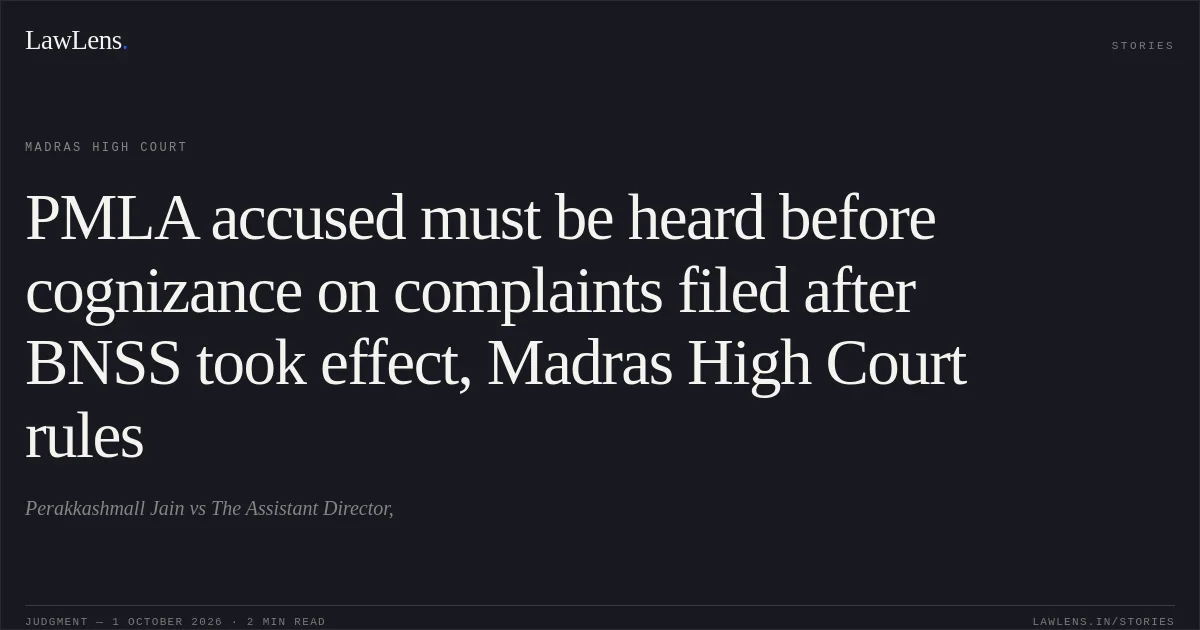
1. Whether Section 223(1) of the BNSS required the Special Judge to give the petitioner an opportunity to be heard before taking cognizance of the PMLA complaint filed after 1 July 2024.
Source reference: para. 3–72. Whether the fact that the ECIR was registered before the BNSS came into force meant that the CrPC, rather than the BNSS, governed the cognizance proceedings.
Source reference: para. 5, 7–9Law Applied
Section 223(1) of the BNSS provides that a Magistrate may not take cognizance of an offence on complaint without giving the accused an opportunity to be heard; the Supreme Court held that this proviso applies to a PMLA complaint filed after 1 July 2024 because such complaints are governed by the complaint procedure in Sections 200–204 of the CrPC, corresponding to Chapter XVI of the BNSS (Kushal Kumar Agarwal v. Directorate of Enforcement, 2025 SCC OnLine SC 1221).
Source reference: para. 6–7The Court also relied on Yash Tuteja v. Union of India, 2024 SCC OnLine SC 533, and Tarsem Lal v. Enforcement Directorate, (2024) 7 SCC 61, on the application of the complaint procedure to PMLA complaints.
Source reference: para. 7Reasoning
The Court treated the filing date of the complaint—not the date of the ECIR—as decisive for applying Section 223 of the BNSS.
Source reference: para. 5–9Because the complaint was filed on 27 March 2025, after the BNSS came into force, the Special Judge was required to give the petitioner an opportunity to be heard before taking cognizance.
Source reference: para. 5–9The Court found that cognizance had been taken without that opportunity and was therefore impermissible under the rule stated in Kushal Kumar Agarwal.
Source reference: para. 5–9It rejected the respondent’s reliance on G. Ganesan and Parvinder Singh, noting that the former was under challenge before the Supreme Court and the latter had been set aside.
Source reference: para. 5–9Holding
The High Court held that the order taking cognizance without hearing the petitioner was illegal.
It set aside the 30 April 2025 cognizance order and the 12 June 2026 order dismissing the discharge petition, restored the complaint to its original file number, and directed the Special Judge to proceed in accordance with law.
Source reference: para. 9–11The revision was partly allowed.
Source reference: para. 9–11Acts & Sections Cited
14 provisions across 3 statutes referred to in this judgment. Each provision opens on LawLens.
Bharatiya Nagarik Suraksha Sanhita, 20238
Prevention of Money-Laundering Act, 20021
Code of Criminal Procedure, 19735
Original Court PDF
Perakkashmall JainvsThe Assistant Director,
Click to open original judgment
Original judgment, available to read, download and summarize on LawLens.in