Facts
The petitioner, A14 in the pending PMLA prosecution in C.C. No. 12 of 2021, sought to prevent the Special Court from pronouncing judgment until the predicate-offence case, C.C. No. 89 of 2023, was decided.
Source reference: paras. 1–2, pp. 1–2The PMLA complaint arose from a CBI case concerning alleged bank-loan fraud; the predicate-offence trial was pending before the Chief Judicial Magistrate, Tiruchirappalli.
Source reference: paras. 1–2, pp. 1–2The High Court had previously directed the PMLA Special Court to proceed and dispose of the case within six months, later extending that period.
Source reference: paras. 3–4, p. 3The petitioner relied on authorities linking the existence of proceeds of crime to a scheduled offence and argued that the PMLA judgment should await the predicate-offence decision.
Source reference: paras. 5–8, pp. 4–6The Enforcement Directorate accepted that the PMLA trial could proceed up to judgment, but raised the concern that earlier directions required the trial to be concluded within the extended period.
Source reference: para. 9, p. 7Issues
Whether the PMLA trial could continue while the predicate-offence trial remained pending, or whether it should be stayed.
Source reference: paras. 9–12, pp. 7–8Whether the PMLA Special Court should defer pronouncing judgment until judgment was pronounced in the predicate-offence case.
Source reference: paras. 10–12, pp. 7–8Law Applied
Section 3 of the Prevention of Money-Laundering Act, 2002, concerns money laundering involving “proceeds of crime,” which are linked to criminal activity relating to a scheduled offence; the existence of a scheduled offence is therefore material to establishing the PMLA charge.
Source reference: para. 5, p. 4Relying on V. Senthil Balaji v. Deputy Director, Directorate of Enforcement and Vijay Madanlal Choudhary, the Court recognised the connection between the scheduled offence and proceeds of crime.
Source reference: paras. 5–6, pp. 4–5It also applied M/s. Bharathi Cements Corporation v. Directorate of Enforcement, as endorsed in the Court’s earlier order, for the proposition that the PMLA trial may proceed independently, but the Special Court may pause before judgment to await the outcome of the scheduled-offence trial.
Source reference: paras. 6–7, pp. 5–6; para. 11, p. 8The Court’s earlier directions to proceed with the PMLA trial did not require judgment to be pronounced before the predicate-offence case was decided.
Source reference: paras. 9–12, pp. 7–8Reasoning
The Court found that C.C. No. 12 of 2021 was based on the scheduled-offence prosecution in C.C. No. 89 of 2023, and that the latter’s outcome would directly affect the findings in the PMLA case.
Source reference: para. 10, p. 7Because the petitioner had not been a party to the earlier revisions directing expedition of the PMLA trial, he had not had an opportunity to raise this objection there.
Source reference: para. 10, p. 7Applying Bharathi Cements, the Court distinguished continuing the trial from pronouncing judgment: the former could proceed, while deferring judgment avoided the risk of inconsistent outcomes if the predicate-offence case later ended in acquittal.
Source reference: paras. 10–11, pp. 7–8Holding
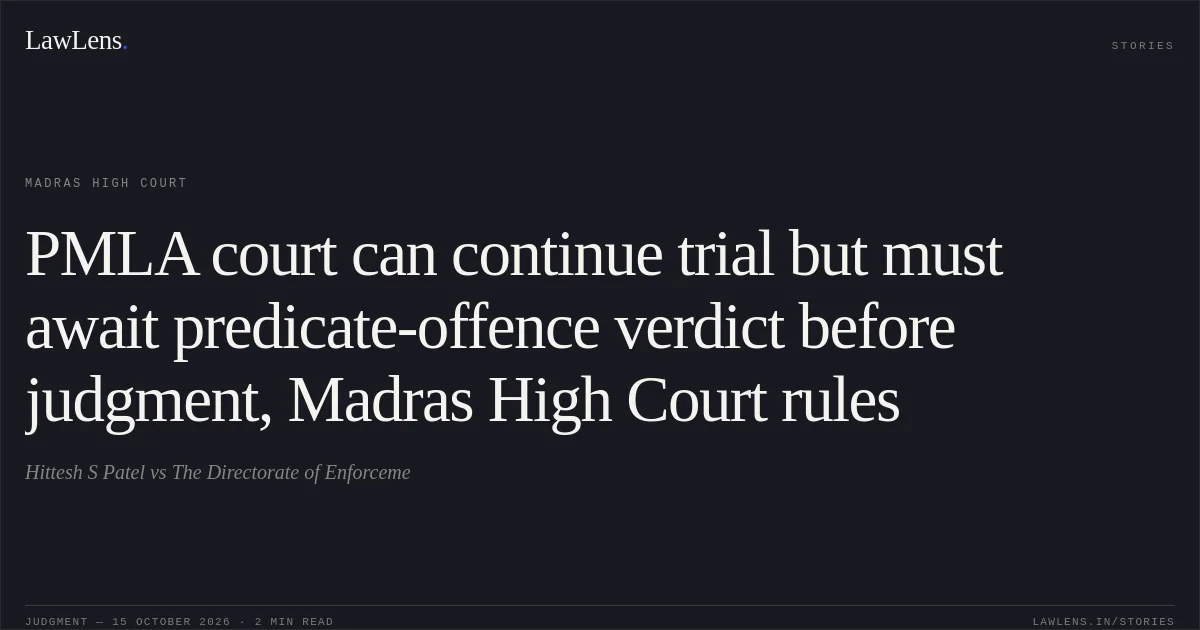
The Court allowed the petition and directed the PMLA Special Court to continue the trial in C.C. No. 12 of 2021, but not to pronounce judgment until judgment was pronounced in C.C. No. 89 of 2023 before the Chief Judicial Magistrate, Tiruchirappalli.
Acts & Sections Cited
6 provisions across 3 statutes referred to in this judgment. Each provision opens on LawLens.
Bharatiya Nagarik Suraksha Sanhita, 20231
Prevention of Money-Laundering Act, 20021
Indian Penal Code, 18604
Original Court PDF
Hittesh S PatelvsThe Directorate of Enforceme
Click to open original judgment
Original judgment, available to read, download and summarize on LawLens.in