Facts
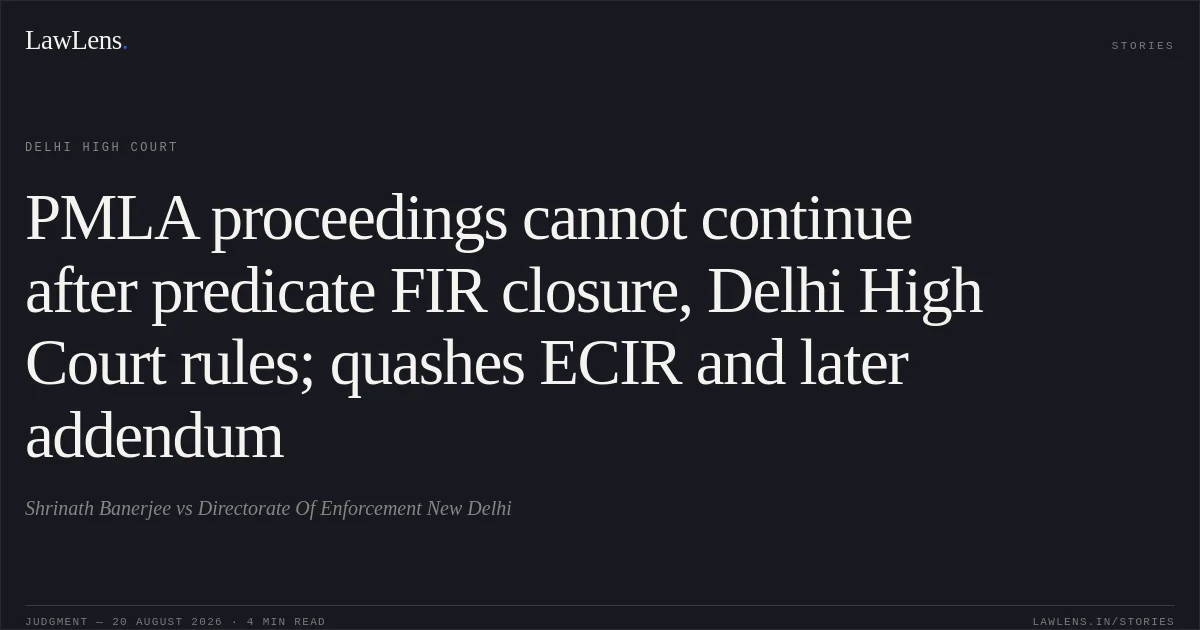
The petitioners, comprising members of the Aristo Group of Companies and relatives, employees and associates of Late Dr. Mahendra Prasad, challenged ECIR No. ECIR/DLZO-II/72/2021 and consequential proceedings under the Prevention of Money Laundering Act, 2002 (“PMLA”), including freezing, search, seizure and summons proceedings.
Source reference: pp. 5–10, paras A.1–A.17The ED registered the ECIR on 28 December 2021 exclusively on the basis of the second FIR, which was treated as the scheduled offence.
Source reference: p. 7, paras A.5–A.6The Trial Court accepted the Cancellation Report and dismissed the Protest Petition on 12 June 2025.
Source reference: pp. 7–8, paras A.7–A.10On 20 August 2025, more than two months after acceptance of the Cancellation Report, the ED issued an addendum incorporating the earlier first FIR into the ECIR as an additional scheduled offence.
Source reference: p. 8, para A.11Issues
Whether the writ petitions challenging the ECIR and consequential PMLA measures were maintainable as Civil Writ Petitions under Article 226 of the Constitution?
Source reference: p. 11, para B.1(i); pp. 49–60, paras J.1–J.16Whether the petitioners should be relegated to the statutory remedies before the Adjudicating Authority under the PMLA?
Source reference: p. 11, para B.1(ii); pp. 61–65, paras K.1–K.8Whether proceedings under the ECIR could continue after the Cancellation Report in the second FIR had been accepted and the Protest Petition dismissed, despite a pending challenge to that order?
Source reference: p. 11, para B.1(iii); pp. 65–88, paras L.1–L.45Whether the addendum dated 20 August 2025 incorporating the first FIR as an additional scheduled offence was legally sustainable, particularly when the first FIR pre-dated the ECIR and was allegedly unrelated to the second FIR?
Source reference: p. 11, para B.1(iv); pp. 88–114, paras M.1–M.45Law Applied
The Court applied Articles 226 and 300A, and Article 19(1)(g) where the PMLA measures affected property and business rights, together with Sections 2(1)(u), 3, 5, 8, 17, 17(1A), 26, 42, 44, 50, 65 and 66 of the PMLA.
Source reference: pp. 49–50, para J.1Under Sections 2(1)(u) and 3, “proceeds of crime” must be property derived or obtained from criminal activity relating to a scheduled offence; the existence of a scheduled offence is therefore a condition precedent for PMLA action.
Source reference: pp. 75–79, paras L.20–L.22Relying principally on Vijay Madanlal Choudhary v. Union of India, (2023) 12 SCC 1, the Court held that the ECIR is an internal administrative document, not a statutory equivalent of an FIR, and that PMLA proceedings cannot survive in the absence of a subsisting scheduled offence.
Source reference: pp. 54–60, paras J.5–J.15The Court also relied on Pavana R. Dibbur v. Directorate of Enforcement, 2023 SCC OnLine SC 1586, Deputy Director, ED v. EMTA Coal Ltd., ED v. Obulapuram Mining Co., Naresh Kumar Kejriwal v. Directorate of Enforcement, and Future Gaming of Hotels Services Pvt. Ltd. v. ED, for the proposition that acceptance of a closure report, acquittal, discharge or quashing of the predicate case ends the foundation for PMLA proceedings, subject to revival if the predicate case is subsequently restored.
Source reference: pp. 66–72, paras L.5–L.13An addendum to an ECIR is legally permissible in principle, particularly for connected or subsequent scheduled offences forming part of the same transaction; however, it remains subject to judicial review on grounds of illegality, irrationality, procedural impropriety, mala fides and colourable exercise of power.
Source reference: pp. 88–100, paras M.2–M.15Reasoning
The Court held that the challenge concerned the ED’s administrative and coercive measures under Sections 17 and 17(1A), and no prosecution complaint had yet been filed under Section 44; consequently, the petitions were maintainable as Civil Writ Petitions.
Source reference: pp. 57–60, paras J.10–J.16The alternative remedy before the Adjudicating Authority was not considered efficacious because the petitioners challenged the jurisdictional foundation and continued subsistence of the ECIR itself, matters falling outside the Authority’s limited remit under Section 8.
Source reference: pp. 61–65, paras K.1–K.8Once the competent criminal court accepted the Cancellation Report and dismissed the Protest Petition, the scheduled offence ceased to subsist and, consequently, no “proceeds of crime” could continue to furnish the jurisdictional basis for PMLA proceedings.
Source reference: pp. 73–82, paras L.16–L.27The pendency of a challenge to that order did not, by itself, revive or preserve the predicate offence; revival could occur only if a superior court subsequently set aside the closure order.
Source reference: pp. 74–75, paras L.17–L.18; p. 84, paras L.29–L.31The first FIR concerned confinement, jewellery and passport-related allegations, whereas the second FIR concerned alleged share transfers, forged signatures and bank transactions; the accused, property and transactions were materially different, and the common familial background did not establish a direct nexus or the same transaction.
Source reference: pp. 105–110, paras M.30–M.38The timing and manner of the addendum indicated an attempt to preserve an ECIR whose original substratum had disappeared, rendering the addendum illegal, procedurally improper and a colourable exercise of power.
Source reference: pp. 112–114, paras M.41–M.44Holding
The Court held that the petitioners could invoke Civil Writ jurisdiction under Article 226 and were not required to pursue the alternative remedy before the Adjudicating Authority.
The ED was restrained from initiating or continuing proceedings under ECIR No. ECIR/DLZO-II/72/2021 in relation to FIR No. 27/2021 unless the predicate proceedings were revived by a competent superior court; all consequential proceedings and coercive actions were quashed, subject to such revival.
Source reference: p. 114, para N.1(iii)The addendum dated 20 August 2025 incorporating FIR No. 279/2019 was held legally unsustainable, and all proceedings and coercive measures emanating from it were quashed.
Source reference: p. 115, para N.1(iv)The Court directed restoration of status quo ante in favour of the respective petitioners and disposed of the writ petitions; pending applications were rendered infructuous.
Source reference: p. 115, paras N.2–N.3Acts & Sections Cited
69 provisions across 6 statutes referred to in this judgment. Each provision opens on LawLens.
Prevention of Money-Laundering Act, 2002
Indian Penal Code, 1860
Passports Act, 19671
Code of Criminal Procedure, 1973
Bharatiya Nagarik Suraksha Sanhita, 20232
Information Technology Act, 20001
Original Court PDF
Shrinath BanerjeevsDirectorate Of Enforcement New Delhi
Click to open original judgment
Original judgment, available to read, download and summarize on LawLens.in