01Facts
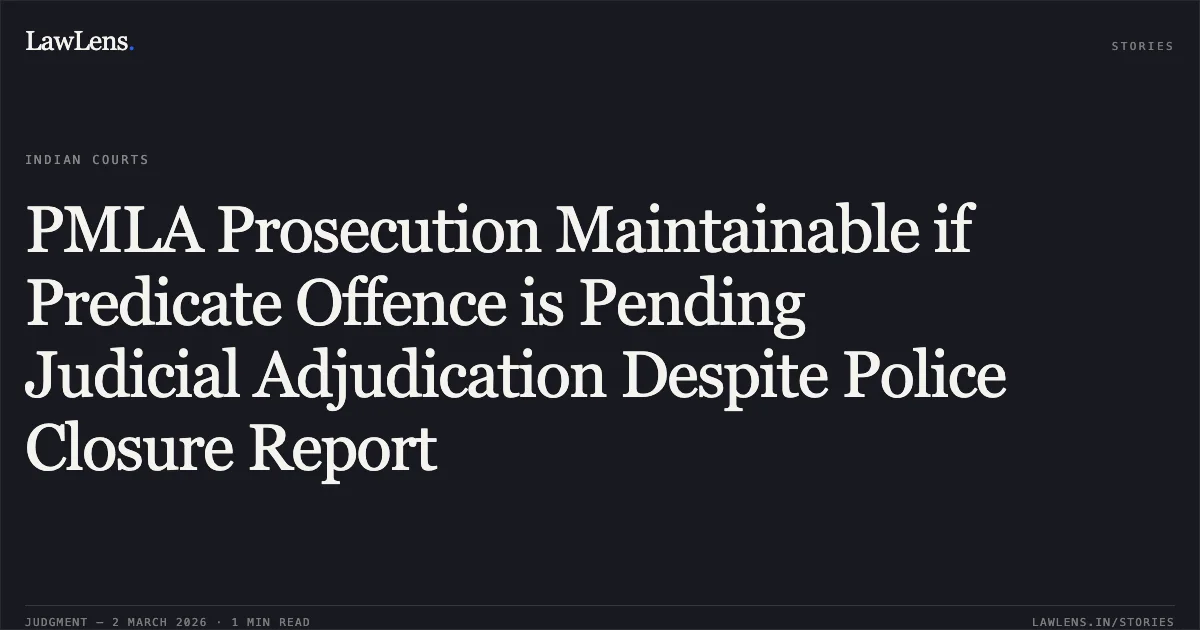
The Enforcement Directorate (ED) registered ECIR/RNZO/09/2022 against Jogendra Tiwari and several associated entities based on four predicate FIRs involving land fraud ("Roy Bangla" land), illegal sand mining, and liquor smuggling.
pp. 5-8The ED alleged that Tiwari acted as the beneficial owner of 11 entities, using them to layer and integrate proceeds of crime (POC) totaling ₹13,29,92,620/- earned from these activities into the formal economy, specifically to pay for wholesale liquor licenses.
pp. 9-10The petitioners filed discharge applications, arguing that most predicate FIRs were either quashed, culminated in final reports, or resulted in acquittals.
pp. 11-13The Special Judge, PML Act, Ranchi, rejected these applications on 21.08.2025.
p. 11The petitioners challenged this rejection via criminal revision under Sections 438 & 442 of the BNSS, 2023.
p. 402Issues
i.1. Whether the order rejecting the discharge application suffers from legal error given the alleged absence of subsisting scheduled offences.
¶ 36(i) / p. 23ii.2. Whether the evidence collected during investigation establishes a prima facie case of money laundering against the petitioners.
¶ 36(ii) / p. 2403Law Applied
The court primarily applied Section 3 of the PMLA, 2002, which defines money laundering as a standalone offence involving the concealment, possession, or use of proceeds of crime.
p. 32It relied on *Vijay Madanlal Choudhary v. Union of India*, which established that while PMLA proceedings require a scheduled offence, the process of attachment and prosecution is independent until the final acquittal in the predicate case.
pp. 33-35The court also applied Section 24 of the PMLA, which mandates a reverse burden of proof on the accused once foundational facts are established.
p. 69Regarding discharge, the court followed *Sajjan Kumar v. CBI* and *M.E. Shivalingamurthy v. CBI*, holding that at the stage of framing charges, the court must only determine if "grave suspicion" exists and cannot conduct a mini-trial or appreciate evidence in detail.
pp. 45-48Provisions in the judgment · 32 · Linked ones open on LawLens
Bharatiya Nagarik Suraksha Sanhita, 2023 Section 193Section 232Section 250Section 262Section 268Section 438Section 442
Prevention of Money-Laundering Act, 2002 Section 2Section 3Section 4Section 24Section 45Section 70
Indian Penal Code, 1860 12 provisions
Section 34Section 166Section 272Section 273Section 379Section 419Section 420Section 427Section 463Section 467Section 468Section 471Code of Criminal Procedure, 1973 Section 173Section 227Section 228Section 239Section 245Section 313
Prevention of Corruption Act, 1988 Section 13
04Reasoning
The Court observed that while the petitioners claimed the predicate offences were extinguished, four foundational FIRs (Land, Sand, and Liquor related) remain legally active or pending judicial consideration.
¶ 101-103Specifically, in the "Roy Bangla" land cases, although police filed final reports, protest petitions remain pending, which constitutes a continuation of the proceedings.
¶ 107-108The Court found that the ED's quantification of POC (₹5.66 Crores) was derived from these active FIRs and was not dependent on the quashed liquor FIRs.
¶ 100-102The investigation revealed a synchronized 1145.87% increase in cash deposits in the petitioners' accounts, suggesting a criminal syndicate controlled by Jogendra Tiwari as the beneficial owner.
¶ 29, 91The Court held that since the jurisdictional fact of a scheduled offence subsists and foundational money trails were documented, the reverse burden under Section 24 was triggered.
¶ 99, 10405Holding
The High Court dismissed the revision petitions, holding that the Special Judge committed no error in rejecting the discharge applications.
¶ 123-124The Court affirmed that as long as predicate offences are pending—including cases where protest petitions are under adjudication—a PMLA prosecution cannot be quashed.
¶ 108-112The Court concluded that "grave suspicion" and a prima facie case were established by the ED's prosecution complaint, and the petitioners must face trial to rebut the presumptions against them.
¶ 114, 122All pending interlocutory applications were disposed of.
¶ 125Original Court PDF
M/s Gupta Traders & Ors. v. State through Enforcement Directorate [2026:JHHC:5999 (Cr. Revision No. 1075 of 2025 and batch)]
Click to open original judgment
Original judgment, available to read, download and summarize on LawLens.in