Facts
The Petitioner, an Executive Director of Punjab National Bank (“PNB”), was appointed by the Central Government under Section 9(3)(a) of the Banking Companies (Acquisition and Transfer of Undertakings) Act, 1970, read with paragraphs 3(1) and 8(1) of the Nationalised Banks (Management and Miscellaneous Provisions) Scheme, 1970, for a five-year tenure ending on 21 January 2019.
Source reference: p.2, para.5His assigned portfolios included Integrated Risk Management, Fraud Risk Management, Inspection and Audit, Management Audit and Review, and, initially, the International Banking Division; the Information Technology Division, which was responsible for SWIFT–CBS integration, was not under his charge.
Source reference: p.3, paras.7–8Following the discovery of the Brady House Branch fraud in 2018, the Central Government issued a show-cause notice alleging that the Bank’s top management had failed to exercise proper control over SWIFT-related systems and that the Petitioner was responsible for supervisory lapses during the period when IBD and Mumbai Zone were allocated to him.
Source reference: p.4, para.11The Petitioner denied responsibility and relied on the fact that SWIFT–CBS integration had been assigned to ITD.
Source reference: p.4, para.12The PNB Board considered the matter and found no substantial material suggesting criminality or criminal intent. It treated the deficiencies as systemic, stated that responsibility for SWIFT–CBS integration lay with ITD, and observed that non-compliance with RBI instructions could not be fully established against the Petitioner. Nevertheless, it opined that he could have exercised greater caution and introduced stronger supervisory controls.
Source reference: p.5, para.14Without furnishing the Board’s comments to the Petitioner or giving him an opportunity to respond, the Central Government removed him under paragraph 8(4) of the 1970 Scheme on 18 January 2019, three days before expiry of his tenure.
Source reference: p.6, para.16The removal order attributed to him a failure, as a member of the Bank’s top management, to exercise proper control, allegedly enabling the fraud to remain undetected for several years.
Source reference: p.6, para.16The removal subsequently affected his pension, gratuity, leave encashment and post-retirement medical benefits.
Source reference: pp.1–2, paras.1–3; pp.20–21, paras.60–61Issues
Whether the Petitioner’s contractual and tenure-based appointment excluded judicial review under Article 226 of the Constitution in respect of removal under paragraph 8(4) of the 1970 Scheme?
Source reference: pp.9–12, paras.24–32Whether paragraph 8(4) required the Central Government to follow any inflexible sequence between consultation with the Board and the opportunity to show cause?
Source reference: pp.12–13, paras.33–38Whether the Petitioner was afforded a reasonable opportunity to show cause when the PNB Board introduced an adverse assessment based on his supervisory responsibilities over Audit, Risk Management and Treasury, which had not been specifically put to him?
Source reference: pp.16–18, paras.46–51Whether the Central Government’s satisfaction that removal was expedient in PNB’s interests was based on relevant and coherent material having a rational nexus with the statutory power under paragraph 8(4)?
Source reference: pp.18–19, paras.52–55Whether removal three days before expiry of the tenure was legally sustainable when the Petitioner had already been divested of his functional responsibilities?
Source reference: pp.19–20, paras.56–61Law Applied
Paragraph 8(4) of the Nationalised Banks (Management and Miscellaneous Provisions) Scheme, 1970 empowers the Central Government to remove a whole-time Director if satisfied that removal is expedient in the interests of the nationalised bank, subject to consultation with the Board and a reasonable opportunity to show cause.
Source reference: p.9, paras.24–27The power is distinct from contractual termination under paragraph 8(1A), and its exercise must comply substantively with the statutory safeguards and rest on relevant material.
Source reference: pp.9–10, paras.26–28Judicial review under Article 226 remains available where a public authority exercises statutory power unlawfully, irrationally, unfairly or without relevant material, notwithstanding the contractual character of the appointment, as recognised in GRIDCO Ltd. v. Sadananda Doloi and M. Gopalakrishnaiah v. Union of India.
Source reference: pp.10–12, paras.29–32Consultation does not mean concurrence, but the Board’s views must be genuinely ascertained and examined: Sushil Muhnot v. Union of India and Indian Administrative Service (S.C.S.) Association v. Union of India.
Source reference: pp.12–14, paras.33–38A reasonable opportunity requires that the affected person be informed of the precise case and material imputations relied upon, consistent with Gorkha Security Services v. Govt. of NCT of Delhi.
Source reference: pp.16–17, paras.46–50The existence of relevant circumstances supporting statutory satisfaction is reviewable, although the Court cannot substitute its assessment for that of the decision-maker: Barium Chemicals Ltd. v. Company Law Board.
Source reference: p.18, para.52The flexibility of natural justice cannot eliminate an express statutory opportunity to show cause: Union of India v. Tulsiram Patel.
Source reference: p.17, para.51The Court may also examine whether a formally contractual termination is in substance an adverse or stigmatic removal: Union of India v. Nina Lath Gupta.
Source reference: pp.21–22, paras.62–65Reasoning
The Court held that the Petitioner’s tenure appointment did not immunise the Government’s exercise of statutory removal power from review under Article 226.
Source reference: pp.9–12, paras.29–32Paragraph 8(4) did not mandate that consultation must invariably precede the show-cause notice; therefore, the sequence adopted by the Government was not, by itself, invalid.
Source reference: pp.12–14, paras.33–38However, the opportunity to show cause was inadequate in substance. The original notice principally relied on the Petitioner’s charge of IBD and Mumbai Zone, whereas the Board’s adverse assessment shifted attention to his supervisory responsibilities over Audit, Risk Management, Treasury and related functions. That enlarged basis of responsibility had not been specifically communicated to him, yet it was relied upon in the removal decision.
Source reference: pp.16–18, paras.46–51Further, the Board’s assessment was materially qualified: it treated the deficiencies as systemic, placed SWIFT–CBS integration with ITD, could not fully establish RBI non-compliance against the Petitioner, and identified no causal link between his conduct and the continuation of the fraud.
Source reference: pp.14–16, paras.40–45The Government could adopt a stricter view, but the record did not show that the conflicting material concerning the Petitioner’s individual responsibility had been reconciled or that he had been given a fair opportunity to answer the enlarged case.
Source reference: pp.18–19, paras.52–55Finally, because he had already been stripped of functional responsibilities for approximately eight months and only three days remained in his tenure, the record failed to disclose why immediate removal, rather than ordinary expiry of tenure, was expedient in PNB’s interests.
Source reference: pp.19–20, paras.56–61Holding
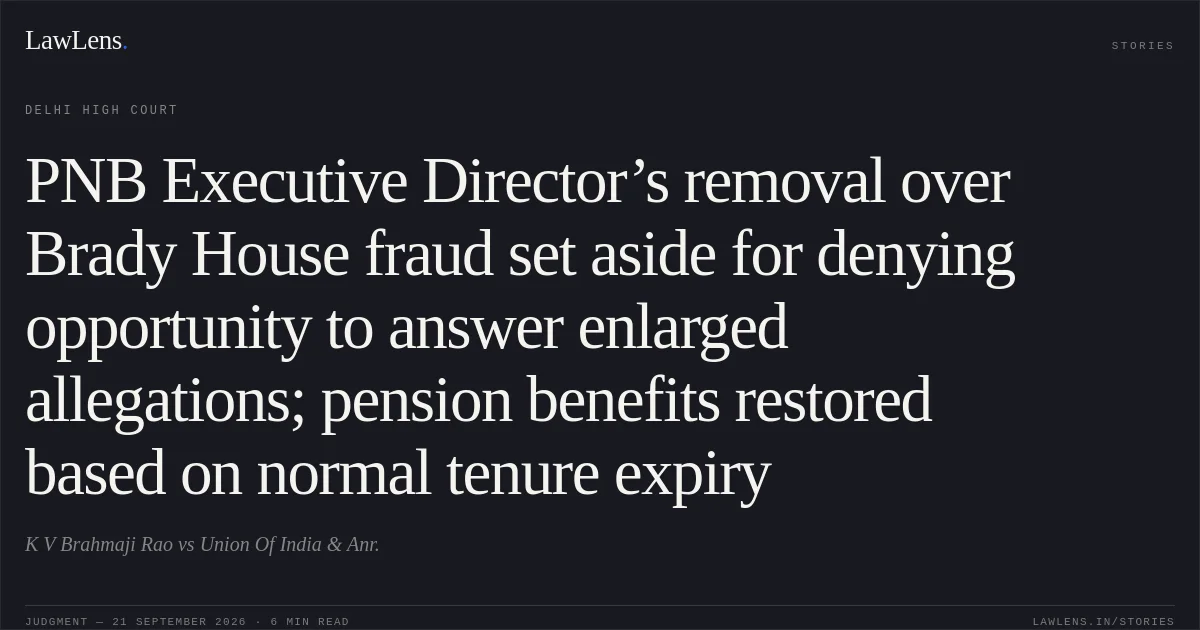
The writ petition was allowed. The Court set aside the notification dated 18 January 2019, holding that the removal was vitiated because the Petitioner was not given a reasonable opportunity to answer the enlarged case relied upon against him, the Board’s qualified assessment did not coherently support the more serious attribution made by the Government, and the record did not establish the necessity of removal immediately before expiry of tenure.
As reinstatement or remand would serve no useful purpose after expiry of the tenure, the Petitioner was directed to be treated as having demitted office on normal expiry of tenure on 21 January 2019, and not by removal.
Source reference: p.24, paras.74–75The Respondents were directed, within eight weeks, to determine and release all otherwise admissible pensionary, retiral and terminal benefits—including gratuity, leave encashment and post-retirement medical benefits—without treating the impugned removal as a disqualification or forfeiture.
Source reference: pp.24–25, paras.76–78Benefits withheld solely because of the removal were directed to carry simple interest at 6% per annum from the date they became payable until payment.
Source reference: p.25, para.79No relief was granted concerning the claimed appointment to Andhra Bank or the earlier withdrawal of functional portfolios.
Source reference: p.26, paras.80–81Acts & Sections Cited
1 provisions across 1 statute referred to in this judgment. Each provision opens on LawLens.
Banking Companies (Acquisition and Transfer of Undertakings) Act, 19701
Original Court PDF
K V Brahmaji RaovsUnion Of India & Anr.
Click to open original judgment
Original judgment, available to read, download and summarize on LawLens.in