Facts
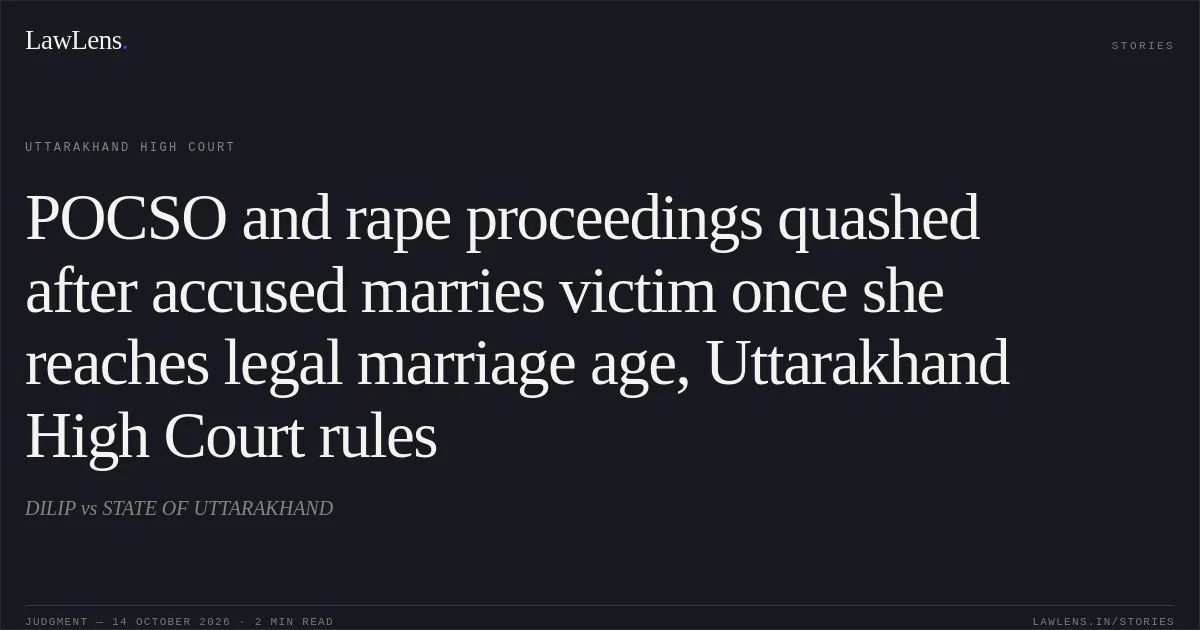
The victim’s mother reported that her daughter, then approximately 15 years old, had gone to a nearby shop and failed to return; she suspected that Dilip had induced and taken her away.
Source reference: para. 3Following investigation, police filed a charge-sheet alleging offences under Sections 363, 366 and 376(2)(n) of the Indian Penal Code, 1860 (IPC), and Sections 5/6 of the Protection of Children from Sexual Offences Act, 2012 (POCSO Act).
Source reference: paras. 2, 4The trial was pending before the Special Judge (POCSO), Haridwar.
Source reference: paras. 2, 4Dilip sought to quash the charge-sheet, summoning order and proceedings, submitting that he and the victim had married on 3 February 2026, after she attained the legally prescribed age for marriage, and were living together as spouses.
Source reference: paras. 5–7The parties appeared before the Court; the State opposed the application, while not disputing the marriage.
Source reference: paras. 5–7Issues
Whether the criminal proceedings alleging offences under Section 376(2)(n) IPC and Sections 5/6 of the POCSO Act could be quashed in the exercise of the High Court’s inherent jurisdiction, having regard to the parties’ subsequent marriage and matrimonial relationship
Source reference: para. 9Law Applied
The Court considered the alleged offences under Sections 363, 366 and 376(2)(n) IPC and Sections 5/6 of the POCSO Act.
Source reference: paras. 2, 4It relied on Gian Singh v. State of Punjab, (2012) 10 SCC 303, which distinguishes predominantly private disputes from serious offences with a significant societal impact, and on Narinder Singh v. State of Punjab, (2014) 6 SCC 466, and Parbatbhai Aahir v. State of Gujarat, (2017) 9 SCC 641, concerning the exercise of inherent jurisdiction to quash proceedings on the basis of a settlement.
Source reference: paras. 10–11The governing consideration identified was whether, in light of the nature and gravity of the offence and the circumstances of the case, quashing would secure the ends of justice.
Source reference: paras. 10–11Reasoning
The Court noted that the parties had married after the victim attained the legally prescribed age for marriage, were living together as husband and wife, and wished to continue their matrimonial relationship; it also noted their families’ economic circumstances.
Source reference: para. 12Having regard to these circumstances, the Court considered that continuing the prosecution would adversely affect their matrimonial life and concluded that quashing was appropriate to secure the ends of justice.
Source reference: para. 13Holding
The Court allowed the application and quashed the charge-sheet dated 28 August 2023, the cognizance/summoning order dated 2 September 2023, and the entire proceedings in Special Sessions Trial No. 132 of 2023, pending before the Special Judge (POCSO), Haridwar.
Any pending applications were also disposed of.
Source reference: paras. 14–15Acts & Sections Cited
5 provisions across 2 statutes referred to in this judgment. Each provision opens on LawLens.
Indian Penal Code, 18603
Original Court PDF
DILIPvsSTATE OF UTTARAKHAND
Click to open original judgment
Original judgment, available to read, download and summarize on LawLens.in