Facts
The appellant challenged the judgment dated 30.01.2024 of the Additional Sessions Judge-cum-Special Judge (POCSO), Barpeta, in Special (POCSO) Case No. 130/2023.
Source reference: pp. 2–4, paras. 2–3The case arose from an ejahar lodged by the victim’s father alleging that the appellant had maintained a sexual relationship with his daughter, resulting in her seven-month pregnancy.
Source reference: pp. 2–4, paras. 2–3The prosecution alleged that the sexual acts occurred when the victim was below 18 years of age.
Source reference: pp. 2–4, paras. 2–3The appellant was charged under Sections 376 IPC and 6 of the POCSO Act and was sentenced under Section 6 POCSO to 20 years’ rigorous imprisonment and fine.
Source reference: pp. 2–4, paras. 2–3The prosecution examined eight witnesses, including the victim, her relatives, villagers who allegedly witnessed an extra-judicial confession, the doctor, and the Investigating Officer.
Source reference: pp. 2–4, paras. 2–3The victim’s birth certificate recorded her date of birth as 15.10.2004; medical examination on 29.05.2023 found a pregnancy of 28 weeks and 3 days.
Source reference: pp. 2–4, paras. 2–3Issues
1. Whether the prosecution proved beyond reasonable doubt that the victim was below 18 years of age when the sexual acts resulting in her pregnancy occurred, thereby attracting Section 6 of the POCSO Act.
Source reference: p. 12, para. 152. Whether the inconsistencies in the victim’s statements rendered her testimony unreliable or, notwithstanding those inconsistencies, the core allegation of non-consensual sexual intercourse remained proved.
Source reference: pp. 13–19, paras. 16–243. Whether the alleged admission made by the appellant during the village discussion constituted a reliable extra-judicial confession, corroborated by other evidence.
Source reference: pp. 20–23, paras. 25–274. Whether the prosecution established rape under Sections 375 and 376(1) IPC even if the POCSO charge failed.
Source reference: pp. 24–26, para. 28Law Applied
The Court applied Section 375 IPC, under which sexual intercourse against a woman’s will, without her consent, or with consent obtained by fear constitutes rape, and Section 376(1) IPC, prescribing a minimum sentence of ten years’ rigorous imprisonment.
Source reference: pp. 24–26, para. 28Section 6 of the POCSO Act applies to aggravated penetrative sexual assault against a child, while Section 29 permits a presumption against the accused only after the prosecution establishes the foundational facts.
Source reference: pp. 10–12, paras. 12, 15The Court relied on Rai Sandeep v. State of NCT of Delhi, (2012) 8 SCC 21, for assessing whether the prosecutrix is a “sterling witness,” requiring consistency on the core facts from the earliest statement through trial.
Source reference: pp. 13–15, para. 16It relied on Sahadevan v. State of Tamil Nadu, (2012) 6 SCC 403, holding that an extra-judicial confession is a weak form of evidence which must be voluntary, truthful, credible, free from material discrepancies, and preferably corroborated.
Source reference: pp. 20–21, para. 25Section 6 of the Evidence Act was invoked regarding res gestae, requiring the statement to be contemporaneous with, or immediately subsequent to, the occurrence, as explained in Krishan Kumar Malik v. State of Haryana, (2011) 7 SCC 130, and Atul Hazarika v. State of Assam, 2014 (1) GLR 314.
Source reference: pp. 22–24, paras. 26–27Section 428 CrPC was applied for setting off the period of detention.
Source reference: p. 27, para. 30Reasoning
The Court held that the victim’s date of birth established that she attained majority on 15.10.2022.
Source reference: p. 12, para. 15Since the medical examination dated 29.05.2023 showed a gestational age of 28 weeks and 3 days, and the victim’s accounts varied materially regarding the timing of the first incident—describing it as either seven or eight months earlier or approximately two years earlier—the Court found it unsafe to conclude that the relevant sexual act occurred while she was a child.
Source reference: p. 12, para. 15; pp. 17–19, paras. 21–23Accordingly, the POCSO conviction could not stand.
Source reference: p. 12, para. 15However, the Court considered the discrepancies insufficient to destroy the core allegation that the appellant had sexual intercourse with the victim.
Source reference: pp. 19, 24–26, paras. 24, 28Her consistent assertion that the appellant gagged her and threatened her with harm explained her failure to disclose the incidents earlier and established absence of free consent.
Source reference: pp. 19, 24–26, paras. 24, 28The alleged admission by the appellant before the village elders was treated as an extra-judicial confession and was found sufficiently supported by the testimony of the victim and witnesses PW-1, PW-3, PW-4 and PW-6.
Source reference: pp. 20–24, paras. 25–27The victim’s immediate disclosure, after pregnancy was detected, that the appellant was responsible was also treated as corroborative res gestae evidence.
Source reference: pp. 20–24, paras. 25–27On this basis, the Court concluded that rape under Section 376(1) IPC was proved, notwithstanding failure to establish the victim’s minority.
Source reference: pp. 24–26, para. 28Holding
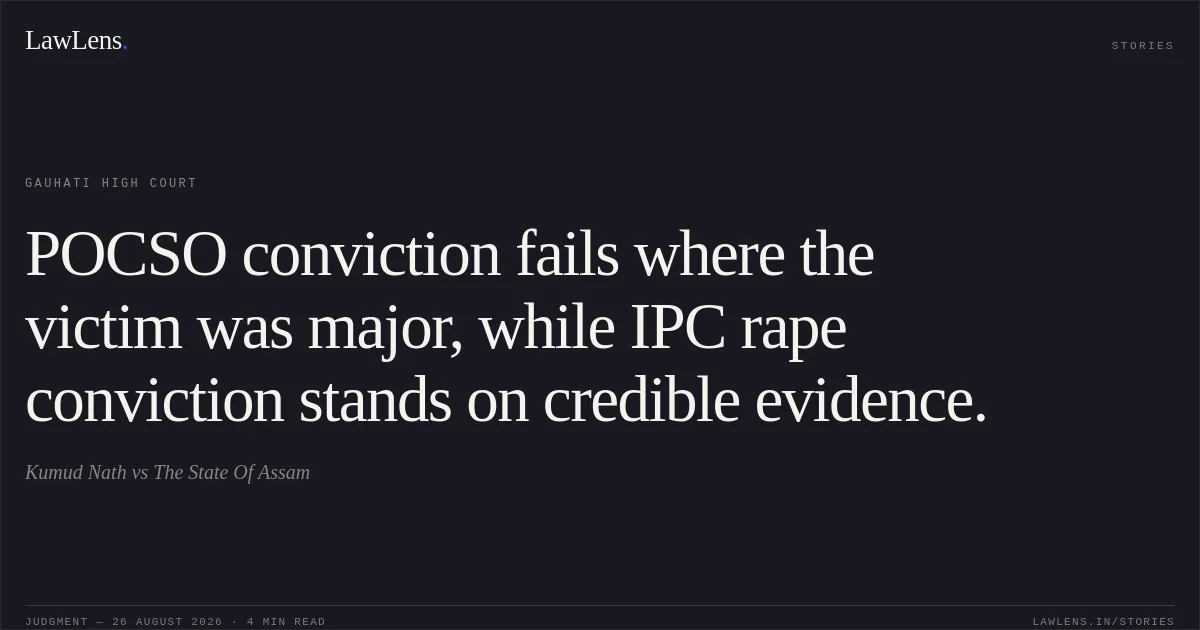
The appeal was partly allowed.
The conviction and sentence under Section 6 of the POCSO Act were set aside because the prosecution failed to prove that the victim was below 18 years of age when the relevant sexual act occurred.
Source reference: p. 27, para. 29The conviction under Section 376(1) IPC was maintained.
Source reference: pp. 27–28, paras. 30–32The appellant was sentenced to ten years’ imprisonment and a fine of Rs. 5,000, with six months’ further imprisonment in default of payment.
Source reference: p. 27, para. 30The period already undergone during trial and after conviction was directed to be set off under Section 428 CrPC.
Source reference: p. 27, para. 30The Trial Court Records were directed to be returned, and the Legal Services Authority was directed to pay remuneration to the Amicus Curiae.
Source reference: pp. 27–28, paras. 30–32Acts & Sections Cited
12 provisions across 5 statutes referred to in this judgment. Each provision opens on LawLens.
Indian Penal Code, 18603
Protection of Children from Sexual Offences Act, 20123
Code of Criminal Procedure, 19734
Juvenile Justice (Care and Protection of Children) Act, 2015.1
Registration of Births and Deaths Act, 19691
Original Court PDF
Kumud NathvsThe State Of Assam
Click to open original judgment
Original judgment, available to read, download and summarize on LawLens.in