Facts
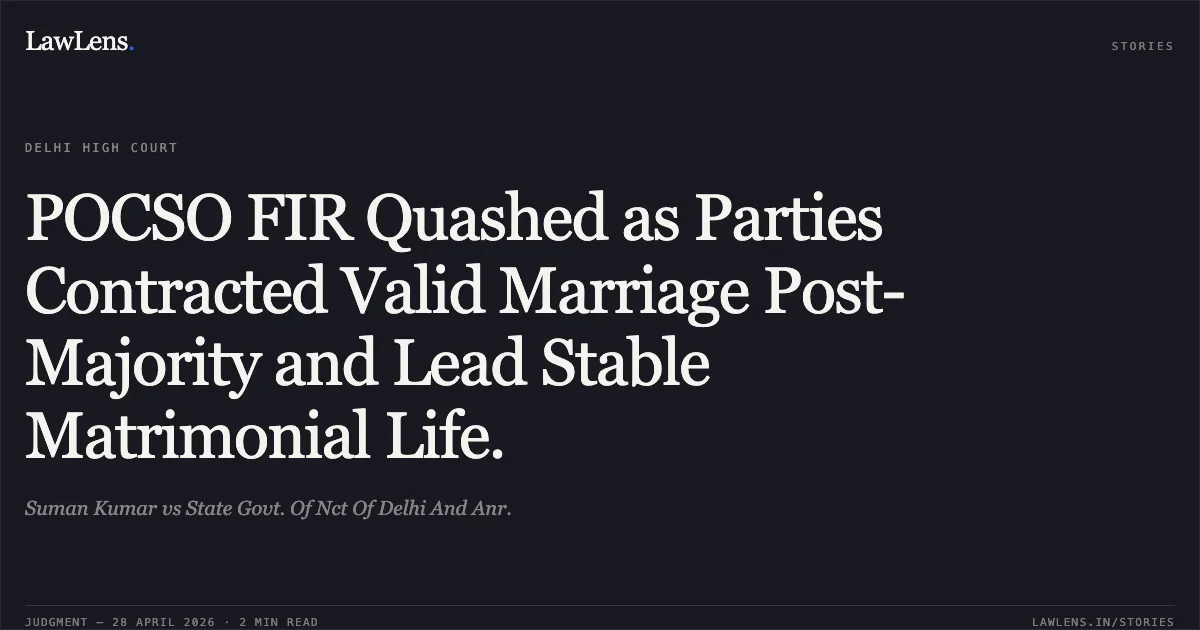
The petitioner sought quashing of FIR No. 177/2023 registered under Section 363 IPC (later adding Sections 366/376 IPC and Section 6 of the POCSO Act).
Source reference: para. 1.1–1.2In March 2023, the petitioner and the victim fled their homes and performed a marriage ceremony in Bihar.
Source reference: para. 1.3At the time, the victim was allegedly a minor, and though she supported the petitioner in her Section 164 Cr.P.C. statement and trial testimony, she was treated as a minor by the prosecution.
Source reference: para. 1.4–1.6After reaching the age of majority/discretion, the parties formally registered their marriage on January 21, 2025, and were blessed with a baby girl on February 2, 2026.
Source reference: para. 1.7The State verified the authenticity of the marriage and birth certificates.
Source reference: para. 2–3Issues
Whether the High Court should exercise its inherent powers to quash criminal proceedings involving non-compoundable and serious offences (POCSO/Rape) when the parties have subsequently entered into a valid marriage and stable family life.
Source reference: para. 8–10Law Applied
The court primarily exercised its inherent powers under Section 528 of the Bharatiya Nagarik Suraksha Sanhita (BNSS), 2023 (the successor to Section 482 Cr.P.C.).
Source reference: para. 10It relied on the principles established in Gian Singh v. State of Punjab [(2012) 10 SCC 303] and Narinder Singh & Ors. v. State of Punjab & Anr. [(2014) 6 SCC 466], which allow for the quashing of non-compoundable cases if the Court is satisfied that the purpose of the proceedings is exhausted and the chance of conviction is remote.
Source reference: para. 9The court also cited recent precedents Mohd. Parwej v. State [2026 SCC OnLine Del 1030] and Harmeet Singh v. State of GNCT Delhi & Ors. [2026:DHC:3142] regarding quashing in the context of matrimonial stability.
Source reference: para. 8Reasoning
The Court observed that the prosecutrix had consistently refused to support the prosecution’s allegations of coercion, claiming she married the petitioner of her own free will.
Source reference: para. 1.4, 4While she was technically a minor at the time of the incident, the Court noted that she had since attained the "age of discretion" and voluntarily formalized the marriage.
Source reference: para. 6–7The Court reasoned that because the parties are now living a "blissful matrimonial life" and have a child, the "scope of conviction was remote and bleak".
Source reference: para. 8–9Consequently, the Court determined that continuing the criminal trial would serve no "meaningful purpose" and would instead "disrupt their stable family-life".
Source reference: para. 8Holding
The Court answered the issue in the affirmative, holding that the interests of justice and the preservation of a stable family unit outweighed the continuance of the prosecution.
Exercising its powers under Section 528 BNSS, the Court quashed FIR No. 177/2023 and all consequential proceedings.
Source reference: para. 10–11The petition was disposed of accordingly.
Source reference: para. 12Acts & Sections Cited
6 provisions across 4 statutes referred to in this judgment. Each provision opens on LawLens.
Indian Penal Code, 18603
Protection of Children from Sexual Offences Act, 20121
Code of Criminal Procedure, 19731
Bharatiya Nagarik Suraksha Sanhita, 20231
Original Court PDF
Suman KumarvsState Govt. Of Nct Of Delhi And Anr.
Click to open original judgment
Original judgment, available to read, download and summarize on LawLens.in


![Subsequent exoneration does not retrospectively invalidate a finalized promotion select list.. UNNIKRISHNAN M vs M/o Environment And Forests. CAT - ['Ernakulam']. LawLens](/stories/thumbnails/subsequent-exoneration-does-not-retrospectively-invalidate-a-finalized-promotion-select-li-ce80a0e84f2f4887857271e8b4341c42.webp)