Facts
The appellant was prosecuted in connection with Shahkund P.S. Case No. 78 of 2021 for allegedly committing rape and penetrative sexual assault upon the victim, stated to be a child, on 17 February 2021. According to the prosecution, the appellant took the victim to an isolated place at about 7:00 p.m., threatened her with a “sixer,” and raped her. It was further alleged that, on 5 March 2021, the appellant eve-teased her, following which she disclosed the earlier incident to her mother. The written information was submitted on 7 March 2021, and the appellant was charged under Section 376 IPC and Sections 4, 8 and 18 of the POCSO Act.
Source reference: pp. 2–4, paras. 3–6The prosecution examined seven witnesses, including the victim, her mother, the investigating officer and the medical officer. The defence examined three witnesses to support its case of false implication arising from a dispute between the parties.
Source reference: pp. 4–5, paras. 7–9The trial court convicted the appellant under Section 376 IPC and Section 4 of the POCSO Act and sentenced him to 20 years’ rigorous imprisonment with a fine of ₹10,000. The appellant challenged the conviction and sentence in the present appeal.
Source reference: p. 2, para. 3Issues
Whether the prosecution proved beyond reasonable doubt that the appellant committed rape and penetrative sexual assault upon the victim, thereby attracting Section 376 IPC and Section 4 of the POCSO Act?
Source reference: pp. 9–16, paras. 19–32Whether the victim’s age was sufficiently established to invoke the provisions and statutory presumptions under the POCSO Act?
Source reference: pp. 13–15, paras. 25–30Whether the contradictions regarding the place of occurrence, delay in lodging the FIR, absence of medical evidence and the defence evidence rendered the conviction unsafe?
Source reference: pp. 10–16, paras. 21–32Law Applied
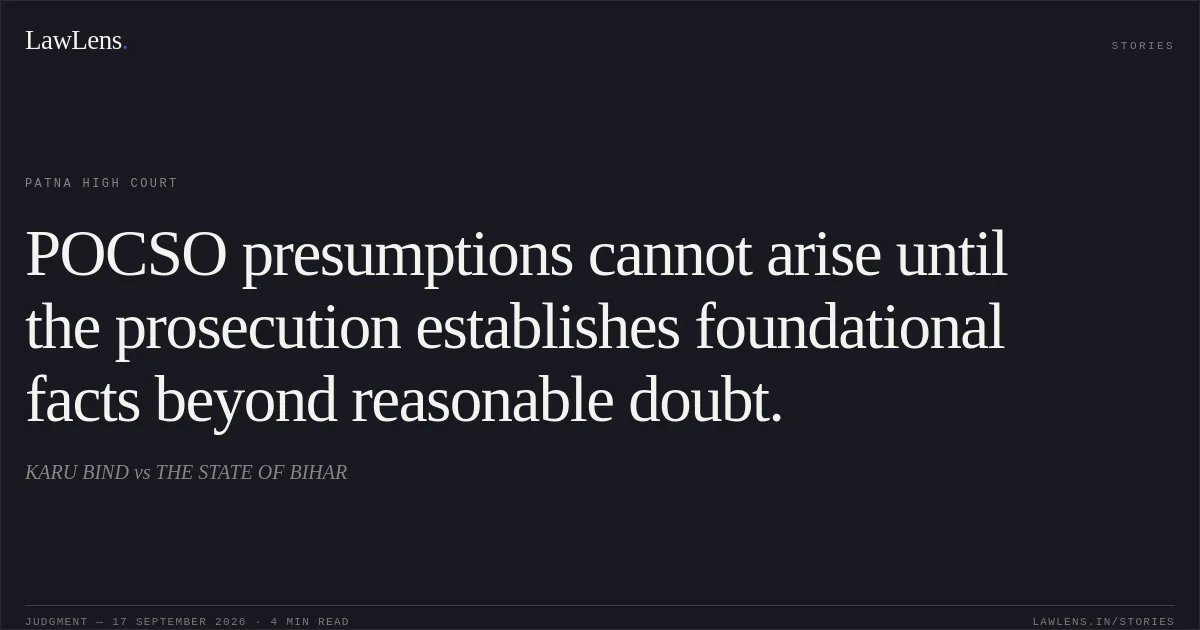
The Court applied Section 376 IPC concerning rape and Sections 4, 8 and 18 of the Protection of Children from Sexual Offences Act, 2012, particularly the requirement that the victim must be proved to be a “child” and that the prosecution must establish the foundational facts before the presumptions under Sections 29 and 30 of the POCSO Act can operate.
Source reference: pp. 3–4, paras. 5–6; p. 15, para. 30Section 162 CrPC was applied to hold that a statement made to the police during investigation cannot ordinarily be signed by the maker or used as substantive evidence, subject to the statutory exceptions.
Source reference: pp. 11–12, para. 23The Court relied on the principle that medical/radiological age estimation carries an applicable margin of error and referred to Court on its Own Motion v. State of NCT of Delhi, 2024 SCC OnLine Del 4484, Manu Kumar @ Monu Kumar @ Mannu Kumar v. State of Bihar, Criminal Appeal (DB) No. 200 of 2023, decided on 10 February 2026, and Rajak Mohammad v. State of Himachal Pradesh, (2018) 9 SCC 248.
Source reference: pp. 13–14, paras. 25–27The Court further reiterated that the presumption of innocence continues to operate in POCSO cases and that conviction must be based on reliable and legally admissible evidence.
Source reference: p. 16, paras. 30–31Reasoning
The Court found material inconsistencies in the prosecution evidence concerning the place of occurrence: the mother stated that the offence occurred in a vacant room, the victim stated that it occurred in a field, and the investigating officer identified another vacant room as the place of occurrence.
Source reference: pp. 10–13, paras. 21–24The victim’s delayed disclosure, the two-day delay in lodging the FIR after the alleged second incident, and the absence of any recovery of the alleged weapon were considered relevant circumstances affecting the prosecution case.
Source reference: pp. 10–15, paras. 21, 28The medical examination found no physical or chemical injury and no evidence of recent sexual intercourse.
Source reference: p. 13, para. 25The Court also held that the radiological age range of 14–16 years, when assessed with a two-year margin of error, could extend to 18 years; consequently, the victim’s status as a child for POCSO purposes was not satisfactorily established.
Source reference: pp. 13–15, paras. 25–27Since the foundational facts were not proved, the presumptions under Sections 29 and 30 of the POCSO Act could not be invoked.
Source reference: p. 15, para. 30Considering these deficiencies, the inconsistent testimony, the defence evidence regarding the appellant’s age and alleged prior dispute with the victim’s family, and the absence of sufficiently reliable corroboration, the Court concluded that the conviction was unsafe.
Source reference: pp. 14–16, paras. 28–31Holding
The High Court allowed the appeal, set aside the judgment of conviction dated 5 August 2022 and the order of sentence dated 10 August 2022, and acquitted Karu Bind of the charges by granting him the benefit of doubt.
The Court held that the prosecution had failed to establish the victim’s status as a child and the foundational facts necessary for the POCSO presumptions, and had also failed to prove the charge under Section 376 IPC through wholly reliable evidence.
Source reference: p. 16, paras. 30–32As the appellant was in custody, the Court directed that he be released forthwith unless required in any other case.
Source reference: p. 16, para. 33Acts & Sections Cited
10 provisions across 3 statutes referred to in this judgment. Each provision opens on LawLens.
Indian Penal Code, 18601
Protection of Children from Sexual Offences Act, 20125
Code of Criminal Procedure, 19734
Original Court PDF
KARU BINDvsTHE STATE OF BIHAR
Click to open original judgment
Original judgment, available to read, download and summarize on LawLens.in