Facts
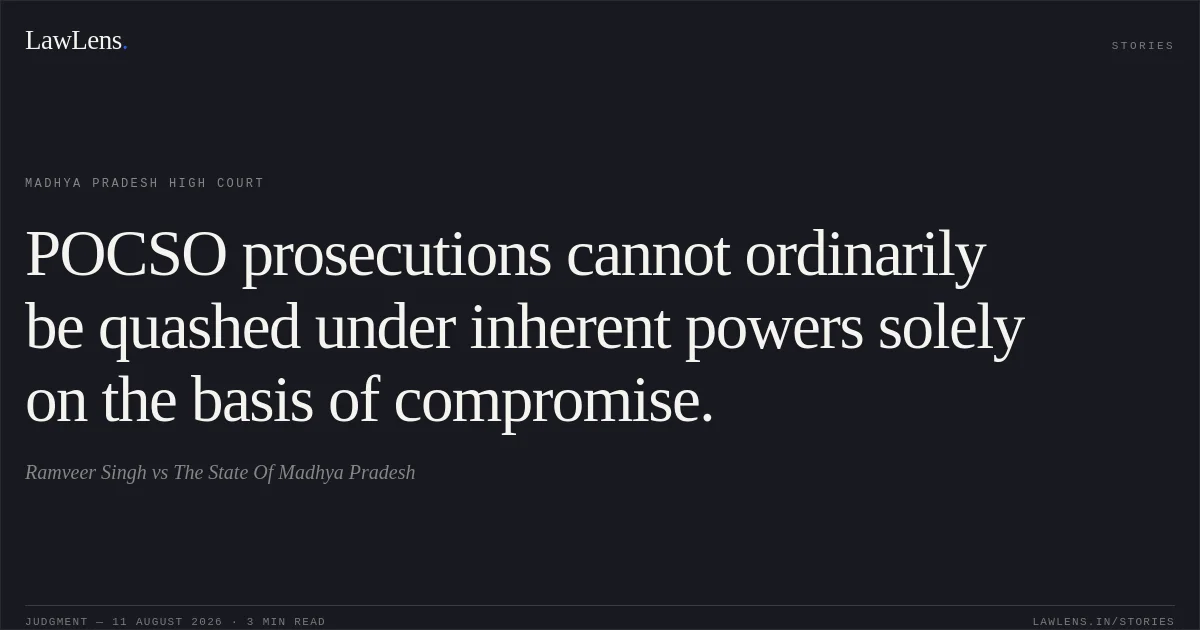
The petitioner sought quashing under Section 528 of the BNSS of FIR Crime No. 125/2026 registered at Police Station City Kotwali, District Bhind, for offences under Sections 137(2), 87 and 64(2)(m) of the BNS and Sections 5L/6 of the POCSO Act, along with consequential proceedings in Sessions Case No. 16/2026.
Source reference: para. 1The prosecution alleged that the complainant’s approximately sixteen-year-old daughter left home on 12 March 2026 to purchase samosas and did not return.
Source reference: para. 2After unsuccessful searches, the complainant suspected that an unknown person had enticed or induced her and taken her away.
Source reference: para. 2During the proceedings, the petitioner and the complainant/respondent No. 2 filed compromise applications supported by affidavits.
Source reference: para. 3The Principal Registrar verified the parties, their signatures and the voluntary nature of the compromise.
Source reference: paras. 3–4The petitioner had not married the prosecutrix.
Source reference: para. 10Issues
Whether the High Court should exercise its inherent jurisdiction under Section 528 of the BNSS to quash the FIR and consequential proceedings on the basis of a compromise between the accused and the complainant in a case involving offences under the POCSO Act?
Source reference: paras. 1, 11–14Whether the compromise could be accepted on the basis of precedents permitting quashing in exceptional circumstances involving a subsequent marriage and harmonious matrimonial life?
Source reference: paras. 8–10Law Applied
The Court applied Section 528 of the BNSS, under which the High Court’s inherent powers must be exercised sparingly, with circumspection, to secure the ends of justice or prevent abuse of process.
Source reference: para. 11Relying on Gian Singh v. State of Punjab, (2012) 10 SCC 303, Narinder Singh v. State of Punjab, (2014) 6 SCC 466, and State of Madhya Pradesh v. Laxmi Narayan, (2019) 5 SCC 688, the Court reiterated that heinous or serious offences having a social impact ordinarily cannot be quashed merely because the parties have compromised.
Source reference: para. 11The Court further relied on the POCSO Act’s protective and societal purpose, holding that offences against children are not merely private disputes and that a compromise cannot override the statutory mandate or public interest.
Source reference: paras. 12–13The Court distinguished Mahesh Mukund Patel v. State of U.P., 2025 SCC OnLine SC 614, and Ajay Mohan v. State of U.P., 2026 AHC 103624, where relief was granted in circumstances involving marriage and a subsequent happy matrimonial life.
Source reference: paras. 8–10Reasoning
Although the compromise was verified as voluntary and free from coercion, the alleged offences included offences under the POCSO Act involving a minor victim.
Source reference: paras. 3–4, 12Applying the principles governing inherent jurisdiction, the Court held that the nature of the offences and their broader social impact outweighed the parties’ private settlement.
Source reference: paras. 11–13The precedents relied upon by the petitioner did not assist him because they concerned materially different facts, particularly a subsequent marriage between the accused and the prosecutrix and an established happy married life; no such marriage had occurred in the present case.
Source reference: paras. 8–10Quashing the prosecution solely on the basis of compromise would undermine the protective object of the POCSO Act and be contrary to the governing law.
Source reference: paras. 12–14Holding
The Court answered the issues against the petitioner and declined to exercise its inherent jurisdiction under Section 528 of the BNSS.
It held that a compromise, even if voluntarily verified, was insufficient to quash proceedings involving offences under the POCSO Act, particularly where the victim was a minor.
Source reference: paras. 13–14The petition seeking quashing of FIR Crime No. 125/2026 and Sessions Case No. 16/2026 was accordingly dismissed, and all pending interlocutory applications were disposed of.
Source reference: paras. 15–16Acts & Sections Cited
6 provisions across 3 statutes referred to in this judgment. Each provision opens on LawLens.
Bharatiya Nagarik Suraksha Sanhita, 20231
Bharatiya Nyaya Sanhita, 20233
Original Court PDF
Ramveer SinghvsThe State Of Madhya Pradesh
Click to open original judgment
Original judgment, available to read, download and summarize on LawLens.in