Facts
The appellant was prosecuted for allegedly taking the minor victim, aged approximately 14–15 years, to the CIRA Industries office on 27 June 2021 and committing penetrative sexual assault upon her, while also threatening to circulate a video of the incident.
Source reference: paras. 4–6, pp. 2–4The trial court convicted him under Sections 376(3) and 506 of the IPC and Section 4 of the POCSO Act, sentencing him to twenty years’ rigorous imprisonment under Section 4(2) of the POCSO Act and seven years’ rigorous imprisonment under the second part of Section 506 IPC.
Source reference: paras. 2–3, pp. 1–2The prosecution examined the victim, her father, the examining doctor, and the investigating officer.
Source reference: paras. 7–9, pp. 4–5The defence relied, inter alia, on evidence of monetary transactions and an alleged loan dispute between the victim’s father and the appellant.
Source reference: paras. 7–9, pp. 4–5Issues
1. Whether the prosecution proved the alleged penetrative sexual assault and criminal intimidation against the appellant beyond reasonable doubt?
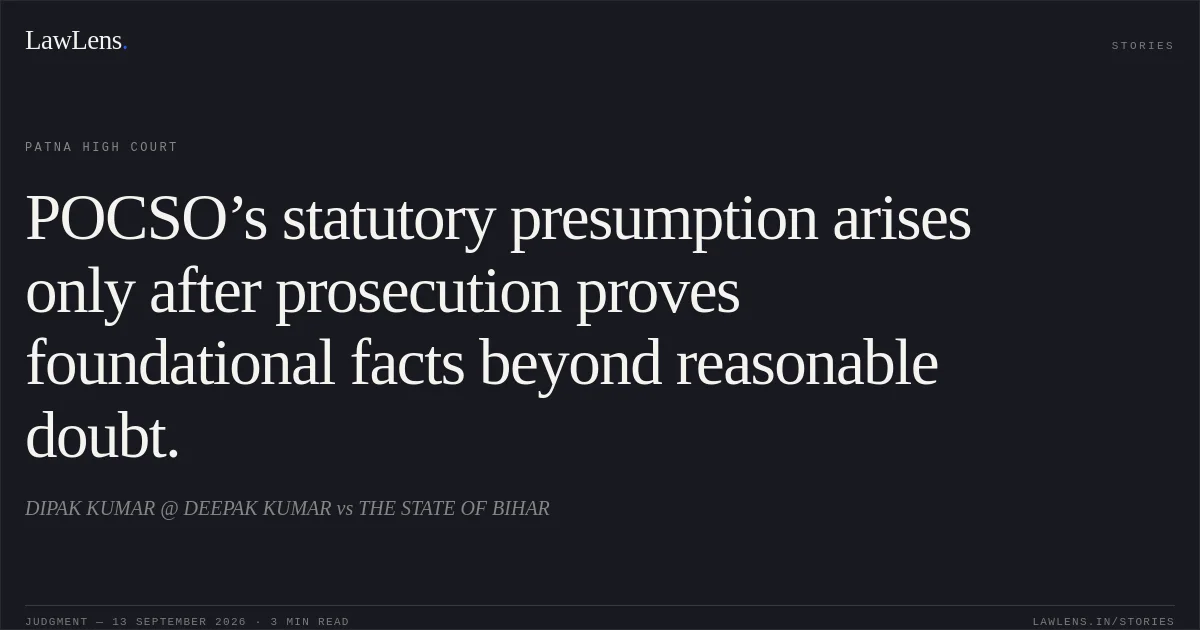
Source reference: paras. 20–29, pp. 9–172. Whether the statutory presumption under Section 29 of the POCSO Act could be invoked without the prosecution first establishing the foundational facts of the alleged offence?
Source reference: paras. 30–33, pp. 17–223. Whether the victim’s testimony was sufficiently consistent and reliable to sustain the conviction without substantial corroboration?
Source reference: paras. 22–29, 34–35, pp. 10–17, 22–234. Whether the defence had rebutted the prosecution case by establishing a probable alternative version and creating reasonable doubt?
Source reference: paras. 23, 33, 35, pp. 11–12, 20–23Law Applied
The Court considered Sections 376(3) and 506 of the IPC and Sections 4, 29 and 30 of the POCSO Act.
Source reference: no citationSection 29 POCSO permits a presumption that the accused committed the charged offence only after the prosecution establishes the foundational facts of the alleged offence; the presumption is not automatic or conclusive.
Source reference: para. 30, p. 17Relying on Veerpal v. State, 2024 SCC OnLine Del 2686, and Joy v. State of Kerala, 2019 SCC OnLine Ker 783, the Court held that foundational facts must first be proved beyond reasonable doubt, after which the accused may rebut the presumption on a preponderance of probabilities.
Source reference: paras. 31–32, pp. 18–20The Court further relied on Ramanand v. State of U.P., AIR 2022 SC 5273, for the principles that the presumption of innocence remains applicable and that the accused may establish a probable defence without proving it beyond reasonable doubt.
Source reference: para. 33, pp. 20–22Under Rai Sandeep @ Deepu v. State (NCT of Delhi), (2012) 8 SCC 21, a “sterling witness” must give a consistent, natural, and unassailable account capable of withstanding cross-examination and cohering with the other evidence.
Source reference: para. 34, pp. 22–23Reasoning
The Court found material inconsistencies and gaps in the prosecution case.
Source reference: no citationThe victim’s assertion that she was forcibly taken to the alleged place of occurrence while going to coaching was not stated to the investigating officer, and the Court noted that the relevant coaching activities appeared to have been prohibited during the COVID-19 lockdown period.
Source reference: paras. 24–25, pp. 12–14The investigation did not verify the coaching centre, examine the guard or staff of CIRA Industries, establish that the appellant worked there, identify the particular room of occurrence, or recover any alleged video footage.
Source reference: paras. 26–27, pp. 14–16The medical examination disclosed no external or internal injury, and the Court treated the medical evidence as not corroborating penetrative sexual assault.
Source reference: paras. 27–28, pp. 15–17The victim’s additional allegations of earlier sexual assaults were not contemporaneously disclosed to her parents and were unsupported by independent evidence.
Source reference: para. 26, pp. 14–15The Court also considered the admitted monetary relationship between the families and the defence evidence concerning an alleged unpaid loan, concluding that the defence had presented a plausible motive for false implication.
Source reference: paras. 23, 35, pp. 11–12, 22–23In these circumstances, the prosecution failed to establish the foundational facts necessary to activate Section 29 POCSO.
Source reference: paras. 31–35, pp. 18–23Even assuming that the presumption arose, the inconsistencies, investigative omissions, medical evidence, and defence version created a reasonable doubt and demonstrated that the victim did not satisfy the standard of a “sterling witness”.
Source reference: paras. 31–35, pp. 18–23Holding
The High Court held that the prosecution had failed to prove the offences under Section 4(2) of the POCSO Act and the second part of Section 506 IPC beyond reasonable doubt.
The trial court had erred in relying on the statutory presumption and in appreciating the evidence.
Source reference: para. 36, p. 23The conviction judgment dated 31 July 2023 and order of sentence dated 2 August 2023 were set aside.
Source reference: paras. 36–37, p. 23The appellant was acquitted by extending the benefit of doubt and directed to be released forthwith, unless required in any other case.
Source reference: paras. 36–37, p. 23The appeal was accordingly allowed.
Source reference: para. 37, p. 24Acts & Sections Cited
11 provisions across 3 statutes referred to in this judgment. Each provision opens on LawLens.
Indian Penal Code, 18602
Protection of Children from Sexual Offences Act, 20127
Code of Criminal Procedure, 19732
Original Court PDF
DIPAK KUMAR @ DEEPAK KUMARvsTHE STATE OF BIHAR
Click to open original judgment
Original judgment, available to read, download and summarize on LawLens.in