Facts
Mohd. Shafiq Sohil lodged a complaint with the Crime Branch alleging that the petitioner, Director of M/s Ashpura Road Lines, had defrauded him of ₹40 lakhs in relation to a sub-contract under the NHDP Phase-II project for construction of a section of NH-44.
Source reference: paras. 2–3; pp. 2–3During a preliminary verification, the Crime Branch repeatedly required the petitioner to appear and produce records. Notices were issued under Section 91 CrPC on 19 May 2023 and 18 July 2023; the respondent alleged that the petitioner failed to produce the requisite records or appear before the investigating authority.
Source reference: para. 3; p. 2The petitioner contended that he had already submitted a detailed reply with relevant documents and that Section 91 CrPC could not be invoked because no investigation or inquiry under the Code had commenced.
Source reference: para. 4; p. 3; para. 6; p. 4The Crime Branch thereafter filed a complaint under Section 175 IPC, and the trial court issued process against the petitioner on 27 February 2024. The petitioner invoked Section 528 BNSS seeking quashing of the complaint and the order issuing process.
Source reference: para. 1; p. 1Issues
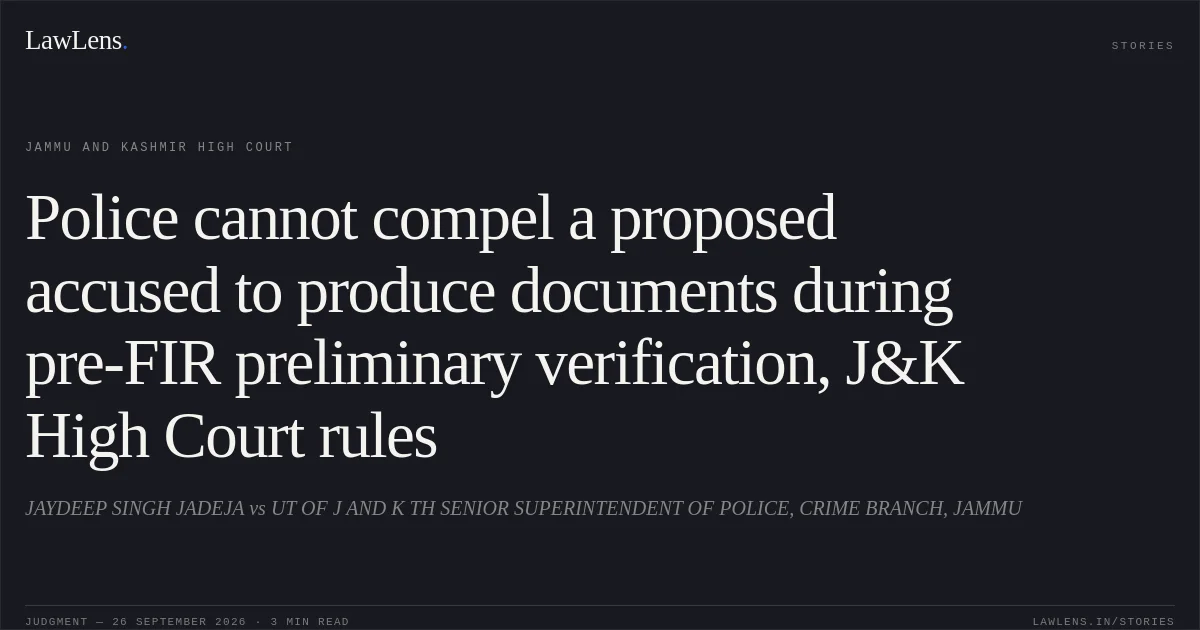
Whether the Crime Branch could invoke Section 91 CrPC to compel production of documents during a preliminary verification conducted before registration of an FIR or commencement of a formal investigation or inquiry under the Code?
Source reference: paras. 9–14; pp. 4–7Whether a complaint under Section 175 IPC could be maintained for alleged non-compliance with a notice issued under Section 91 CrPC when such recourse to Section 91 was legally impermissible?
Source reference: para. 15; p. 7Whether the trial court mechanically issued process against the petitioner without proper application of mind?
Source reference: para. 15; p. 7Law Applied
The Court applied Section 91 CrPC, which permits a court or officer-in-charge of a police station to require production of documents or things only when necessary or desirable for an investigation, inquiry, trial, or other proceeding under the Code.
Source reference: para. 9; p. 4The expression “other proceeding” was construed ejusdem generis with “investigation, inquiry, or trial,” and therefore could not extend to a preliminary verification unconnected with a formal proceeding under the Code.
Source reference: para. 13; p. 6The Court further considered Section 173(3) BNSS, which expressly contemplates a preliminary inquiry in specified cognizable offences with prior permission, while noting that no equivalent provision existed under the CrPC when the notices were issued.
Source reference: para. 12; p. 6Relying on Lalita Kumari v. Government of Uttar Pradesh, (2014) 2 SCC 1, the Court held that preliminary inquiry is limited to ascertaining whether the information discloses a cognizable offence and cannot be used to test the veracity of allegations or conduct a compelled evidentiary investigation.
Source reference: para. 12; pp. 6–7Consequently, Section 175 IPC could not be invoked for non-compliance with an unlawfully issued Section 91 notice.
Source reference: para. 15; p. 7Reasoning
The respondent expressly admitted that the Crime Branch was conducting only a preliminary verification and that no formal investigation or inquiry under the CrPC had commenced.
Source reference: para. 11; p. 5Since Section 91 CrPC operates only in the context of an investigation, inquiry, trial, or cognate proceeding under the Code, the notices issued during the preliminary verification lacked statutory foundation.
Source reference: paras. 10–13; pp. 4–6The Court further held that preliminary verification is confined to determining whether a cognizable offence is prima facie disclosed; it cannot assume the character of an investigation into the truth of the allegations or compel the proposed accused to furnish documents or information.
Source reference: para. 14; p. 7Accordingly, the petitioner’s alleged non-compliance could not constitute an offence under Section 175 IPC. The trial court’s issuance of process, despite the legal defect in the notices, was therefore held to be mechanical and without proper application of mind.
Source reference: para. 15; p. 7Holding
The Court allowed the petition and quashed the proceedings in the complaint titled “Crime Branch v. Jaydeep Singh Jadeja”, pending before the Special Mobile Magistrate, Passenger Tax and Shops and Establishment Act, Jammu, together with the order dated 27 February 2024 issuing process under Section 175 IPC.
It held that continuation of the proceedings would amount to an abuse of the process of law.
Source reference: para. 16; p. 8The Enquiry Officer was nevertheless left at liberty to proceed with the original complaint in accordance with law.
Source reference: para. 16; p. 8Acts & Sections Cited
4 provisions across 3 statutes referred to in this judgment. Each provision opens on LawLens.
Bharatiya Nagarik Suraksha Sanhita, 20232
Indian Penal Code, 18601
Code of Criminal Procedure, 19731
Original Court PDF
JAYDEEP SINGH JADEJAvsUT OF J AND K TH SENIOR SUPERINTENDENT OF POLICE, CRIME BRANCH, JAMMU
Click to open original judgment
Original judgment, available to read, download and summarize on LawLens.in