01Facts
The petitioner is the proprietor of M/S Infinity Family Spa, located at Flat No. 3, First Floor, opposite Kannada Bhavan, Kalaburagi, and claims to run it lawfully under a lease and trade licence issued by the Kalaburagi Municipal Corporation (R4).
p. 2 · ¶ 6 · pp. 5–6He alleged that R2 (Commissioner of Police) and R3 (IG of Police) instructed the jurisdictional police to close his spa, and that police forced closure without any notice or closure order, compelling him to file the petition under Articles 226 and 227.
¶ 2 · p. 3The State denied any forcible closure, submitting that police acted on credible information, verified it by visiting some spa centres, and had the right and duty to inspect and act against illegal activity.
¶ 3 · pp. 3–4R4 submitted that a trade licence was issued, but the business must be lawful.
¶ 4 · pp. 4–5The Court noted that the petitioner's grievance was harassment and forced closure without legal authority.
¶ 6 · pp. 5–602Issues
i.1. Whether police may obstruct or close a lawful spa business, in the absence of legal authority, without infringing Article 19(1)(g) and the right to life and livelihood.
¶ 7 · pp. 5–6ii.2. Whether police may visit and inspect a spa premises and take action where they receive credible information of unlawful activity, and the extent of such power.
¶ 7 · pp. 6–7 · directions (i)–(ii) · p. 603Law Applied
The Court relied on Article 19(1)(g) of the Constitution, which guarantees the right to carry on any occupation, trade or business, holding that police obstruction of a lawful business violates it.
¶ 7 · pp. 5–6It also invoked the right to life and livelihood, which extends to the proprietor and the employees of the establishment.
¶ 7 · pp. 5–6Articles 226 and 227 provided the writ jurisdiction invoked.
p. 2The Court further recognised that police may inspect premises and act on credible information of unlawful activity, and that action must be taken in accordance with law.
¶ 7 · p. 6 · directions (i), (iv) · pp. 6–7The judgment cites no statute, such as a licensing or police provision, and no precedent; its reasoning rests on constitutional principles and the parties' submissions.
04Reasoning
The Court did not adjudicate the disputed factual question of whether police forcibly closed the petitioner's premises, nor whether the business was lawful.
¶ 3 · pp. 3–4 · ¶ 7 · pp. 5–6Instead, it resolved the matter prospectively. It held that if the petitioner's activities are lawful, police cannot obstruct them, as this would infringe Article 19(1)(g) and affect livelihood. It accepted the State's position that police may act on credible information of illegal activity, so the protection is conditional on lawful operation.
¶ 7 · pp. 5–6 · ¶ 7 · p. 6The Court thus balanced the petitioner's right to carry on business against the State's power to investigate and curb unlawful activity. The directions allow periodic visits on credible information and bar interference with lawful activity, without expressly granting the petitioner's prayer to reopen the premises.
directions (i)–(iii) · pp. 6–705Holding
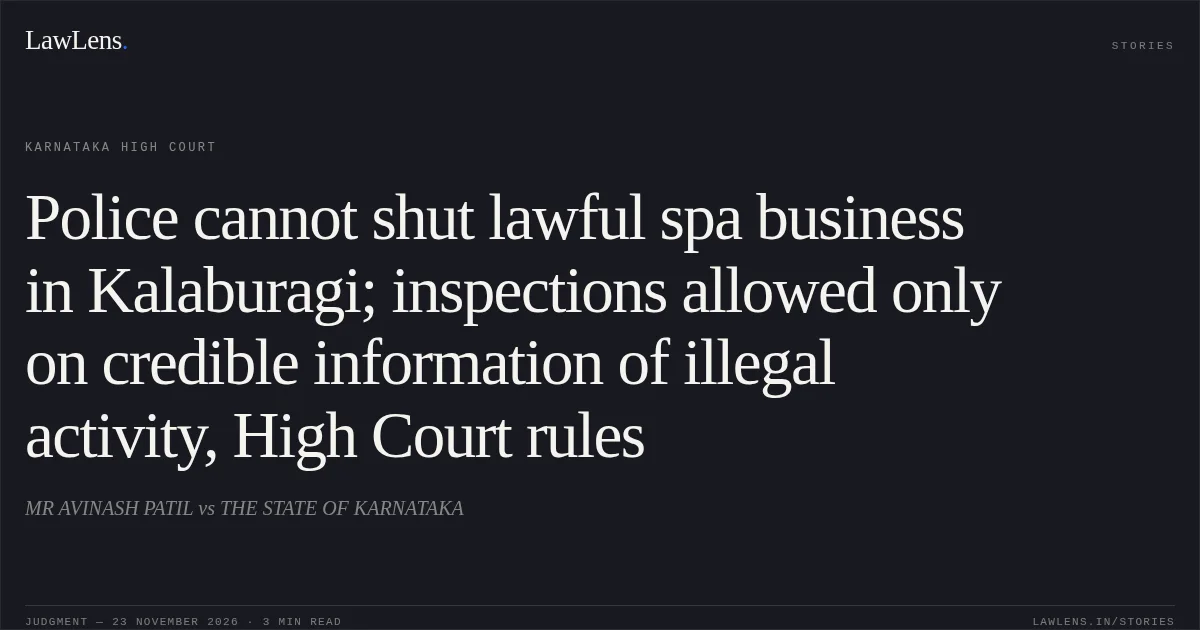
The Court held that police cannot obstruct a lawful spa business, as this would violate Article 19(1)(g) and the right to livelihood, but that police may visit the premises and take action in accordance with law upon credible information of unlawful activity.
¶ 7 · pp. 5–7The writ petition was disposed of with the following directions: (i) the petitioner shall carry out lawful activities, and police may visit and act on credible information of illegal activity; (ii) jurisdictional police may visit periodically on credible information; (iii) respondents shall not interfere with lawful activities; and (iv) the order does not prevent police from acting if the activities are found unlawful. No order as to costs was made.
directions (i)–(iv) · pp. 6–7 · p. 7Original Court PDF
MR AVINASH PATILvsTHE STATE OF KARNATAKA
Click to open original judgment
Original judgment, available to read, download and summarize on LawLens.in