Facts
On 5–7 August 2011, officials inspected LifeCare Hospital, Deepka, and allegedly found several preserved foetuses of approximately 16–32 weeks, abortion-related instruments, expired medicines, and other objectionable materials.
Source reference: paras. 2(A), 20–27The Block Medical Officer forwarded the inspection report to the police, resulting in registration of FIR No. 69/2011 against the hospital’s doctors and operator under Section 5 of the Medical Termination of Pregnancy Act, 1971 (“MTP Act”), Section 22(3) of the PC&PNDT Act, and Section 315 of the IPC.
Source reference: paras. 2(A), 20–27After investigation, the accused were tried by the Additional Sessions Judge, Katghora, who acquitted them on 31 August 2016, holding that the prosecution had failed to prove the charges beyond reasonable doubt.
Source reference: paras. 2(B)–3The State preferred an appeal against acquittal.
Source reference: no citationIssues
1. Whether the prosecution initiated through a police FIR and charge-sheet was legally maintainable for the alleged offence under Section 22(3) of the PC&PNDT Act, in view of Section 28 of that Act?
Source reference: paras. 8, 11–152. Whether the trial court’s acquittal of the respondents under Section 5 of the MTP Act, for violation of Section 3, was perverse or contrary to the evidence on record?
Source reference: paras. 8, 16–19, 29–353. Whether the prosecution had established the offence under Section 315 of the IPC, and whether the respondents had shown that the relevant acts were done in good faith to save the life of the mother?
Source reference: paras. 29, 34–364. Whether the High Court could interfere with the acquittal in an appeal against acquittal where the trial court’s findings were alleged to be perverse or legally erroneous?
Source reference: para. 35Law Applied
Section 28 of the PC&PNDT Act creates a statutory restriction on cognizance of offences under that Act, permitting cognizance only upon a complaint by the Appropriate Authority, an authorised officer, or a person complying with the statutory notice requirement; offences under the Act are triable by a Metropolitan Magistrate or Judicial Magistrate First Class.
Source reference: paras. 9, 11–12Sections 30 of the PC&PNDT Act and Rule 12 of the 1996 Rules regulate search and seizure by the Appropriate Authority.
Source reference: para. 9Under Sections 3 and 5 of the MTP Act, termination of pregnancy is legally protected only within the prescribed gestational limits and statutory conditions, subject to the emergency exception where termination is immediately necessary to save the mother’s life.
Source reference: paras. 16–18, 31Section 315 IPC penalises an act intended to prevent a child from being born alive or to cause its death after birth, unless done in good faith to save the mother’s life.
Source reference: para. 29The Court applied Section 111 of the Evidence Act regarding the burden of proving good faith in circumstances involving active confidence, relying on Sewakram Sobhani v. Karanjia, 1981 (3) SCC 208, which treats good faith as a fact-dependent question requiring due care and attention.
Source reference: paras. 32–33It also relied on State of Uttar Pradesh v. Brij Pal Singh, 2026 INSC 901, concerning the limited role of police investigation under the PC&PNDT Act.
Source reference: paras. 14–15It also relied on Constable 907 Surendra Singh v. State of Uttarakhand, 2025 INSC 114, which permits interference with acquittal where the judgment suffers from patent perversity, misreading, or omission of material evidence and only the finding of guilt is reasonably possible.
Source reference: para. 35Reasoning
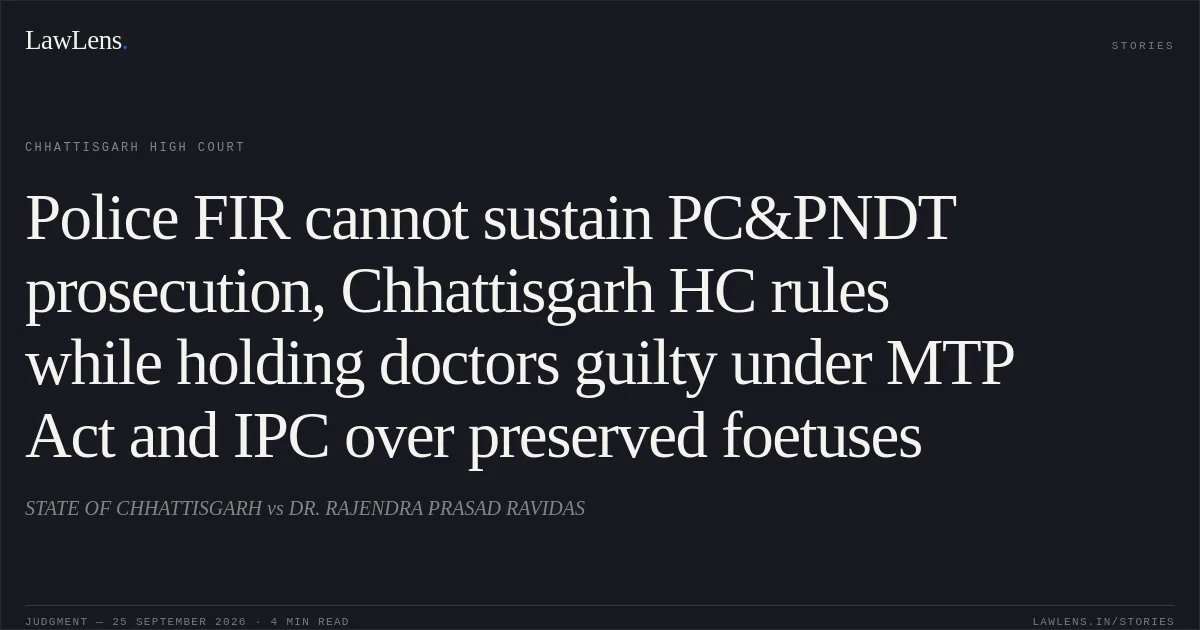
The High Court held that the PC&PNDT prosecution was procedurally invalid because the case originated in a police FIR and culminated in a police charge-sheet, rather than a complaint by the Appropriate Authority in the manner contemplated by Section 28.
Source reference: paras. 13–15Consequently, the acquittal under Section 22(3) of the PC&PNDT Act was affirmed, although on a different legal basis from that adopted by the trial court.
Source reference: paras. 13–15In contrast, the evidence of the inspection-team doctors established that multiple foetuses, including foetuses of approximately 16–32 weeks, were preserved in the hospital along with abortion-related instruments.
Source reference: paras. 20–27, 30The Court found that the trial court had wrongly treated the absence of a woman’s complaint or the fact that no abortion was witnessed during the raid as sufficient to negate the alleged offences.
Source reference: paras. 30–34The respondents failed to explain that the foetuses resulted from lawful termination carried out within the statutory conditions or in good faith to save a mother’s life.
Source reference: paras. 30–34On that basis, the trial court’s acquittal under Section 5 of the MTP Act and Section 315 IPC was held perverse and warranting appellate interference.
Source reference: paras. 34–36Holding
The appeal was partly allowed.
The acquittal of the respondents under Section 22(3) of the PC&PNDT Act was affirmed because the prosecution was instituted through an impermissible police FIR and charge-sheet, contrary to Section 28 of the Act.
Source reference: para. 15The acquittal under Section 5 of the MTP Act and Section 315 IPC was set aside, and the High Court held that the prosecution had proved those offences against the respondents.
Source reference: para. 36The matter was directed to be listed for hearing the accused on the question of sentence under the applicable procedural provision.
Source reference: paras. 37–39Acts & Sections Cited
20 provisions across 5 statutes referred to in this judgment. Each provision opens on LawLens.
Pre-conception and Pre-natal Diagnostic Techniques (Prohibition of Sex Selection) Act, 1994
Indian Penal Code, 18605
Code of Criminal Procedure, 19732
Bharatiya Nagarik Suraksha Sanhita, 20231
Original Court PDF
STATE OF CHHATTISGARHvsDR. RAJENDRA PRASAD RAVIDAS
Click to open original judgment
Original judgment, available to read, download and summarize on LawLens.in