Facts
The petitioner alleged that his brother, Sunujit Sangyung, sustained grievous bullet injuries during police firing on protesters at Maibang Railway Station, Dima Hasao, on 25 January 2018; two protesters died and several others were injured.
Source reference: paras. 3.1–3.2The State contended that the initially peaceful protest had become violent, with protesters pelting stones, damaging railway and public property, attacking officials, and attempting to set fire to a railway fuel tank; after tear gas, stun grenades, rubber bullets and blank firing allegedly failed, the police resorted to controlled firing below the knee.
Source reference: paras. 5–5.4Two criminal cases were registered: Maibang P.S. Case No. 02/2018 on the basis of the SDPO’s information and Maibang P.S. Case No. 06/2018 on the complaint of the JNH President.
Source reference: para. 7A police enquiry, a Magisterial Enquiry and a One Man Enquiry Commission examined the incident. The Commission concluded that the use of force was timely and unavoidable and that there was no administrative or police lapse, while recording that protesters complained of firing at the head and chest.
Source reference: para. 8During the writ proceedings, the investigations concluded: a charge-sheet was filed in Case No. 02/2018 against six accused persons, including Sunujit Sangyung, and a final report was filed in Case No. 06/2018.
Source reference: para. 9The petitioner sought quashing of the Magisterial Enquiry and its notice, an independent enquiry by a retired High Court Judge, and exemplary compensation for the deceased and seriously injured victims.
Source reference: para. 2Issues
Whether, in view of the existing enquiry reports, the passage of time, and the conclusion of the criminal investigations, a further independent enquiry into the Maibang police firing should be ordered
Source reference: paras. 7–10Whether the police firing and the injuries suffered by the protesters constituted an established violation of their fundamental rights under Article 21, warranting compensation under Article 226 of the Constitution
Source reference: paras. 11–18Whether the deceased victims’ families and the seriously injured victims were entitled to compensation in addition to amounts already sanctioned by the State
Source reference: paras. 17–20Law Applied
The Court applied Article 21 of the Constitution and its public-law remedy under Article 226 for established violations of fundamental rights.
Source reference: paras. 12–13Under Nilabati Behera v. State of Orissa, compensation may be awarded for infringement of fundamental rights as a remedy distinct from and additional to private-law damages; sovereign immunity is unavailable.
Source reference: paras. 12–13D.K. Basu v. State of West Bengal establishes that monetary compensation is an appropriate public-law remedy for an established violation of the right to life, with the State being vicariously liable, subject to adjustment against any private-law damages.
Source reference: para. 14Relying on Anita Thakur v. Government of J&K, the Court recognised that authorities may use reasonable and proportionate force to disperse an unlawful assembly, but unnecessary or excessive force violates fundamental rights; force must be limited to what is absolutely necessary and discontinued once the danger has ceased.
Source reference: para. 15Public-law compensation is compensatory or exemplary monetary amends for breach of public duty and is independent of civil or criminal remedies.
Source reference: paras. 13–14, 18–19Reasoning
The Court declined to direct a fresh independent enquiry because the incident occurred in 2018, multiple enquiries had already been conducted, and the two criminal investigations had culminated in a charge-sheet and final report; any grievance regarding the investigation could be pursued before the competent criminal court in accordance with law.
Source reference: para. 10However, the Court found that the existence of provocation and violence by protesters did not automatically justify the manner in which the police used force.
Source reference: paras. 11, 16Although the protesters had turned violent and damaged public and railway property, the firing was carried out from the railway platform while the protesters were on the track, and the nature of the injuries—including bullet injuries above the waist—indicated that the force used was not fully confined to the necessary and proportionate manner required by law.
Source reference: paras. 11, 16The Court attributed the upper-body injuries either to inadequate appreciation of the situation or to police distraction caused by stone-pelting, but held that the injuries nevertheless established a violation of the victims’ fundamental rights under Article 21.
Source reference: para. 16Since such violation justified public-law compensation, the State, rather than individual police personnel, was held liable; existing governmental compensation did not bar an additional constitutional award.
Source reference: paras. 17–20Holding
The Court refused the prayer for a further independent enquiry and did not quash the existing enquiry proceedings, leaving the petitioner free to pursue lawful remedies concerning the criminal investigations.
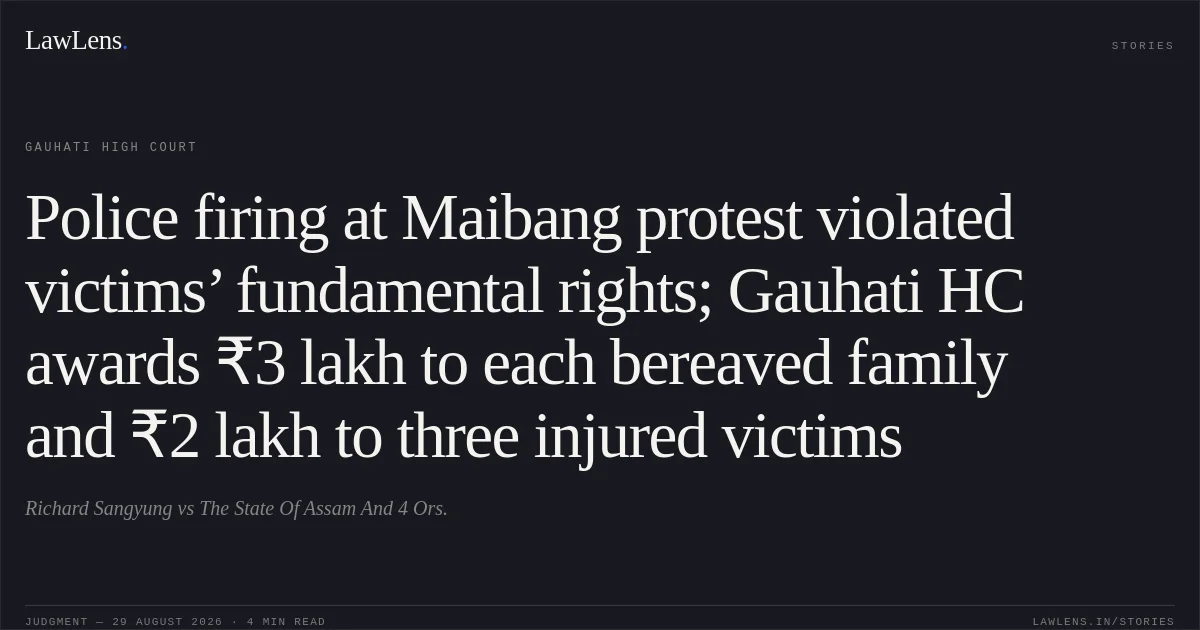
It nevertheless held that the police firing resulted in an Article 21 violation and directed the State to pay ₹3,00,000 to the family of each deceased victim, Praben Hakmus and Mithun Dibragede, and ₹2,00,000 each to the three seriously injured victims, Alpana Langthasa, Thaisring Hojai and Sunujit Sangyung.
Source reference: para. 17The compensation was ordered in addition to any amount already sanctioned by the Government and was to be released within three months of receipt of a certified copy of the order; the award was without prejudice to any civil claim for damages.
Source reference: paras. 18–20The writ petition was accordingly disposed of.
Source reference: para. 21Acts & Sections Cited
20 provisions across 3 statutes referred to in this judgment. Each provision opens on LawLens.
Indian Penal Code, 1860
Code of Criminal Procedure, 19732
Original Court PDF
Richard SangyungvsThe State Of Assam And 4 Ors.
Click to open original judgment
Original judgment, available to read, download and summarize on LawLens.in
![Courts will not interfere with transfers absent mala fides or violation of statutory rules.. M Ramya vs EMPLOYEES STATE INSURANCE CORPORATION (ESIC). CAT - ['Chennai']. LawLens](/stories/thumbnails/courts-will-not-interfere-with-transfers-absent-mala-fides-or-violation-of-statutory-rules-a6845e9ca6f548fca284c51c8351957f.webp)
![Courts cannot direct one-time recruitment age relaxation absent authority in the governing rules or advertisement.. UT OF PUDUCHERRY vs M ANDAL. CAT - ['Chennai']. LawLens](/stories/thumbnails/courts-cannot-direct-one-time-recruitment-age-relaxation-absent-authority-in-the-governing-895d78fde47143e2a8ed0207c4b6a44f.webp)
![A review cannot correct an allegedly erroneous decision absent an error apparent on the record.. Ajit Kumar Jha vs RAILWAY BOARD. CAT - ['Delhi']. LawLens](/stories/thumbnails/a-review-cannot-correct-an-allegedly-erroneous-decision-absent-an-error-apparent-on-the-re-8ac952fd4eba470c92f7da20af72a220.webp)