Facts
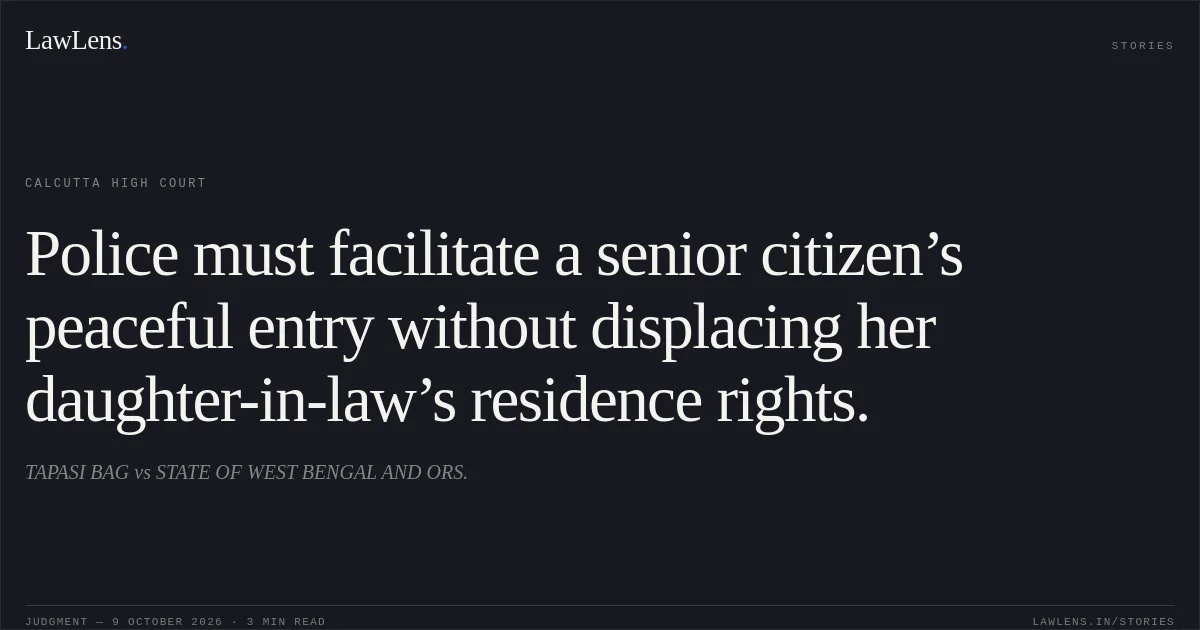
The petitioner, a senior citizen and widow, alleged that her daughter-in-law, respondent no. 5, had prevented her from residing at the petitioner’s house in Village Bargachia.
Source reference: para. 1–3The petitioner sought police assistance to secure peaceful entry and residence; she did not seek respondent no. 5’s eviction.
Source reference: para. 1–3A police case based on the petitioner’s complaint was investigated, and a final report declaring the case a “mistake of fact” was submitted before the Magistrate.
Source reference: para. 5(a)–(b)Matrimonial proceedings between the petitioner’s son and respondent no. 5 remained pending.
Source reference: para. 5(c)–(e), 6Respondent no. 5 stated that she did not oppose the petitioner residing at the premises, while the police report recorded that the petitioner had declined an invitation to return.
Source reference: para. 5(c)–(e), 6The Court considered whether it could direct the petitioner’s entry and residence under Article 226.
Source reference: para. 10Issues
1. Whether the High Court, exercising jurisdiction under Article 226, could direct that the petitioner be permitted to enter and reside in the premises she owned, without determining the parties’ matrimonial disputes.
Source reference: para. 9–102. Whether police assistance could be directed to secure the petitioner’s peaceful entry, having regard to respondent no. 5’s right to reside in her matrimonial home.
Source reference: para. 8, 14–15Law Applied
Article 226 confers plenary jurisdiction on the High Court, including power to direct police authorities to facilitate a senior citizen’s peaceful entry into and residence in self-acquired property without adjudicating title disputes, as recognised in Ramapada Basak v. State of West Bengal, 2021 SCC OnLine Cal 2161.
Source reference: para. 12Under S. Vanitha v. Deputy Commissioner, Bangalore Urban District, (2021) 15 SCC 730, the Maintenance and Welfare of Parents and Senior Citizens Act, 2007 seeks to protect elderly persons from being driven out of their homes, but a daughter-in-law’s residence rights must also be respected.
Source reference: para. 10Satish Chandra Ahuja v. Sneha Ahuja, (2021) 1 SCC 414, establishes that a daughter-in-law’s right to reside in a shared household does not confer an indefeasible right to exclude elderly owners; the competing rights must be balanced.
Source reference: para. 11Reasoning
The Court noted that the petitioner sought only her own peaceful entry and residence, not respondent no. 5’s eviction.
Source reference: para. 4Although respondent no. 5 was entitled to remain in her matrimonial home pending the matrimonial proceedings, that entitlement did not defeat the petitioner’s right, as a senior citizen and owner, to reside in her property.
Source reference: para. 8, 14The Court declined to determine allegations connected with the matrimonial discord and observed that the police-inactivity grievance, in its original form, had been overtaken by the registration, investigation, and final report in the criminal case.
Source reference: para. 9, 13It therefore balanced the parties’ rights by permitting the petitioner to return while preserving respondent no. 5’s residence rights and directing police assistance only if the petitioner’s entry was obstructed.
Source reference: para. 14–16Holding
The Court held that the petitioner could return to and reside at the premises on giving respondent no. 5 three days’ prior notice; respondent no. 5 was not to obstruct her entry or subject her to threats, harassment, or disturbance.
If entry was prevented, the Officer-in-Charge, Haripal Police Station, was directed to ensure the petitioner’s peaceful entry upon intimation.
Source reference: para. 15(b)The petitioner remained at liberty to pursue remedies against the final report before the Magistrate, and the Court’s observations were not to prejudice the pending proceedings.
Source reference: para. 15(c)–(d)The writ petition was allowed, with no order as to costs.
Source reference: para. 17Acts & Sections Cited
6 provisions across 2 statutes referred to in this judgment. Each provision opens on LawLens.
Indian Penal Code, 18605
Maintenance and Welfare of Parents and Senior Citizens Act, 20071
Original Court PDF
TAPASI BAGvsSTATE OF WEST BENGAL AND ORS.
Click to open original judgment
Original judgment, available to read, download and summarize on LawLens.in