Facts
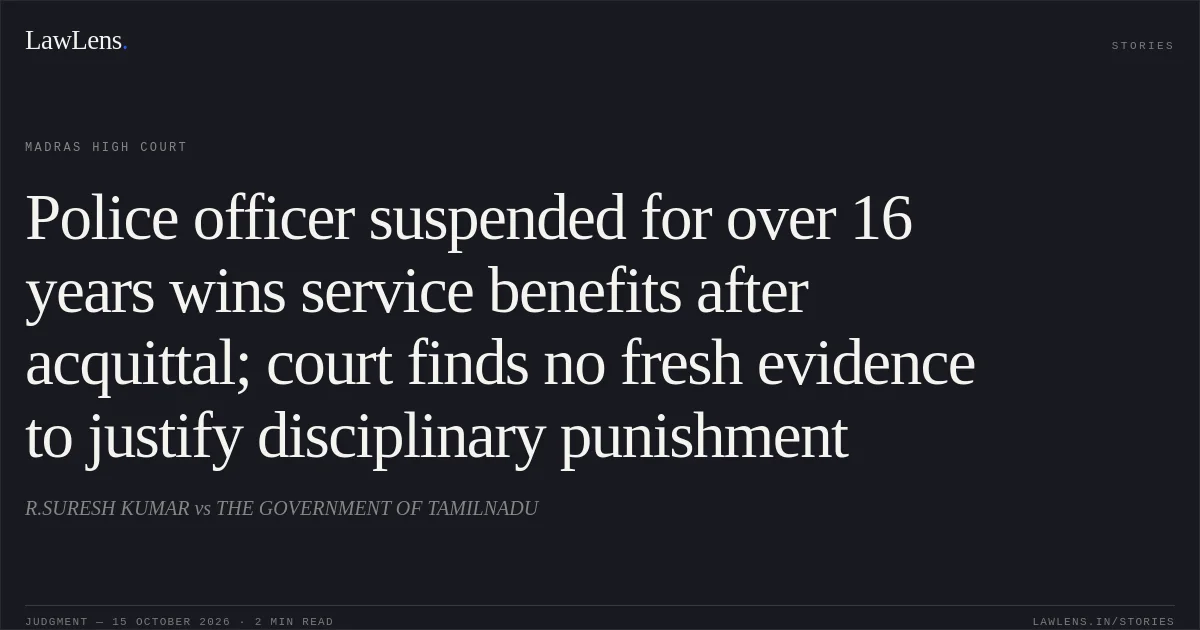
The petitioner, a Sub-Inspector of Police, was prosecuted for alleged bribery under Sections 7 and 13(2) read with Section 13(1)(d) of the Prevention of Corruption Act and was acquitted by the Special Court for Vigilance and Anti-Corruption on 28 November 2017.
Source reference: p. 2After his request for reinstatement, the respondents initiated disciplinary proceedings based on the same set of charges and evidence.
Source reference: p. 2The disciplinary authority imposed dismissal, later modified on appeal to withholding of increment for three years with cumulative effect; the punishment was further reduced in revision to withholding of increment for two years without cumulative effect and confirmed by the Government.
Source reference: p. 2–4In earlier writ proceedings, the High Court permitted the disciplinary inquiry to continue but directed the authorities to comply with Clause 3 of Police Standing Order 67 (PSO 67), including its restriction on departing from the criminal court’s conclusions absent fresh circumstances or identified evidentiary or procedural defects.
Source reference: p. 8–9The petitioner challenged the final punishment under Article 226
Source reference: p. 2–4, 8–9Issues
Whether the disciplinary authorities could find the petitioner guilty on the same charges and evidence after his acquittal, contrary to Clause 3 of PSO 67 and the directions in the earlier writ proceedings.
Source reference: p. 8–11Whether the punishment imposed in the disciplinary proceedings was liable to be set aside in light of the acquittal, the absence of fresh circumstances or defects, and the prolonged suspension and proceedings.
Source reference: p. 9–13Law Applied
Article 226 of the Constitution empowers the High Court to review the legality of disciplinary action.
Source reference: p. 6–9Clause 3 of PSO 67 permits departmental proceedings following an acquittal but provides that departmental authorities should not dissent from the criminal court’s conclusions unless fresh circumstances reveal lacunae or defects in the evidence or procedure before that court.
Source reference: p. 6–9The judgment also recognised the general distinction between proof beyond reasonable doubt in criminal proceedings and proof on a preponderance of probabilities in departmental proceedings; however, the earlier writ order made compliance with PSO 67 a specific constraint in this case.
Source reference: p. 6–9Reasoning
The Special Court had found, after considering the prosecution evidence, that the alleged kattapanchayat was not proved and that the alleged receipt of a bribe therefore did not arise.
Source reference: p. 5–6The disciplinary proceedings relied on the same charges and oral and documentary evidence, and the High Court found no fresh circumstances, evidentiary lacunae, or procedural defects that could justify departing from the criminal court’s conclusions.
Source reference: p. 9–13The petitioner’s failure to cross-examine witnesses in the inquiry did not overcome the specific limitation imposed by PSO 67 and the earlier court directions.
Source reference: p. 9–13The disciplinary finding was therefore contrary to those directions; the prolonged suspension and proceedings further supported interference.
Source reference: p. 9–13Holding
The High Court allowed the writ petition and set aside the disciplinary punishment, including the dismissal as modified by the appellate authority.
It directed the respondents to grant the petitioner attendant and consequential benefits, continuity of service, and notional promotion, and to settle the monetary benefits within twelve weeks of receiving the order.
Source reference: p. 11–12No costs were awarded; the connected miscellaneous petition was closed.
Source reference: p. 11–12Acts & Sections Cited
2 provisions across 1 statute referred to in this judgment. Each provision opens on LawLens.
Prevention of Corruption Act, 19882
Original Court PDF
R.SURESH KUMARvsTHE GOVERNMENT OF TAMILNADU
Click to open original judgment
Original judgment, available to read, download and summarize on LawLens.in