Facts
The petitioners are the legal representatives of the Decree Holder, Sri N. Kempaiah, who obtained a permanent injunction decree against the respondents in O.S.No.124/2018 on 03.08.2020.
Source reference: para. 2After the decree was upheld by both the First Appellate Court and the High Court in a Second Appeal (subsequently withdrawn), the original plaintiff passed away.
Source reference: para. 2The petitioners filed an execution petition under Order XXI Rule 32 of the CPC (Ex.No.43/2025) and moved an interlocutory application (I.A.No.1) under Section 151 of the CPC seeking police protection to erect a compound wall to protect their possession.
Source reference: para. 2The Trial Court (Executing Court) dismissed the application, holding that police protection cannot be granted under Section 151 when the specific procedure under Order XXI Rule 32 (arrest/attachment) exists for enforcing injunctions.
Source reference: para. 4Aggrieved by this dismissal, the petitioners approached the High Court.
Source reference: para. 5Issues
1. Whether the executing court was justified in dismissing the application under Section 151 of the CPC as not maintainable only on the ground that the Decree Holder has to invoke Order XXI Rule 32 of the CPC?
Source reference: para. 11Law Applied
The Court primarily applied Order XXI Rule 32 of the Code of Civil Procedure (CPC), which governs the execution of decrees for injunction.
Source reference: para. 11Section 151 of the CPC, which grants the court inherent powers to prevent the abuse of the process of the court and to ensure justice where the Code is silent.
Source reference: para. 11The principle from Raja Venkateswarlu v. Mada Venkata Subbaiah (2017), which held that quoting the wrong provision is not fatal to an application if jurisdiction otherwise exists.
Source reference: para. 12The precedent from Balakrishna K.P. v. K.P. Puttaraju (2025), establishing that courts have the duty to provide police aid to protect possession in exceptional circumstances to prevent parties from taking the law into their own hands.
Source reference: para. 6Reasoning
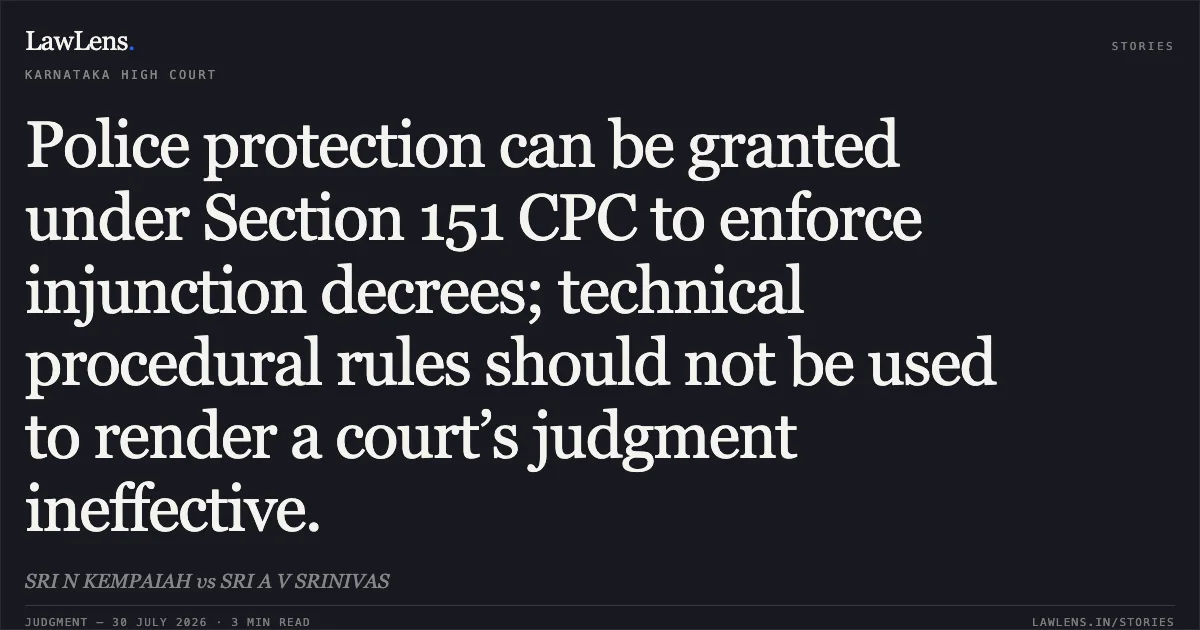
The High Court found that while Order XXI Rule 32 describes the mode of execution for injunctions, it does not specifically mention police assistance; therefore, the inherent power under Section 151 must be invoked to supplement the procedure.
Source reference: para. 11The court observed that the petitioners did not file Section 151 as an independent execution petition but as an interlocutory prayer within a validly filed execution proceeding under Order XXI Rule 32.
Source reference: para. 13The court reasoned that an Executing Court must not adopt a technical approach that renders a decree ineffective, noting that procedural laws are the "handmaid of justice".
Source reference: para. 14It further clarified that although police protection should not be granted mechanically, the court is obligated to conduct a factual inquiry into allegations of wilful disobedience or obstruction before deciding the merits of the application, rather than dismissing it on maintainability grounds.
Source reference: para. 14Holding
The court held that an application for police protection under Section 151 is maintainable during execution proceedings and that the Executing Court's refusal to examine it on merits amounted to a failure to exercise vested jurisdiction.
The High Court allowed the writ petition and set aside the order dated 03.02.2026 passed by the Additional Civil Judge, Ramanagara. The matter was remanded to the Trial Court with directions to conduct an inquiry into the alleged interference and provide a reasonable opportunity for both sides to be heard.
Source reference: para. 15Original Court PDF
SRI N KEMPAIAHvsSRI A V SRINIVAS
Click to open original judgment
Original judgment, available to read, download and summarize on LawLens.in