Facts
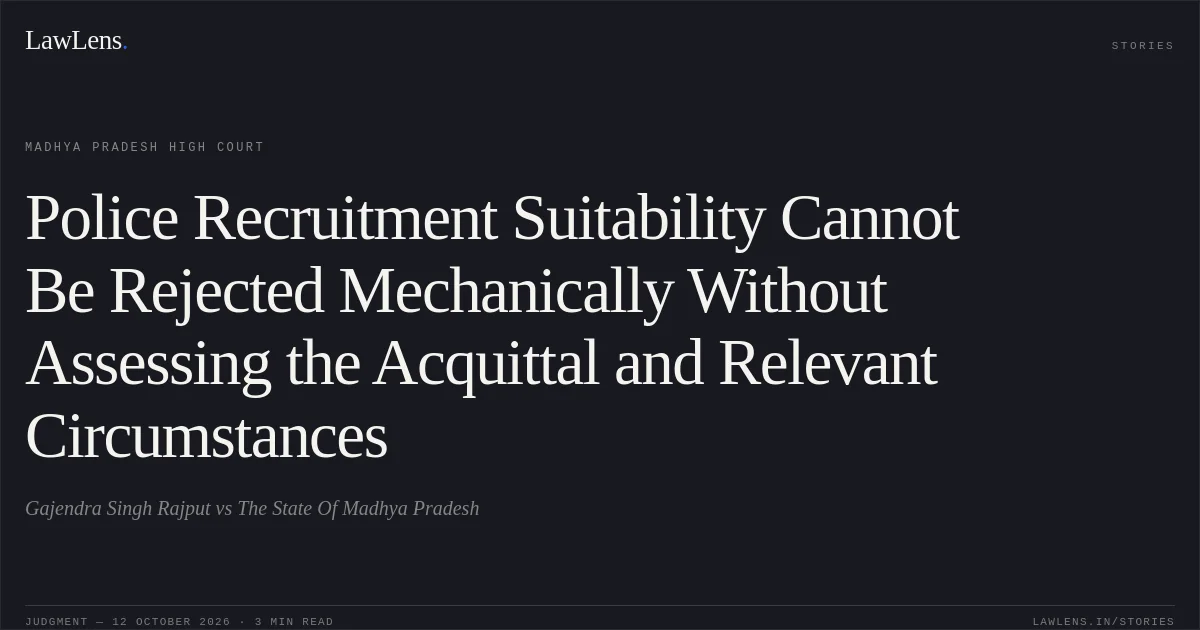
Petitioner No. 2 challenged the rejection of his candidature for Constable GD (DEF) after he disclosed that he had been charged in Crime No. 113/2025 under Sections 74, 75(1)(iv), 78, 126(2) and 3(5) of the Bharatiya Nyaya Sanhita, 2023.
Source reference: para. 5He was acquitted by the trial court on 27 June 2025; the Screening Committee nevertheless found him unsuitable, citing the nature of the alleged offences and a purported criminal mindset.
Source reference: para. 7Petitioner No. 2 contended that he had made a full disclosure, that the rejection did not address the acquittal or the applicable departmental circular, and that similarly situated candidates had been appointed.
Source reference: paras. 6–7Petitioner No. 1 did not press his claim after securing appointment in the Railway Protection Force; his petition was dismissed as not pressed, and the petition continued for petitioner No. 2.
Source reference: paras. 1–3Issues
1. Whether the Screening Committee could reject petitioner No. 2’s candidature mechanically on the basis of the charged offences and the fact of acquittal, without considering the circumstances of the case and the trial court’s findings.
Source reference: paras. 5–6, 102. Whether the impugned rejection required reconsideration under the applicable departmental circular and Supreme Court principles governing assessment of a candidate’s suitability after disclosure and acquittal.
Source reference: paras. 6, 10–11Law Applied
Under Article 226 of the Constitution, the Court may review an administrative suitability decision for arbitrariness or non-application of mind.
Source reference: para. 10Avtar Singh v. Union of India, (2016) 8 SCC 471, and Pawan Kumar v. Union of India, (2022) 12 SCC 364, require the competent authority to assess the totality of the circumstances—including the nature of the allegations, the candidate’s role, the judgment of acquittal and subsequent conduct—rather than act mechanically on the registration of an FIR or the technical classification of an offence.
Source reference: para. 10The Court also directed reconsideration in accordance with the Madhya Pradesh Home Department Circular dated 24 July 2018.
Source reference: para. 11The respondents relied on State of M.P. v. Parvez Khan, (2015) 2 SCC 591, Union Territory, Chandigarh Administration v. Pradeep Kumar, (2018) 1 SCC 797, and Union of India v. Methu Meda, (2022) 1 SCC 1, to argue that acquittal alone does not create an entitlement to appointment and that police suitability may be assessed by the employer.
Source reference: para. 8Reasoning
The impugned orders referred to the FIR sections and inferred a criminal mindset but did not examine the trial court’s findings, the petitioner’s disclosure, or the evidence recorded at trial.
Source reference: para. 10The trial court had recorded that the complainant withdrew her allegations and that the prosecution failed to prove the charges beyond reasonable doubt.
Source reference: para. 7Although suitability remained for the employer to determine, the Committee’s decision was not shown to reflect the objective, case-specific assessment required by Avtar Singh and Pawan Kumar.
Source reference: para. 10The petitioner No. 1’s provisional selection for the RPF after disclosure of the same antecedent was also identified as a matter warranting consideration.
Source reference: para. 10Holding
The Court quashed the impugned orders dated 9 January 2026 and 2 March 2026 and remanded petitioner No. 2’s suitability for fresh consideration under the 24 July 2018 circular, the cited Supreme Court decisions, the trial court’s acquittal judgment and the RPF-related development.
The competent authority was directed to issue a reasoned order within 60 days of receiving a certified copy; if petitioner No. 2 is found suitable, appointment orders with notional seniority from the date his batchmates were appointed are to follow within two weeks.
Source reference: para. 11The petition was disposed of without an order as to costs.
Source reference: paras. 12–13Acts & Sections Cited
7 provisions across 2 statutes referred to in this judgment. Each provision opens on LawLens.
Bharatiya Nyaya Sanhita, 20235
Indian Penal Code, 18602
Original Court PDF
Gajendra Singh RajputvsThe State Of Madhya Pradesh
Click to open original judgment
Original judgment, available to read, download and summarize on LawLens.in