Facts
Maple Infra InvIT Investment Manager Pvt. Ltd. constituted an Internal Complaints Committee (“ICC”) under the Sexual Harassment of Women at Workplace (Prevention, Prohibition and Redressal) Act, 2013 (“POSH Act”). Respondent No. 2, formerly employed as General Counsel by Maple Infra, submitted a complaint to the ICC on 28 October 2023 alleging, inter alia, gender bias, discrimination, retaliation and conduct having a sexual tone.
Source reference: paras. 3–5After the complaint was referred to an external ICC member due to a conflict objection against one ICC member, the ICC communicated on 30 October 2023 that it had reviewed and deliberated upon the allegations and determined that they did not involve a “sexual element”; it therefore declined to conduct an inquiry.
Source reference: paras. 4, 26–28Respondent No. 2 challenged the communication under Section 18(1) of the POSH Act before the Industrial Court, Mumbai. The petitioners questioned the maintainability of that appeal, contending that the ICC communication was not a “recommendation” under Section 13 and that no inquiry under Section 11 had been conducted.
Source reference: paras. 6–7, 9–12The Industrial Court rejected the maintainability objections, set aside the ICC communication and remanded the matter to the ICC for a fresh inquiry, although the parties had primarily argued only the issue of maintainability. The petitioners consequently invoked the writ jurisdiction of the High Court.
Source reference: paras. 41–46Issues
Whether a communication by the ICC stating that a complaint does not involve an element of sexual harassment, and declining to conduct an inquiry, constitutes a “recommendation” under Section 13(2) of the POSH Act and is appealable under Section 18?
Source reference: paras. 25, 51–58Whether the Industrial Court was justified in deciding the merits of the appeal and remanding the matter to the ICC while it had taken up only the maintainability issue?
Source reference: paras. 41–49, 84–88Whether the objections concerning Mr. Rohit Anand’s separate employment with CDPQ and his location outside India deprived the Industrial Court of jurisdiction at the maintainability stage?
Source reference: para. 97Whether the petitioners’ objection that the complaint contained no element of sexual harassment should be decided separately as a preliminary issue or together with the merits of the statutory appeal?
Source reference: paras. 98–99Law Applied
The Court applied Sections 2(n) and 3 of the POSH Act, defining and prohibiting sexual harassment; Section 9, permitting an aggrieved woman to submit a complaint; Section 11(1), which mandates that the ICC “shall” inquire into a complaint of sexual harassment; Section 13(2), under which the ICC may recommend that no action be taken where allegations are not proved; and Section 18, which provides an appeal against recommendations under Section 13.
Source reference: paras. 29–34The Court held that the statutory appeal under Section 18 must be construed in the context of the mandatory inquiry obligation under Section 11 and the remedial purpose of the POSH Act: an ICC’s decision rejecting a complaint on the ground that it contains no sexual element is, for appellate purposes, a recommendation under Section 13(2), even if the ICC failed to conduct the prescribed inquiry.
Source reference: paras. 53–58The Court relied on the welfare-oriented interpretation of the POSH Act in Vishakha v. State of Rajasthan, Dr. Sohail Malik v. Union of India, and Regional Provident Fund Commissioner v. Hooghly Mills Co. Ltd., and considered the approach in Poonam Vijay Thakkar v. Aditya Birla Capital Shared Services Ltd. and Sharanjeet Kaur v. IDBI Bank Ltd., which recognised an appellate remedy against rejection or closure of a sexual-harassment complaint.
Source reference: paras. 59–62, 78–82It further applied the principles of natural justice and procedural fairness, holding that a tribunal cannot decide the merits of a proceeding without notice and opportunity to address those merits.
Source reference: paras. 84–85, 95–96Reasoning
The Court distinguished between a complete refusal by an employer to take cognizance of a complaint and a decision by the ICC, after receiving and considering the complaint, that the allegations do not constitute sexual harassment. In the present case, the complaint had been received, referred to the ICC, deliberated upon and expressly rejected through a reasoned communication; it was therefore a substantive decision capable of operating as a recommendation under Section 13(2).
Source reference: paras. 63–72A contrary interpretation would enable an ICC to avoid appellate scrutiny simply by rejecting complaints at the threshold without conducting the mandatory inquiry under Section 11, thereby frustrating the protective and remedial object of the POSH Act.
Source reference: paras. 55–58, 62The availability of a discretionary writ remedy under Article 226 could not eliminate or restrict the broader statutory appeal under Section 18.
Source reference: paras. 69–72However, the Industrial Court exceeded its limited remit: it was hearing only the maintainability application, yet it made findings on the allegedly unhealthy workplace, the offensive nature of the expressions used, the requirement of an inquiry and the merits of the complaint without giving the parties notice or a proper opportunity of hearing.
Source reference: paras. 41–49, 84–96Since whether the complaint actually disclosed sexual harassment was a merits issue and a jurisdictional fact relevant to directing an ICC inquiry, it had to be decided by the Industrial Court in the properly conducted appeal, not summarily or piecemeal.
Source reference: paras. 65, 85, 98–99The separate-employer and territorial objections concerning Mr. Anand were likewise left open for determination with the merits.
Source reference: para. 97Holding
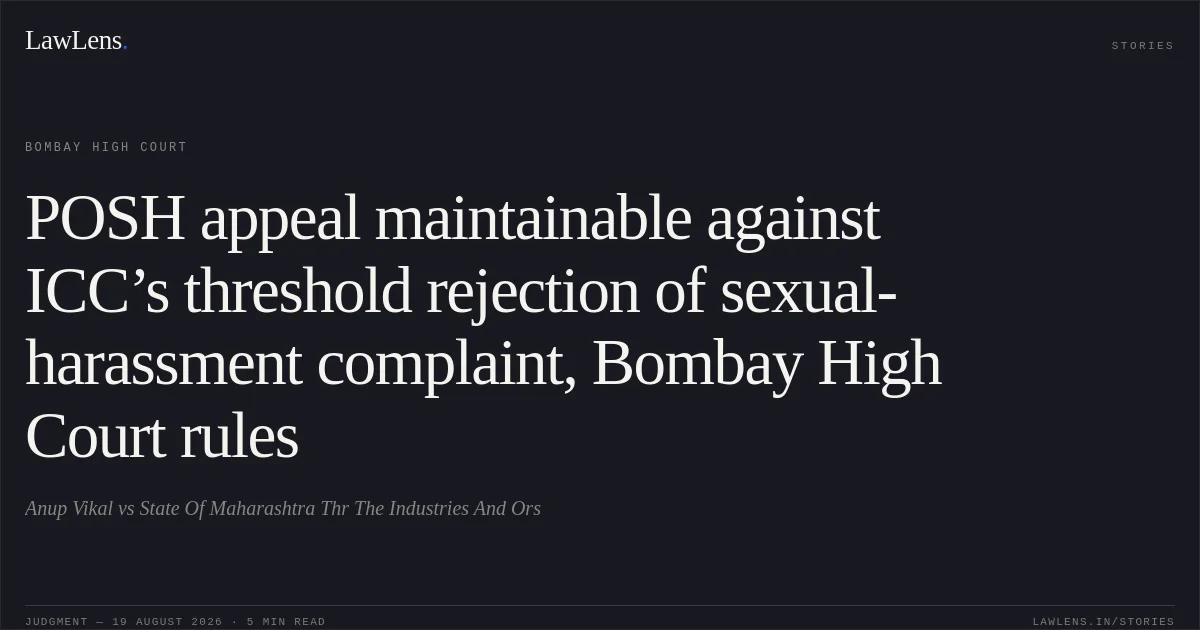
The High Court held that the ICC’s communication dated 30 October 2023, stating that the complaint did not involve a sexual element and declining to inquire into it, constituted a recommendation under Section 13(2) of the POSH Act. Consequently, the appeal filed under Section 18 was held to be maintainable and the petitioners’ maintainability applications were dismissed.
However, the Industrial Court’s order dated 4 May 2026 was set aside to the extent that it decided the merits, quashed the ICC communication and remanded the matter directly to the ICC without proper adjudication or hearing.
Source reference: paras. 84–88, 95–96, 100(ii)The statutory appeal was remanded to the Industrial Court for fresh decision on merits, with all parties’ contentions kept open, preferably within four months.
Source reference: para. 101The writ petitions were partly allowed and disposed of without costs.
Source reference: para. 102Acts & Sections Cited
12 provisions across 2 statutes referred to in this judgment. Each provision opens on LawLens.
Sexual Harassment of Women at Workplace (Prevention, Prohibition and Redressal) Act, 2013
Indian Penal Code, 18601
Original Court PDF
Anup VikalvsState Of Maharashtra Thr The Industries And Ors
Click to open original judgment
Original judgment, available to read, download and summarize on LawLens.in