Facts
The Petitioner, a permanent Government servant (LDC), was accused of sexual harassment by Respondent No. 4 (Complainant), who is a person with an intellectual disability
Source reference: para. 4-5During the Internal Complaints Committee (ICC) inquiry, Respondent No. 4 retracted her complaint, stating she was forcibly instigated and threatened by Respondent No. 3 (the Principal) to sign a pre-prepared false complaint
Source reference: para. 7, 14Relying on this retraction, the ICC closed the proceedings but recorded that the Complainant was influenced by an "unknown source"
Source reference: para. 8-9The Petitioner appealed to the Industrial Tribunal, seeking to name Respondent No. 3 and initiate disciplinary action against him
Source reference: para. 11The Tribunal dismissed the appeal as non-maintainable, holding that the Petitioner was not directly "aggrieved" by the ICC's findings and that Respondent No. 3 could not be prosecuted under Section 14 of the POSH Act based solely on a retraction letter
Source reference: para. 12Issues
1. Whether the Petitioner qualifies as a "person aggrieved" under Section 18 of the POSH Act to challenge an ICC report that omits the specific source of a malicious complaint
Source reference: para. 17-182. Whether the findings of the ICC can be modified to name a third-party instigator when that person is specifically identified in a retraction statement
Source reference: para. 20-213. Whether disciplinary action can be directed against a person for instigating a false complaint under Section 14 of the POSH Act
Source reference: para. 22-26Law Applied
Section 18 of the Sexual Harassment of Women at Workplace (Prevention, Prohibition and Redressal) Act, 2013 ('POSH Act'), which grants the right of appeal to "any person aggrieved" by ICC recommendations
Source reference: p. 11Section 14 of the POSH Act, which provides for punishment only against the woman or the person making the complaint if the allegation is found to be malicious
Source reference: p. 15-16Section 9 regarding who can file a complaint, noting the definition of "aggrieved woman" under Section 2(a)
Source reference: p. 16-17Reasoning
The Court found that the Petitioner was indeed an "aggrieved person" because the ICC’s conclusion regarding an "unknown source" was factually inconsistent with the very evidence it relied upon—the retraction letter—which explicitly named Respondent No. 3
Source reference: para. 18, 20The Court held that the Tribunal committed a jurisdictional error by dismissing the appeal on maintainability, as any person affected by the ICC's recommendations (including the accused) has a statutory right to appeal
Source reference: para. 19Regarding the prayer for disciplinary action, the Court reasoned that Section 14 is narrowly drafted to penalize only the "complainant" (aggrieved woman or person acting on her behalf under Section 9); it does not provide a mechanism to punish third-party "instigators"
Source reference: para. 25-26Therefore, while the ICC report could be corrected to reflect the facts, the POSH Act itself could not be used as a forum for disciplinary proceedings against Respondent No. 3
Source reference: para. 26Holding
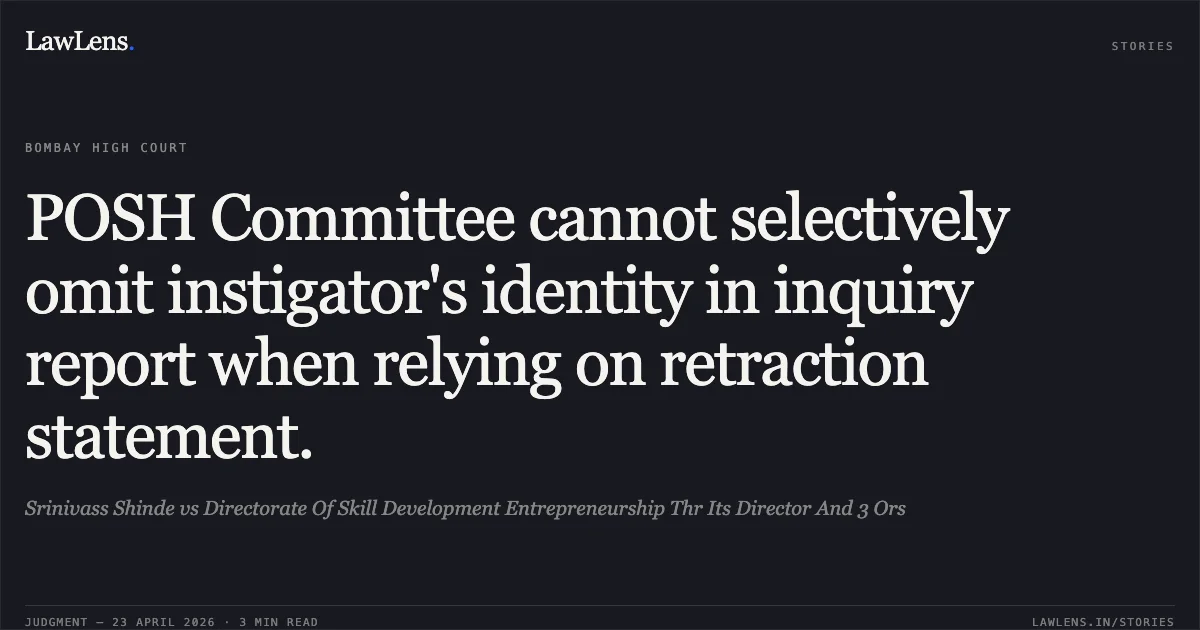
The High Court quashed the Industrial Tribunal’s order and partly allowed the Petition. It held that the ICC cannot selectively omit names when relying on a retraction statement.
The Court directed that the ICC report's conclusion be modified to state: “The Respondent No. 3 instigated the Respondent No. 4 to file a false sexual harassment case against the Petitioner”
Source reference: para. 27The prayer for directing disciplinary action under the POSH Act was rejected, though the Petitioner was granted liberty to initiate appropriate proceedings against Respondent No. 3 before other legal forums
Source reference: para. 26, 29Acts & Sections Cited
6 provisions across 1 statute referred to in this judgment. Each provision opens on LawLens.
Sexual Harassment of Women at Workplace (Prevention, Prohibition and Redressal) Act, 20136
Original Court PDF
Srinivass ShindevsDirectorate Of Skill Development Entrepreneurship Thr Its Director And 3 Ors
Click to open original judgment
Original judgment, available to read, download and summarize on LawLens.in