Facts
The Appellants, former employees of the Delhi Vidyut Board (DVB), were transferred to successor government power companies (Respondents) following the reorganization of DVB via a Tripartite Agreement dated 28.10.2000.
Source reference: para 9-10Between 2013 and 2025, the Respondents issued various memoranda and charge-sheets to the Appellants for alleged misconduct.
Source reference: para 11-17The Appellants challenged these disciplinary actions in W.P.(C) No. 1106/2026, contending that as erstwhile DVB employees, they retained "Government servant" status and no disciplinary proceedings could be initiated without the prior approval of the President of India under Rules 13 and 14 of the CCS (CCA) Rules, 1965.
Source reference: para 8, 20The Single Judge dismissed the Writ Petition on 27.01.2026 on grounds of misjoinder of causes of action, delay, and lack of merit.
Source reference: para 7, 23-29The Appellants preferred this intra-court appeal against that dismissal.
Source reference: no citationIssues
1. Whether the disciplinary proceedings initiated by the successor companies were void for lack of prior approval from the President of India under Rules 13 and 14 of the CCS (CCA) Rules.
Source reference: para 362. Whether the Appellants continued to be governed by the CCS (CCA) Rules post-absorption into the transferee companies.
Source reference: para 413. Whether the Writ Petition was liable to be dismissed on the grounds of misjoinder of causes of action and laches.
Source reference: para 37, 44Law Applied
Rule 6 of the Delhi Electricity Reform (Transfer Scheme) Rules, 2001, which mandates that upon transfer, employees cease to be in the service of the DVB and their service conditions are governed by the transferee's regulations.
Source reference: para 39The doctrine in Brij Mohan v. Government of NCT of Delhi & Anr., establishing that once absorption is complete, a servant cannot insist on the transferor’s disciplinary architecture.
Source reference: para 40State of Jharkhand & Anr. v. Rukma Kesh Mishra (2025 SCC OnLine SC 676), which held that the necessity of approval for initiating disciplinary action depends strictly on the construction of the specific applicable rules.
Source reference: para 24, 42Reasoning
The Court reasoned that under Rule 6(6) of the Transfer Scheme Rules, the Appellants’ legal link to the DVB was severed upon transfer.
Source reference: para 39While Rule 6(7) provided a temporary continuation of old service rules as an interim arrangement, this lasted only until the transferee companies framed their own regulations.
Source reference: para 39, 41The Court found that disciplinary control had fully migrated to the Respondents, and the Appellants failed to prove that the President remained their appointing or disciplinary authority in the post-transfer regime.
Source reference: para 25, 40The Court further noted that a single writ petition challenging seven distinct disciplinary actions occurring over a decade (2013–2025) constituted a misjoinder of causes of action and was barred by unexplained laches.
Source reference: para 28-29, 44The subsequent Notification delineating internal hierarchies did not retrospectively invalidate previous charge-sheets issued by competent authorities.
Source reference: para 28, 43Holding
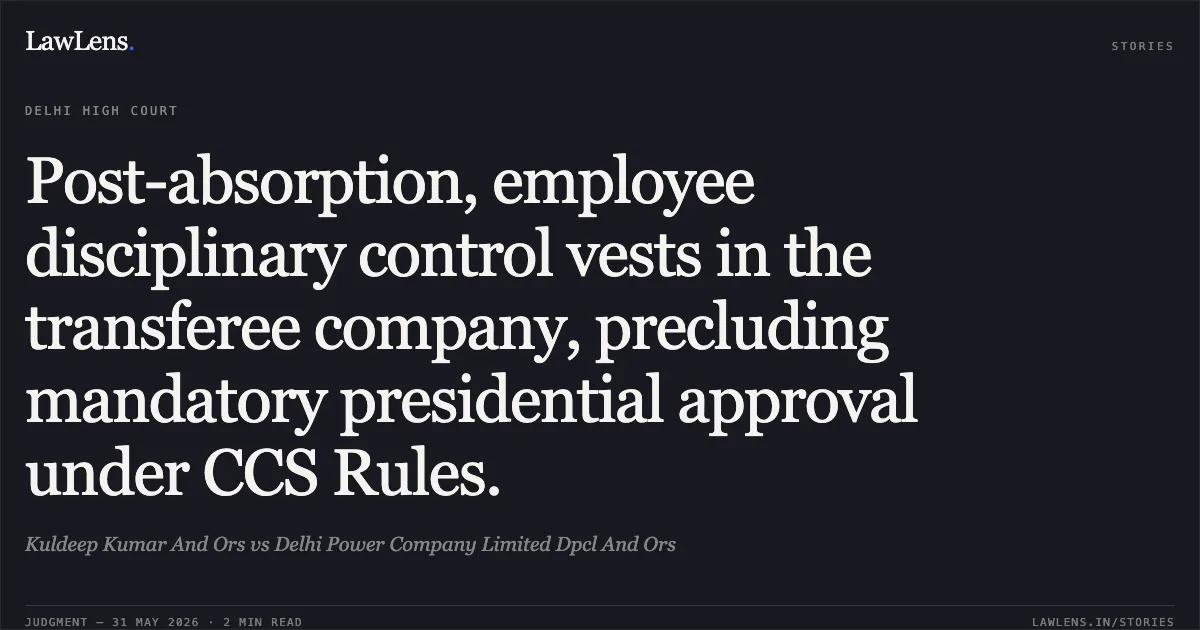
The Court answered the issues in the negative, holding that the CCS (CCA) Rules do not apply in perpetuity post-absorption and Presidential approval was not required for the Respondents to initiate disciplinary action.
The Court upheld the Single Judge’s order, finding no merit in the challenge against the charge-sheets or the internal Notification and dismissed the Appeal, while preserving the Appellants’ right to raise legal defenses within their respective ongoing disciplinary proceedings.
Source reference: para 43, 44-45Acts & Sections Cited
1 provisions across 1 statute referred to in this judgment. Linked provisions open on LawLens.
Electricity (Supply) Act, 19481
Original Court PDF
Kuldeep Kumar And OrsvsDelhi Power Company Limited Dpcl And Ors
Click to open original judgment
Original judgment, available to read, download and summarize on LawLens.in

![Authorities must decide pensionary and retiral-benefit claims through a reasoned order within eight weeks.. Habibullah khan vs HOME DEPARTMENT. CAT - ['Srinagar']. LawLens](/stories/thumbnails/authorities-must-decide-pensionary-and-retiral-benefit-claims-through-a-reasoned-order-wit-d0cbe8a8119c48fbabe7df9f2d353488.webp)
![Continuous temporary-status service entitles dependants to family pension despite absence of formal regularisation.. SMT SUSHILA DEVI vs DEPARTMENT OF POSTS. CAT - ['Allahabad']. LawLens](/stories/thumbnails/continuous-temporary-status-service-entitles-dependants-to-family-pension-despite-absence-0006d1f107144299ac3b945914aae9ff.webp)