Facts
On September 5, 2010, the claimant (Manoj Jerambhai Vasoya) was riding a motorcycle when he was struck by a truck.
Source reference: p. 2The claimant alleged the truck driver turned suddenly without an indicator, causing the claimant’s left leg to be amputated below the knee.
Source reference: p. 2, 5While the FIR was lodged against the truck driver, the police subsequently filed a charge-sheet against the claimant; however, the claimant was later acquitted by the Trial Court.
Source reference: p. 4The Motor Accident Claims Tribunal (MACT), Jamnagar, awarded the claimant ₹14,54,515 with 9% interest, holding the truck driver 80% negligent.
Source reference: p. 1-2The Insurance Company appealed on the grounds of contributory negligence and challenged the quantum of future economic loss, noting the claimant's salary increased during the pendency of the petition.
Source reference: p. 3-4Issues
1. Whether the Tribunal erred in holding the truck driver 80% negligent despite a charge-sheet being filed against the claimant.
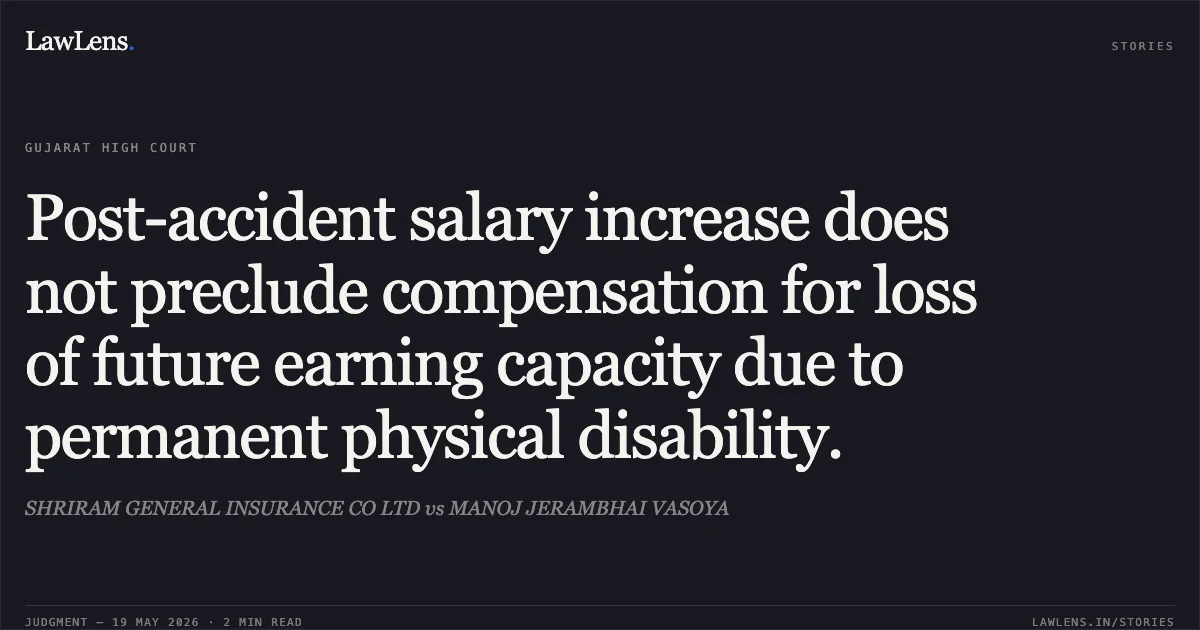
Source reference: p. 3, 52. Whether a claimant is entitled to compensation for future loss of income if their actual earnings increased after the accident.
Source reference: p. 4, 6Law Applied
In motor accident claims, evidence led before the Tribunal carries more weight than police papers/charge-sheets, as established in National Insurance Company Limited v. Chamundeswari Ors. (2021) 18 SCC 596.
Source reference: p. 5-6Regarding quantum, the court relied on the Supreme Court precedent in Soni Sharma v. Oriental Insurance Company Limited Ors. (2026 ACJ 109), which establishes that a mere increase in income or continuation in service does not negate a claim for loss of earning capacity or future promotional prospects, especially in roles requiring physical fitness.
Source reference: p. 6-7Reasoning
The High Court rejected the appellant's argument on negligence, noting that while the charge-sheet named the claimant, the Panchnama and FIR supported the claimant's version that the truck turned suddenly without an indicator.
Source reference: p. 5Following Chamundeswari, the court prioritized the unrebutted oral testimony of the claimant over the police charge-sheet.
Source reference: p. 6On the issue of quantum, the court reasoned that income increases are often tied to inflation and the cost-of-living index rather than a lack of disability impact.
Source reference: p. 6Applying the Soni Sharma doctrine, the court held that physical impairment (leg amputation) inherently affects long-term efficiency and promotional prospects, making the compensation for future loss of income valid regardless of the claimant's post-accident salary hike.
Source reference: p. 7Holding
The High Court dismissed the appeal and upheld the Tribunal’s award of ₹14,54,515.
The court held that the 80:20 apportionment of negligence was justified based on the evidence and confirmed that future economic loss is compensable even if the claimant’s current income has risen.
Source reference: p. 6, 7The court ordered the Registry to transmit any deposited amounts to the Tribunal and returned the Record and Proceedings.
Source reference: p. 7Acts & Sections Cited
1 provisions across 1 statute referred to in this judgment. Each provision opens on LawLens.
Motor Vehicles Act, 19881
Original Court PDF
SHRIRAM GENERAL INSURANCE CO LTDvsMANOJ JERAMBHAI VASOYA
Click to open original judgment
Original judgment, available to read, download and summarize on LawLens.in


