Facts
The respondents, Junior Engineers in the Railways, were appointed and then sent for training before being regularised.
Source reference: p. 2–3The Railway authorities excluded that post-appointment training period when calculating qualifying service for Modified Assured Career Progression (MACP) benefits.
Source reference: p. 2–3, 7–8The Central Administrative Tribunal allowed their application, directing that the training period be counted, subject to the respondents’ eligibility under the Scheme.
Source reference: p. 3The Union of India challenged that decision before the Delhi High Court.
Source reference: p. 6Issues
1. Whether training undertaken after appointment but before regularisation must count as qualifying service for MACP benefits.
Source reference: p. 1–2, 7–82. Whether the Supreme Court’s ruling concerning the Assured Career Progression (ACP) Scheme applies to the respondents’ claims under the MACP Scheme.
Source reference: p. 7–8Law Applied
Clause 9 of the Annexure to the Railway Board circular dated 10 June 2009 provides that regular service for MACP purposes commences from joining a post in the direct-entry grade on a regular basis, and excludes service rendered on an ad hoc or contractual basis before regular appointment, including pre-appointment training; it does not expressly exclude training undertaken after appointment but before regularisation.
Source reference: p. 7–8In Union of India v. Ashok Kumar Barik, the Supreme Court declined to interfere with High Court orders where employees received regular pay and increments from the outset, holding that the post-appointment training period could not be excluded under the ACP policy.
Source reference: p. 6The judgment also referred to the principle that similarly situated employees should ordinarily receive equal treatment, subject to exceptions such as delay, laches, or acquiescence.
Source reference: p. 5–6Reasoning
The respondents’ training occurred after appointment, not before appointment, and their pre-regularisation service was neither ad hoc nor contractual.
Source reference: p. 7–8The High Court therefore held that Clause 9 did not bar counting that period: its exclusion concerned pre-appointment training and specified forms of service, not post-appointment training before regularisation.
Source reference: p. 8The Court further considered the Supreme Court’s reasoning in Ashok Kumar Barik—including that training followed appointment—and rejected the distinction based solely on the fact that the earlier case concerned ACP rather than MACP.
Source reference: p. 6, 8Holding
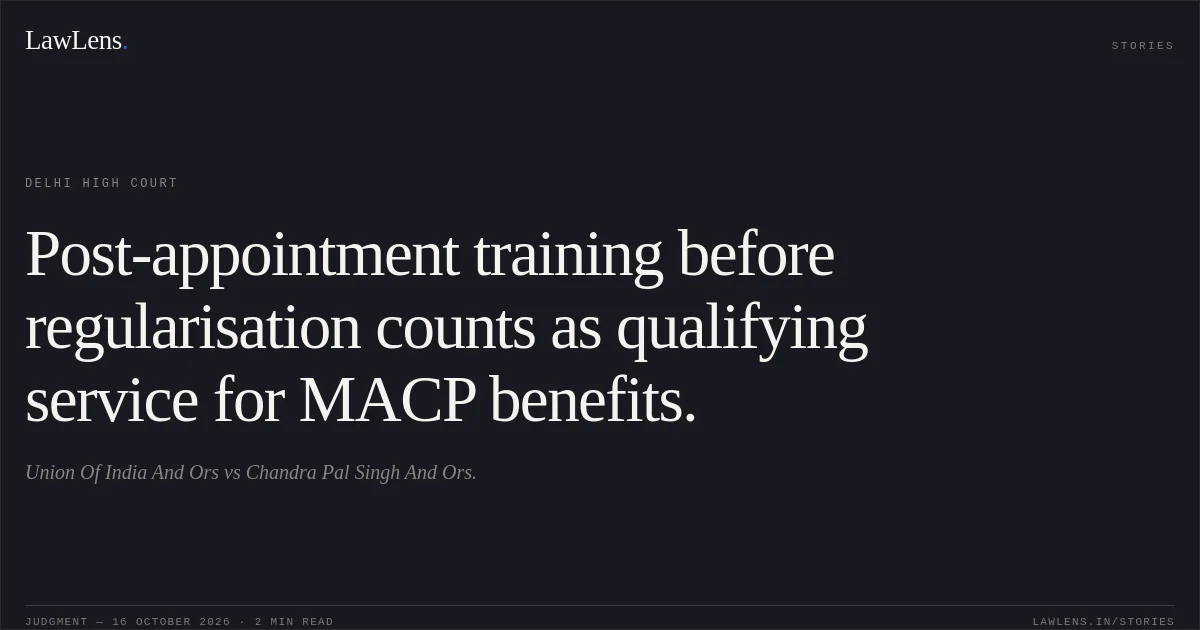
The Court held that post-appointment training undertaken before regularisation must be counted as qualifying service for MACP purposes in these circumstances, and that the ACP ruling in Ashok Kumar Barik could not be distinguished merely because the present claim arose under MACP.
It affirmed the Tribunal’s judgment in its entirety and dismissed the writ petition in limine.
Source reference: p. 9Original Court PDF
Union Of India And OrsvsChandra Pal Singh And Ors.
Click to open original judgment
Original judgment, available to read, download and summarize on LawLens.in