Facts
The petitioner retired on 31 May 2023.
Source reference: pp. 2–3By order dated 19 January 2024, the second respondent ordered recovery of alleged excess payments said to have commenced in 1997.
Source reference: pp. 2–3The petitioner was a Group C employee, and the respondents did not allege that the excess payments resulted from his misrepresentation.
Source reference: pp. 2–3The petitioner objected to recovery but accepted pay refixation.
Source reference: pp. 2–3He challenged the recovery order under Article 226 of the Constitution.
Source reference: p. 1Issues
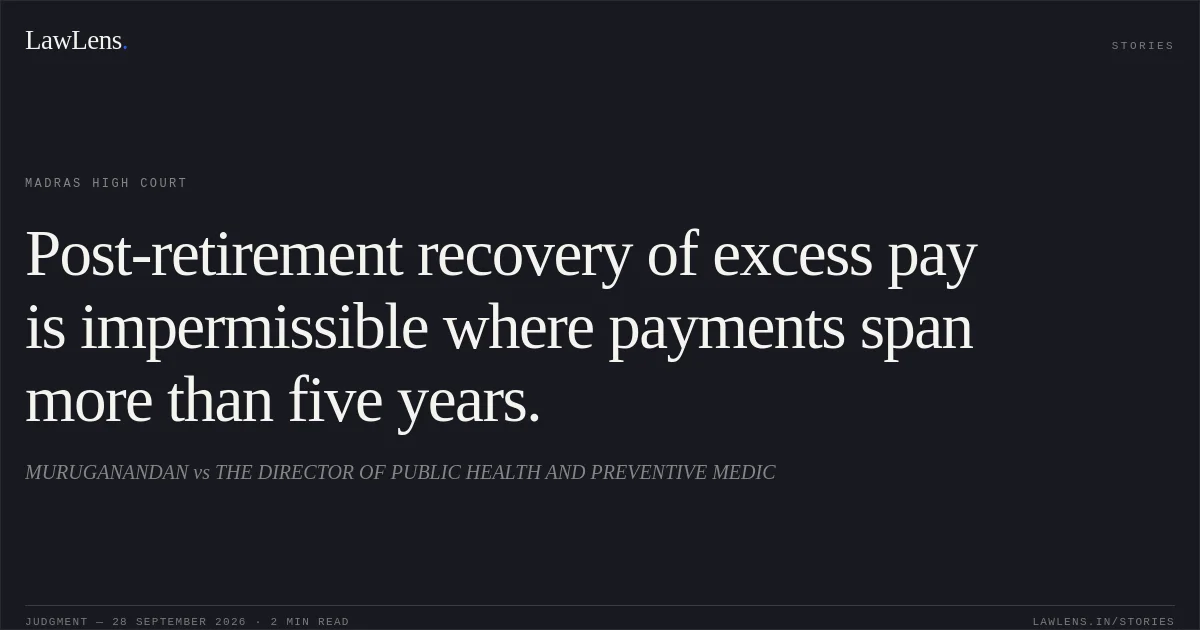
Whether recovery of alleged excess salary paid to the petitioner could be ordered after his retirement, where the payments had commenced more than five years before the recovery order.
Source reference: pp. 2–3Whether the respondents’ pay refixation could be sustained notwithstanding the prohibition on recovery.
Source reference: pp. 2, 4–5Law Applied
In State of Punjab v. Rafiq Masih (White Washer), (2015) 4 SCC 334, the Supreme Court identified circumstances in which recovery of mistaken excess payments is impermissible, including recovery from Group C or Group D employees; from retired employees or those due to retire within one year; and where the excess payment was made for more than five years before the recovery order.
Source reference: pp. 3–4The High Court also exercised its jurisdiction under Article 226 to review and grant relief against the impugned order.
Source reference: p. 1Reasoning
The petitioner’s case fell within multiple categories identified in Rafiq Masih: he was a Group C employee, the recovery order was made after his retirement, and the alleged excess payments began in 1997—more than five years before the 2024 order.
Source reference: pp. 3–5As the respondents did not contend that the payments resulted from the petitioner’s misrepresentation, the Court held that recovery would cause hardship and was impermissible.
Source reference: pp. 3–5The petitioner had accepted refixation, so the Court distinguished that measure from recovery and left the refixation undisturbed.
Source reference: pp. 3–5Holding
The writ petition was partly allowed.
The impugned order dated 19 January 2024 was quashed insofar as it ordered recovery, while the pay refixation was confirmed.
Source reference: pp. 4–5Any amount already recovered was to be repaid without interest within three months of receipt of the order.
Source reference: pp. 4–5Connected miscellaneous petitions were closed, with no order as to costs.
Source reference: pp. 4–5Original Court PDF
MURUGANANDANvsTHE DIRECTOR OF PUBLIC HEALTH AND PREVENTIVE MEDIC
Click to open original judgment
Original judgment, available to read, download and summarize on LawLens.in