Facts
The petitioners (original accused) sought quashing of Criminal Case No. 3558 of 2024 filed under Section 138 of the Negotiable Instruments (N.I.) Act
Source reference: p. 1The complaint was filed by Mr. Amit Nagindas Kapadia as a Power of Attorney (PoA) holder for "Jalaram Jari Industries"
Source reference: p. 2The dispute arose after the accused allegedly failed to deliver goods or refund advances totaling ₹63,00,000, leading to the dishonor of eight cheques
Source reference: p. 2-3The petitioners challenged the complaint on two primary grounds: first, that it was not filed by the authorized proprietor (the original proprietor having passed away); and second, that the Magistrate took cognizance without hearing the accused, allegedly violating Section 223(1) of the Bhartiya Nagrik Suraksha Sanhita (BNSS), 2023
Source reference: p. 4-5Issues
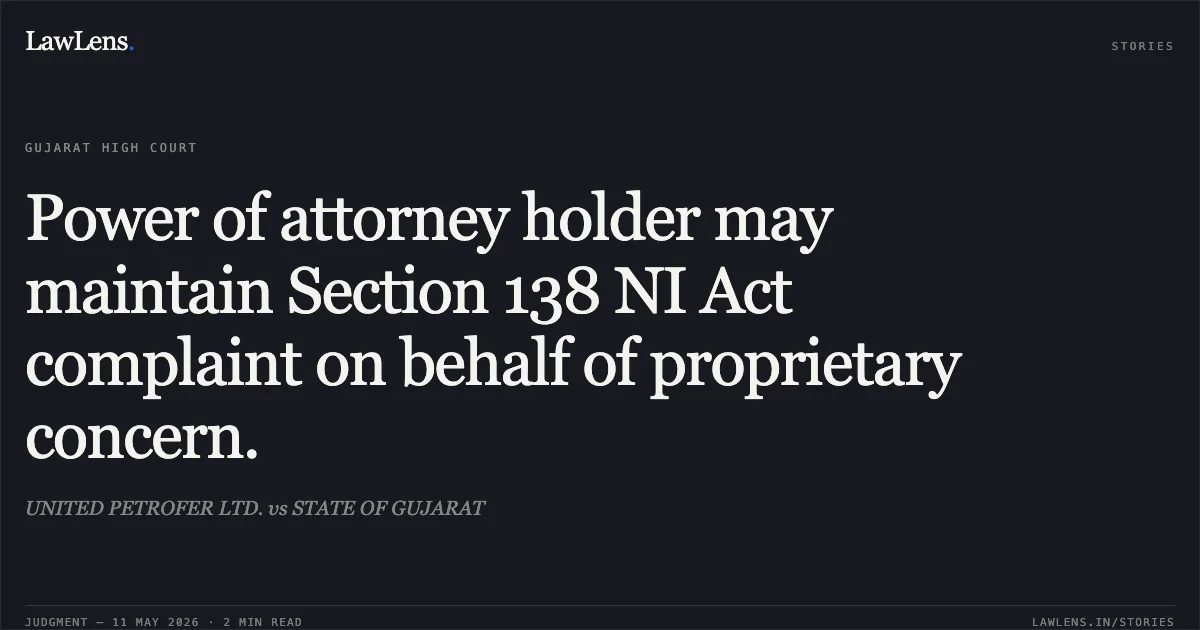
1. Whether a complaint under Section 138 of the N.I. Act is maintainable when filed by a Power of Attorney holder on behalf of a proprietary concern
Source reference: p. 92. Whether the mandatory provision of hearing the accused before taking cognizance under Section 223(1) of the BNSS, 2023, applies to proceedings under the N.I. Act
Source reference: p. 5, 15Law Applied
Section 142 of the N.I. Act, which prescribes the procedure for taking cognizance of cheque dishonor.
Source reference: p. 15Supreme Court precedents in M/s. Shankar Finance & Investments v. State of Andhra Pradesh and A.C. Narayanan v. State of Maharashtra, which establish that a PoA holder can validly initiate criminal proceedings on behalf of a principal/proprietary concern.
Source reference: p. 10, 13The principle that the N.I. Act is a "complete Code in itself," overriding general procedural requirements of the BNSS/CrPC where specific procedures are provided.
Source reference: p. 15Reasoning
The Court observed that the complaint’s title explicitly identified the complainant as the PoA holder of the firm, satisfying the legal requirement that the agent acts for the principal rather than in a personal capacity.
Source reference: p. 10, 14Regarding the BNSS challenge, the Court reasoned that Section 142 of the N.I. Act contains a non-obstante clause ("Notwithstanding anything contained in the Code...") and provides a specific statutory scheme for cognizance, rendering the prior-hearing requirement of Section 223(1) of the BNSS inapplicable.
Source reference: p. 15-16The Court further noted that the trial had already advanced significantly—the plea was recorded, and the PoA holder was currently being cross-examined—meaning the petitioners' challenges regarding authority and knowledge were matters of evidence for the trial court to decide.
Source reference: p. 17Holding
The Court dismissed the petition, holding that the complaint filed by the PoA holder is maintainable and that the procedural requirement under Section 223(1) of the BNSS does not apply to N.I. Act complaints.
The interim relief was vacated, and the request for a stay on the judgment to approach the Supreme Court was rejected due to the advanced stage of the trial.
Source reference: p. 18-19Acts & Sections Cited
5 provisions across 2 statutes referred to in this judgment. Each provision opens on LawLens.
Bharatiya Nagarik Suraksha Sanhita, 20232
Negotiable Instruments Act, 18813
Original Court PDF
UNITED PETROFER LTD.vsSTATE OF GUJARAT
Click to open original judgment
Original judgment, available to read, download and summarize on LawLens.in